
Lillian Gien, MD, spoke about continued use of immunotherapy in patients with recurrent clear cell carcinoma of the ovary following results of a trial examining pembrolizumab plus epacadostat.
Lillian Gien, MD, spoke about continued use of immunotherapy in patients with recurrent clear cell carcinoma of the ovary following results of a trial examining pembrolizumab plus epacadostat.
Michael Wang, MD, spoke about key data from the phase 3 SHINE trial which analyzed the use of first-line ibrutinib plus bendamustine and rituximab in older patients with mantle cell lymphoma.

Shared insight on the broader benefits of maintenance therapy in metastatic urothelial carcinoma and the mainstay agents in this setting.
Expert oncologists provide a comprehensive overview of treatment options available to patients with metastatic urothelial carcinoma.
Dr. Joyce O’Shaughnessy briefly reviews and provides insights into the FeDeriCa and the PHranceSCa studies.
Clinical insights concerning the administration of combination pertuzumab/trastuzumab/hyaluronidase-zzxf for patients with HER2-positive breast cancer.
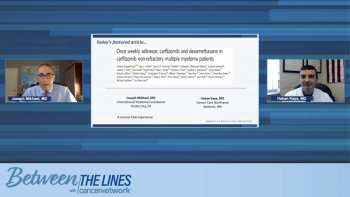
Dr Mikhael reviews the baseline characteristics, study design and key efficacy and safety data of selinexor, carfilzomib, dexamethasone (XKd) in patients with relapsed/refractory multiple myeloma who are non-refractory to carfilzomib.
Joseph Mikhael, MD, provides a brief overview of the relapsed/refractory multiple myeloma landscape and explains the mechanism of action of selinexor.
Ursula A. Matulonis, MD, spoke about the motivation behind the phase 3 SORAYA trial investigating mirvetuximab soravtansine in patients with folate receptor α–high platinum-resistant ovarian cancer.
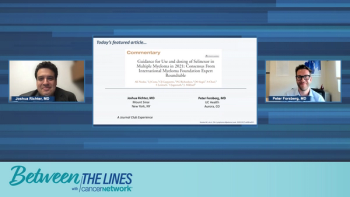
Insights on supportive care measures to minimize or counter common adverse effects for patients with R/R MM taking selinexor-based therapies
Closing out the program, Dr Ajay Nooka comments on the structural and biological disparities of care in multiple myeloma between Black and Caucasian patients, including age of presentation, delay of diagnosis and treatment, access to treatment options, and treatment response.
A look at some of the unmet needs in transplant-eligible multiple myeloma, particularly within the high-risk patient population.
Ajay Nooka, MD, and Matthew James Pianko, MD, discuss how they risk stratify patients with transplant-eligible multiple myeloma and the corresponding treatment approaches.
Discourse centered around dosing strategies for selinexor-based therapies.

Dr Caitlin Costello discusses how she adapts treatment to patients with transplant-ineligible NDMM based on fitness level, and why some patients receive doublet therapy.
Experts explain their approaches to maintenance therapy for patients with transplant-ineligible NDMM and when therapy should be reduced.
Dr Matthew James Pianko details how he determines treatment duration and discontinuation for transplant-eligible multiple myeloma.
Kevin Kalinsky, MD, MS, spoke about future studies following results from the phase 2 MAINTAIN trial of ribociclib with or without endocrine therapy and after progression on a CDK4/6 inhibitor for patients with unresectable or metastatic hormone receptor–positive, HER2-negative breast cancer.
Joseph Mikhael, MD, spoke about the mechanism of action of bispecific antibody teclistamab relative to other agents in the space such monoclonal antibodies and CAR T-cell therapies in multiple myeloma.
At 2022 IGCS, Lilian Gien, MD, spoke about a phase 2 trial which analyzed pembrolizumab plus epacadostat in patients with recurrent clear cell carcinoma of the ovary.
The MAINTAIN trial was designed to assess endocrine therapy with or without ribociclib after progression on a CDK4/6 inhibitor in patients with unresectable or metastatic hormone receptor–positive, HER2-negative breast cancer.
A breast cancer expert shares the current first-line standard of care for patients with HER2-positive breast cancer and presents scenarios where the standard treatment approach may not be appropriate.
Joyce O’Shaughnessy, MD shares an overview of the HER2-positive breast cancer landscape, focusing on prognosis and risk of recurrence for patients with early-stage and metastatic breast cancer.
Closing out their review of tazemetostat in R/R FL, participants consider its practical use in practice alongside other novel treatment modalities.
Dr Larry Anderson summarizes the study design and updated data of the MAIA trial, and Dr Rebecca Silbermann compares it against the SWOG 0777 trial.
Andrew Cowan, MD, presents the results of the ENDURANCE study comparing two triplet regimens in transplant-ineligible MM.
A brief review of both neoadjuvant and adjuvant treatment options available to patients with localized bladder cancer.
Opening their discussion on urothelial carcinoma management, panelists highlight risk factors, symptoms, and staging practices in this setting.
Tiffany Sia, MD, spoke about major takeaways from her study and how to implement procedural interventions for patients with gynecologic malignancies who have oligoprogression.
Two subject matter experts discuss keystone trials supporting the use of Selinexor in patients with R/R MM, each with unique dosing structures and different selinexor-based combinations.