

Spatial transcriptomics and multiplex immunohistochemistry from samples may elucidate outcomes for patients who undergo surgical care for cancer.

Your AI-Trained Oncology Knowledge Connection!
Spatial transcriptomics and multiplex immunohistochemistry from samples may elucidate outcomes for patients who undergo surgical care for cancer.

Panelists discuss how the significant overall survival (OS) benefit demonstrated by the new combination therapy (amivantamab-lazertinib) compared with standard monotherapy makes it a preferred treatment option for most patients despite a slightly increased toxicity and time commitment.

Panelists discuss how PSMA PET imaging plays a crucial role in detecting biochemical recurrence of prostate cancer, offering superior sensitivity and specificity compared with conventional imaging methods. In clinical practice, PSMA PET is typically ordered when there is a rise in prostate-specific antigen (PSA) levels post treatment, indicating potential recurrence. The imaging results significantly influence treatment decisions such as distinguishing between localized salvage therapy and systemic treatments. Pivotal trials have demonstrated the efficacy of various tracers.
Panelists discuss how PSMA PET imaging plays a crucial role in the initial staging of prostate cancer, offering superior accuracy over conventional methods. Medical professionals consider factors such as diagnostic performance, tracer availability, and patient-specific characteristics when selecting appropriate PSMA PET agents. The integration of PSMA PET findings into clinical practice has led to more precise treatment planning, potentially improving patient outcomes. Pivotal trials have demonstrated the efficacy of various PSMA PET tracers in detecting prostate cancer metastases.
Panelists discuss how the treatment landscape for EGFR-mutated lung cancer has evolved, with 3 strong options now available, including single-agent osimertinib and 2 combinations: osimertinib plus chemotherapy (FLAURA2) and amivantamab plus lazertinib (MARIPOSA), with the latter showing significant overall survival benefits.
Future work may focus on optimizing symptom management associated with percutaneous transesophageal gastrostomy placement in malignant bowel obstructions.

“Psycho-oncology has made remarkable progress; however, there are still critical areas for further development,” Cristiane D. Bergerot, PhD, BS, MS, said.
Postoperative length of stay ranged from 4 to 9 days for patients who underwent percutaneous transesophageal gastrostomy for malignant bowel obstructions.
It is crucial that oncologists and other cancer care specialists collaborate with psycho-oncology specialists to optimize patient treatment outcomes.
World Psycho-Oncology Day is an initiative aimed at spreading awareness and pursuing the further integration of psychosocial care into cancer treatment.
Organizations such as ASCO and ESMO recognize the importance of integrating psychosocial care into cancer treatment.
Focused, high-dose radiotherapy doses may prolong survival and the interval to subsequent therapy for patients with advanced prostate cancer.
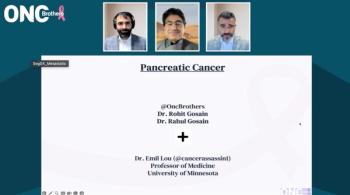
Panelists discuss how the frontline treatment of pancreatic cancer typically involves chemotherapy regimens such as FOLFIRINOX (leucovorin calcium, fluorouracil, irinotecan hydrochloride, and oxaliplatin) or gemcitabine-based therapies, with decisions guided by tumor characteristics, patient performance status, and treatment goals, aiming to improve survival outcomes and quality of life in newly diagnosed patients.
Panelists discuss how the treatment algorithm for metastatic pancreatic cancer involves a multidisciplinary approach, starting with chemotherapy regimens such as FOLFIRINOX (leucovorin calcium, fluorouracil, irinotecan hydrochloride, and oxaliplatin) or gemcitabine-based therapies and followed by considerations for targeted therapies, immunotherapy, and clinical trial participation, with the goal of managing symptoms, prolonging survival, and improving quality of life.
Panelists discuss how radiation therapy plays a crucial role in the treatment of pancreatic cancer, particularly in combination with surgery and chemotherapy, to manage locally advanced disease, reduce tumor size, and improve patient outcomes while also considering its potential adverse effects and optimal usage in treatment regimens.
Panelists discuss how next-generation sequencing (NGS) and germline testing are increasingly being used in pancreatic cancer to identify genetic mutations, guide personalized treatment decisions, and inform the use of targeted therapies, ultimately improving patient outcomes and advancing precision medicine.
Panelists discuss how the treatment approach for pancreatic cancer typically involves a multidisciplinary strategy that combines surgery, chemotherapy, radiation therapy, and emerging targeted therapies, with a focus on improving patient outcomes through individualized care plans based on tumor characteristics and disease stage.
Data show increasing use of proton therapy overall but widening gaps in populations who have access to this treatment, Curtiland Deville Jr, MD, says.

A lack of guidelines, a loss of follow-up, and out-of-state procedures are all potential reasons for 26% of patients undergoing appendectomy.
Panelists discuss how BESPOKE trial results demonstrate significantly improved disease-free survival rates in patients with negative circulating tumor DNA (ctDNA) status compared with those with detectable ctDNA, underscoring its potential as a powerful prognostic biomarker.

Panelists discuss how the treatment landscape for diffuse large B-cell lymphoma (DLBCL) is poised for transformation as novel chimeric antigen receptor T-cell approaches integrate with existing therapies, enhancing efficacy and durability. Insights from Tandem 2025 highlight advancements in cellular therapy, including combinatorial strategies and next-generation chimeric antigen receptor T-cell designs, driving optimism for improved patient outcomes.
Panelists discuss how the BESPOKE trial enrolled a diverse cohort of patients with varying demographic profiles, disease stages, comorbidities, and treatment histories to ensure comprehensive representation for personalized medicine approaches.
Treatment with KRAS inhibitors may help mitigate a common driver of genetic alteration across a majority of pancreatic cancers.
Various methods of communication ensure that members from radiation oncology, pathology, and other departments are on the same page regarding treatment.
The staged approach to colectomy offers survival benefits, and it may help avoid unnecessary procedures that only require appendectomy.
Comprehensive prehabilitation may help prepare patients for bladder-preserving surgery, helping to optimize quality of life outcomes.
Updated results from the BREAKWATER study seemed to be most impactful to the CRC space, according to Michael J. Pishvaian, MD, PhD.
“We did not find any benefit for any of the subgroups in our paper and our study,” Muhammad Talha Waheed, MD, stated.
Panelists discuss how high-quality imaging is crucial for accurately staging prostate cancer, guiding treatment decisions, and optimizing patient outcomes. Superior resolution and sensitivity of PSMA PET tracers enhance lesion detection, influencing surgical, radiation, and systemic therapy choices. Differences in tracer properties impact specificity, affecting treatment planning. Advanced imaging reduces uncertainty, improving risk stratification and therapeutic precision.

Experts discuss other therapies or clinical trials that might be explored after trastuzumab deruxtecan, particularly for patients with HER2-positive microsatellite-stable (MSS) adenocarcinoma and progression on multiple lines of therapy.