

Sikander Ailawadhi, MD, offers expert insight into managing the risk of atrial fibrillation in CLL patients receiving BTKis.

Your AI-Trained Oncology Knowledge Connection!
Sikander Ailawadhi, MD, offers expert insight into managing the risk of atrial fibrillation in CLL patients receiving BTKis.
A group of experts in oncology investigates the feasibility of combination adjuvant immunotherapy in NSCLC consolidation, assessing the utilization of multiple immune checkpoint inhibitors and scrutinizing the rationale, with a focus on findings from the COAST study and PACIFIC-8 studies.
Vinay Raja, MD, explores the management of patients with Stage-III disease and actionable EGFR/ALK aberrations, as well as the treatment approach for patients with PD-L1 <1%.
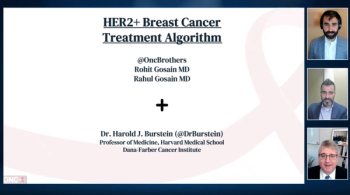
Harold J. Burstein, MD, PhD, discusses the management of adverse events in patients with HER2+ breast cancer, and the Oncology Brothers provide closing thoughts on the entire discussion.
Medical oncologists discuss the various treatment options for patients with metastatic HER2+ breast cancer and where they fit into the treatment algorithm.
The Oncology Brothers and Harold J. Burstein, MD, PhD, discuss clinical approaches to treating patients with locally advanced HER2+ breast cancer.
Harold J. Burstein, MD, PhD, joins the Oncology Brothers, Rahul Gosain, MD, and Rohit Gosain, MD, to provide clinical insights on treatment practices for patients with early-stage HER2+ breast cancer.

Examine the efficacy and safety of the BCMA-targeting bispecific antibody elranatamab as monotherapy and in combinations from the Phase 2 MagnetisMM-3 trial in patients with relapsed or refractory multiple myeloma.

Notions of blame around smoking may be a prominent factor in patients with lung cancer feeling stigmatized for developing their disease, according to Lisa Carter-Bawa PhD, MPH, APRN, ANP-C, FAAN.
Considering cystectomy in patients with bladder cancer may help with managing the shortage of Bacillus Calmette-Guerin, according to Joshua J. Meeks, MD, PhD, BS.
Ursula Linne-Mclaren briefly discusses valuable guidance for patients and caregivers, particularly those considering bispecific therapies, providing a supportive perspective on the journey through R/R MM treatment.
Nurse Linne-Mclaren provides her insights into the proactive measures, monitoring strategies, and experiences related to talquetamab-associated adverse events, along with a broader perspective on prophylactic measures for managing potential adverse events in bispecific therapies.
Ursula Linne-Mclaren, RN, reviews a clinical scenario in a relapsed/ refractory multiple myeloma patient.
Amber Koehler, PA-C, provides expert perspective on addressing hypertension risk in CLL patients undergoing treatment with BTK inhibitors.
A panel of oncology experts offer insights into key consideration factors for BTKi selection for CLL in the relapsed and refractory setting, exploring the impact of emerging MAIC data on treatment decision making.
A panel of oncology experts examine the role of consolidation immunotherapy in patients receiving concurrent chemoradiotherapy for unresectable Stage-III NSCLC, discussing 5-year survival outcomes from the PACIFIC trial, the impact on institutional treatment approaches, criteria for selecting patients for consolidation durvalumab, the significance of baseline scans, as well as exploring real-world evidence on consolidation durvalumab.
Krishna Reddy, MD, PhD, explores the roles of sequential and concurrent chemoradiotherapy (sCRT and cCRT) in patients with unresectable stage III NSCLC, delving into considerations for selecting between the two approaches and examining potential variations in treatment based on factors such as age, performance status (PS), or comorbidities.
Anemia in patients who receive talazoparib plus enzalutamide for metastatic castration-resistant prostate cancer appears to be manageable without any compromises in patient-reported outcomes and quality of life.
Patients with locally advanced or metastatic urothelial cancer and visceral disease may particularly benefit from enfortumab vedotin plus pembrolizumab, according to Amanda Nizam, MD.

Present initial results from the Phase 1 RedirecTT-1 trial exploring the combination of teclistamab and talquetamab in relapsed/refractory multiple myeloma.

Compare outcomes between ide-cel chimeric antigen receptor T-cell (CAR-T) therapy and standard treatment regimens such as pomalidomide and daratumumab combinations in patients with heavily pretreated relapsed and refractory multiple myeloma.
A panel of oncology experts review recently presented data updates from ALPINE and ELEVATE-RR, discussing the potential impact of these findings on the clinical practice setting.
Oncology Clinical Pharmacist Specialist Amir Ali delves into potential challenges related to access and the use of this therapy, providing a comprehensive perspective on the complexities of incorporating GPRC5-targeting bispecifics into R/R MM patient management.
Amir discusses challenges encountered during the administration process, offering valuable perspectives on the practical considerations and complexities in delivering these innovative therapies.

High-grade adverse effects with zanidatamab plus palbociclib and fulvestrant seem to be uncommon in patients with HER2-positive, hormone receptor–positive, metastatic breast cancer, according to Sara Hurvitz, MD, FACP.
A panel of oncology experts share their general approach in navigating treatment selection for patients with R/R CLL, highlighting key factors to consider in making treatment decisions.
Amir Ali, PharmD reviews a clinical scenario in a relapsed/ refractory multiple myeloma patient.
A panel of medical oncologists provides insights on managing toxicities in patients with triple-negative breast cancer who are receiving antibody-drug conjugates.
Ruth M. O’Regan, MD, and Anna Weiss, MD, discuss treatment paradigms for patients with metastatic triple-negative breast cancer and the role of surgery.
The expert panel provides clinical insights on treating patients with high-risk or locally advanced triple-negative breast cancer.