

A panel of experts on multiple myeloma review a patient profile, offer their initial impressions, and highlight the role of an advanced practice provider.

Your AI-Trained Oncology Knowledge Connection!
A panel of experts on multiple myeloma review a patient profile, offer their initial impressions, and highlight the role of an advanced practice provider.
Dostarlimab plus chemotherapy appears to yield favorable overall survival in patients with mismatch repair proficient endometrial cancer.
Martin Voss, MD, reviews data updates from ASCO GU 2024 on the KEYNOTE-B61 study of lenvatinib + pembrolizumab in nccRCC in addition to real-world outcomes in patients with chromophobe RCC.
mRNA may be a potential modality for developing cancer-based vaccines, according to Catherine J. Wu, MD.
Panelists discuss systemic therapy approaches for RCC patients presenting with brain, liver, or bone metastases, noting more limited efficacy of IO-IO therapy in brain metastases and tendencies to use IO-TKI therapy for aggressive or rapidly progressing disease.
Final remarks and presentation of awards.

Some patients with large B-cell lymphoma may have to travel a great distance for an initial evaluation for CAR T-cell therapy.
Brian Slomovitz, MD, MS, FACOG discusses the use of new antibody drug conjugates for treating patients with various gynecologic cancers.
Analyzing the KRAS mutation across various cancer types may be a worthwhile target when using a cancer vaccine or immunotherapy, says Catherine J. Wu, MD.
Education is essential to referring oncologists manage toxicities associated with CAR T-cell therapy for patients with large B-cell lymphoma.
There is no absolute age cutoff where CAR T cells are contraindicated for those with large B-cell lymphoma, says David L. Porter, MD.
David L. Porter, MD, emphasizes referring patients with large B-cell lymphoma early for CAR T-cell therapy consultation.
Scott T. Tagawa, MD, MS, FACP, FASCO, discusses the recent approval of nivolumab plus chemotherapy for patients with unresectable or metastatic urothelial carcinoma.
Arvind N. Dasari, MD, MS, gives an overview of the rationale and study design of the phase 2/3 CIRCULATE-NORTH AMERICA clinical trial.
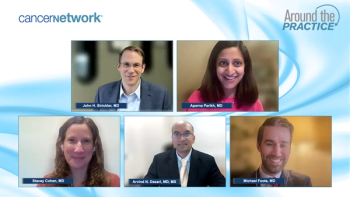
Experts on colorectal cancer provide comprehensive insights on the GALAXY study, highlighting key updates that were presented at ASCO GI 2024.
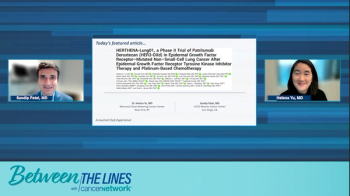
The panel discusses how HER3-directed therapy with patritumab deruxtecan may fit into the evolving treatment paradigm for EGFR-positive lung cancer as more data emerges.
Dr. Yu and Dr. Patel examine the safety profile of patritumab deruxtecan, including adverse event monitoring and management approaches to optimize patient outcomes.
It may be applicable to administer CAR T-cell therapy to patients with large B-cell lymphoma in a community or outpatient setting.
Expert panelists discuss the importance of rapid improvement within 24-72 hours with steroids for managing unpredictable immune-related toxicities that can occur with frontline IO-IO or IO-TKI regimens for patients with RCC.
The panel discusses long-term data showing more limited benefit of IO-IO therapy versus TKI regimens for favorable risk RCC patients and implications for their risk-adapted treatment approach.
Experts discuss the Phase 2 D-ALBA trial results examining combination of dasatinib plus blinatumomab as frontline therapy for adults with Philadelphia chromosome-positive B cell acute lymphoblastic leukemia.
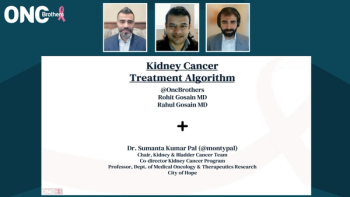
Sumanta Kumar Pal, MD, FASCO, provides advice for community oncologists, and the Oncology Brothers review key points from the discussion.
Focusing on advanced kidney cancer, medical oncologists offer clinical perspectives on treatment in the second line and beyond.
The Oncology Brothers and Sumanta Kumar Pal, MD, FASCO, offer comprehensive insights on the treatment of patients with metastatic kidney cancer.
Sumanta Kumar Pal, MD, FASCO, joins Rohit Gosain, MD, and Rahul Gosain, MD, to discuss risk stratification and treatment practices for patients with localized kidney cancer following surgery.
Experts provide extended follow-up on efficacy and safety outcomes with initial therapy combining ponatinib and hyperfractionated cyclophosphamide, vincristine, doxorubicin, and dexamethasone (hyper-CVAD) in patients with newly diagnosed Philadelphia chromosome-positive acute lymphoblastic leukemia.
Findings from a study highlight that 7/8 mismatched unrelated donor posttransplant cyclophosphamide may be a suitable alternative treatment option for those with graft-vs-host disease.

The use of novel agents like tarlatamab may be “interesting” among patients with small cell lung cancer in the relapsed setting, says Gregory Peter Kalemkerian, MD.
The FDA approval of zanubrutinib plus obinutuzumab showed a benefit to patients with relapsed/refractory follicular lymphoma, according to Julie Vose, MD, MBA.
Aparna Parikh, MD, reviews the DYNAMIC trial, which is focused on ctDNA-guided adjuvant therapy in early-stage colorectal cancer.