
Experts discuss prophylactic measures for managing potential adverse events associated with talquetamab and other bispecifics, while all faculty will offer advice for health care providers involved in the care of patients receiving talquetamab.
Experts discuss prophylactic measures for managing potential adverse events associated with talquetamab and other bispecifics, while all faculty will offer advice for health care providers involved in the care of patients receiving talquetamab.

The act of asking for help is critical to finding mentors who can help one advance in the brain cancer field, according to Yoshie Umemura, MD.
Key opinion leaders summarize essential takeaways and highlight unmet needs in the hepatocellular carcinoma treatment landscape.
The panel reviews the CheckMate 9DW study design and evaluates its safety data.
Patients with HR-positive, HER2-positive breast cancer and high-risk features may derive benefit from ovarian function suppression plus endocrine therapy.
Through multidisciplinary collaboration, Yoshie Umemura, MD, and colleagues were able to organize the Gliofocus trial in brain cancer relatively fast.
Following the presentation of a case of a patient with multiple myeloma, the panel have a roundtable discussion on how to approach treatment.
A panel of myeloma specialists review the case of a 67-year-old patient with multiple myeloma (MM) who received a bispecific antibody.
Experts on multiple myeloma offer clinical insights on preparing patients who are going to receive GPRC5D therapy, highlighting step-up and treatment dosing for talquetamab.
Beth Faiman, CNP, PhD, outlines unique toxicities seen with other GPRC5D-targeted therapies in multiple myeloma.
Focusing on clinical trials evaluating combination strategies with bispecifics, Larysa J. Sanchez, MD, discusses the TRIMM-2, TRIMM-3, and MajesTEC-3 studies.
Rafael Fonseca, MD, discusses the MonumenTAL-2 and MonumenTAL-3 clinical trials investigating talquetamab combination strategies in relapsed/refractory multiple myeloma.
Medical experts explore how non–clear cell RCC histology impacts treatment selection, addressing challenges with less common subtypes vs more frequent ones, and discuss how clinical data and experience inform treatment sequencing and shared decision-making.
Medical experts discuss clinical trials supporting alternative therapies for advanced non–clear cell RCC, including Cabo alone, Nivo + Cabo, and others, and whether these studies covered all histologies.
Medical experts discuss how adverse events vary by bispecific class, the specific adverse events observed in practice, and their management strategies.
Medical experts explore common types of referrals, compare in-state vs out-of-state processes, and examine the impact of social factors on the referral process.

Ruxolitinib, currently approved as treatment for patients with myelofibrosis and polycythemia vera, is currently undergoing evaluation in myeloma studies.
Paolo Tarantino, MD discusses updated breast cancer trial findings presented at ESMO 2024 supporting the use of agents such as T-DXd and ribociclib.
Yoshie Umemura, MD, discusses how multiple departments can positively impact a patient with brain cancer during their visit to a medical center.
Higher, durable rates of response to frontline therapy are needed to potentially improve long-term survival among patients with non–small cell lung cancer.
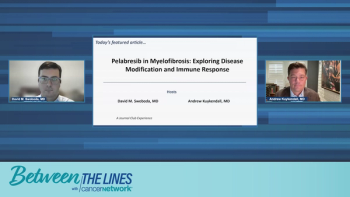
Panelists discuss how Janus kinase (JAK) inhibitors, including ruxolitinib, fedratinib, pacritinib, and momelotinib, as well as investigational agents like pelabresib and navitoclax, target the dysregulated JAK-STAT pathway to manage symptoms and potentially modify disease progression in myelofibrosis.
Panelists discuss how myelofibrosis management involves a combination of medications, supportive care, and potentially stem cell transplantation to alleviate symptoms, control disease progression, and improve quality of life.
Experts provide advice to patients and caregivers on managing oral and skin toxicities.
Experts discuss the adverse events observed with talquetamab, including oral toxicities and skin and nail issues, and how these are managed.
Key opinion leaders examine IMbrave 150 data stratified by baseline varices and compare outcomes between patients with Child-Pugh A and B.
Medical experts analyze the exploratory efficacy and safety results for patients with portal vein invasion (Vp4), addressing the challenges in treating this subgroup.
Medical experts review long-term data from the KEYNOTE-B61 trial on pembrolizumab and lenvatinib, compare its efficacy and safety across non–clear cell RCC subtypes, and discuss dose management and safety relative to the CLEAR trial.
Medical experts outline the current first-line treatment options for advanced non–clear cell RCC, including the factors influencing agent selection, as well as discuss how recent NCCN guideline updates and label changes affect treatment decisions in community practice.
Medical experts examine differences and similarities in the referral process and treatment protocols for non–BCMA-targeted vs BCMA-targeted bispecific therapies, including aspects like step-up dosing and premedication.
Medical experts address the referral process for bispecific therapy between community and academic centers, including patient eligibility and educational requirements such as REMS certification.