In the phase 2 RALLY-MF study, selcodebart produced a 55% major response rate among evaluable non–transfusion-dependent patients with myelofibrosis.
Sacituzumab govitecan plus pembrolizumab maintained PFS improvements vs chemotherapy plus pembrolizumab in first-line metastatic TNBC.
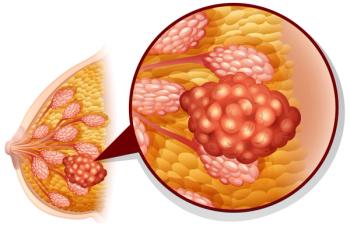
Progression-free survival (PFS) was longer across key subgroups when treated with sacituzumab govitecan-hziy (Trodelvy) plus pembrolizumab (Keytruda) for patients with previously untreated PD-L1-positive metastatic triple-negative breast cancer, according to results from the phase 3 ASCENT-04 trial (NCT05382286) presented at the
In the intent-to-treat (ITT) population, the median PFS was 11.2 months (95% CI, 9.3-16.7) in the sacituzumab govitecan plus pembrolizumab arm vs 7.8 months (95% CI, 7.3-9.3) in the chemotherapy plus pembrolizumab arm (HR, 0.65; 95% CI, 0.51-0.84). For those with TROP2 biomarker analysis set (BAS), the median PFS was 11.7 months (95% CI, 9.3-16.8) vs 7.8 months (95% CI, 7.3-9.3), respectively (HR, 0.63; 95% CI, 0.48-0.82).
Patients in quartile 1 (Q1) for Trop-2 H-score had a median PFS of 9.3 months (95% CI, 7.4-19.4) in the sacituzumab govitecan arm vs 9.0 months (95% CI, 6.0-10.9) in the chemotherapy arm (HR, 0.81; 95% CI, 0.48-1.36). For Q2, the median PFS was 9.6 months (95% CI, 7.3-16.7) vs 7.4 months (95% CI, 6.9-9.7) between each arm, respectively (HR, 0.73; 95% CI, 0.44-1.22). For Q3, the median PFS was 13.5 months (95% CI, 9.3-not evaluable [NE]) vs 8.4 months (95% CI, 5.6-10.8), for an HR of 0.46 (95% CI, 0.27-0.80). For Q4, the median PFS was 16.6 months (95% CI, 8.1-NE) vs 9.2 months (95% CI, 5.5-11.3), for an HR of 0.57 (95% CI, 0.33-0.99).
“Sacituzumab govitecan plus pembrolizumab treatment was associated with consistently improved PFS vs chemotherapy plus pembrolizumab across Trop-2 expression quartiles, with trends toward greater separation of Kaplan-Meier curves in Q3 and Q4,” Sara M. Tolaney, MD, MPH, chief of the Division of Breast Oncology at Dana-Farber Cancer Institute and associate professor of medicine at Harvard Medical School, noted during the presentation.
The PFS based on BRCA subgroups showed those with tumor BRCA (tBRCA) BAS had a median PFS of 11.1 months (95% CI, 9.2-16.7) in the sacituzumab govitecan arm vs 7.8 months (95% CI, 7.2-9.3) in the chemotherapy arm (HR, 0.69; 95% CI, 0.52-0.91). Those with BRCA wild-type disease had a median PFS of 9.6 months (95% CI, 7.6-16.7) vs 7.4 months (95% CI, 6.9-9.2), respectively (HR, 0.67; 95% CI, 0.49-0.91). Those with BRCA-mutated disease had a median PFS of 16.6 months (95% CI, 7.5-NE) vs 12.9 months (95% CI, 7.1-NE), respectively (HR, 0.88; 95% CI, 0.45-1.74).
“Median PFS was longer with [sacituzumab govitecan plus pembrolizumab] vs [chemotherapy plus pembrolizumab] in both tBRCA subgroups,” Tolaney said.
For those with HER2 disease, the median PFS for those with HER2 immunohistochemistry (IHC) 0 was 16.6 months (95% CI, 9.1-21.2) in the sacituzumab govitecan arm vs 9.0 months (95% CI, 7.2-10.8) in the chemotherapy arm (HR, 0.69; 95% CI, 0.46-1.04). For those with HER2-low disease, the median PFS was 11.2 months (95% CI, 9.1-16.6) vs 7.7 months (95% CI, 7.0-9.4), respectively (HR, 0.67; 95% CI, 0.48-0.92).
Trop-2 expression was characterized by H-score determined by IHC. tBRCA status was measured by whole-exome sequencing as local testing and was uncommon; participants were grouped by tBRCA wild-type or mutated status. Those with mutated status included patients with BRCA1, BRCA2, or both genes. HER2 expression was measured by in situ hybridization (ISH) and IHC; patients were grouped as HER2 IHC 0 or HER2-low, which included IHC 1+ or IHC 2+/ISH.
In ASCENT-04, eligible patients had previously untreated, locally advanced unresectable or metastatic PD-L1-positive triple-negative breast cancer; they were randomly assigned 1:1 to receive either sacituzumab govitecan plus pembrolizumab or chemotherapy plus pembrolizumab.
This analysis was done with central testing of fresh or archival tumor samples. Patients were included in the biomarker analysis set if they had at least 1 evaluable biomarker measurement available at baseline.
Tolaney SM, Schmid P, de Azambuja E, et al. ASCENT-04: Analysis of efficacy by biomarker subgroups with sacituzumab govitecan (SG) + pembrolizumab (pembro) vs chemotherapy (chemo) + pembro in participants (pts) with previously untreated PD-L1+ metastatic triple-negative breast cancer (mTNBC). J Clin Oncol. 2026;44(suppl 16):1013. doi:10.1200/JCO.2026.44.16_suppl.1013