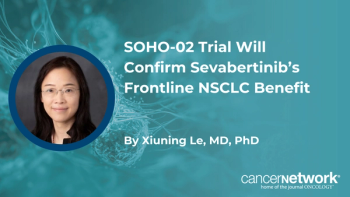
Xiuning Le, MD, PhD, discusses the confirmatory SOHO-02 trial needed to convert sevabertinib’s accelerated approval to full approval.
According to Yoanna S. Pumpalova, MD, both early-onset and later-onset colorectal cancers are genetically similar in terms of somatic mutations.
Research into the distinct pathophysiological drivers of early-onset colorectal cancer (CRC) is a focus of investigation at Columbia University, according to Yoanna S. Pumpalova, MD. Standard genomic analyses have largely demonstrated that the somatic mutation profiles of early onset CRC tumors are genetically similar to those observed in average-onset colorectal cancers, but clinical presentations reveal some differences. Notably, the younger population exhibits a higher incidence of rectal cancers compared with older cohorts.
To address these discrepancies, Pumpalova is collaborating with Joel T. Gabre, MD, a gastroenterologist and scientist at the Columbia University Herbert Irving Comprehensive Cancer Center, to move beyond traditional mutational status and dig into the tumor microenvironment. The research focuses on identifying specific inflammatory markers surrounding early-onset colon and rectal cancers. They have observed an increase in inflammatory markers within this patient population.
Understanding these microenvironmental interactions may facilitate a significant evolution in the therapeutic landscape for early onset CRC. If the relationship between pro-inflammatory insults and the colonic mucosa is validated, investigators may be able to target early onset CRCs using treatments that target that anti-inflammatory pathway.
This transition from a purely genetic focus to an immunological and environmental perspective represents a potential paradigm shift in the management of CRC. By identifying specific molecular axes within the inflammatory pathway, multidisciplinary teams may eventually be able to move toward precision interventions tailored to the unique microenvironmental signature of early-onset disease, potentially improving outcomes for patients who currently experience rising incidence rates.
Pumpalova is an assistant professor of medicine and a medical oncologist at the Columbia University Herbert Irving Medical Center.
Transcript:
CancerNetwork: How do you hope to see the field evolve with respect to treating patients with early onset colorectal cancer?
Pumpalova: So far—and this is something we're studying actively here at Columbia—we're looking at what is different about early onset colorectal cancers compared with our average, later-onset colorectal cancers. A lot of these analyses have shown the tumors to be, genetically, very similar; the somatic mutation profile of these tumors tends to be very similar. There is a difference in terms of left vs right-sided colorectal cancer incidence, where there are more rectal cancers in the younger population. But when you look genetically at the mutational status, they tend to be very similar. But when we dig a little deeper, which is what I'm doing in collaboration with [Joel T. Gabre, MD], a gastroenterologist and a scientist, [and] we look at the actual tumor microenvironment and the inflammatory markers around these early onset colon and rectal cancers, we are seeing an increase in inflammatory markers. Our hypothesis is that there is an interaction between the colonic mucosa and pro-inflammatory insults, whether that's sedentary lifestyle, diet, an environmental exposure that we have yet to identify, or all of the above; we don't know. But it is possible that if that hypothesis is correct, then we would be able to specifically target early onset colorectal cancer using targets or medications that target that anti-inflammatory pathway.