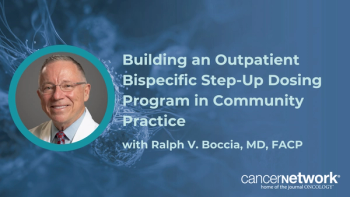
Ralph V. Boccia, MD, FACP, explained how community practices can build the workflow and capacity to deliver bispecific step-up dosing in an outpatient setting.
In the final analysis of the phase 3 MAIA trial, daratumumab-based treatment yielded a median overall survival of 90.3 months in transplant-ineligible NDMM.
Daratumumab (Darzalex) plus lenalidomide (Revlimid) and dexamethasone (D-Rd) demonstrated a sustained overall survival (OS) benefit vs lenalidomide/dexamethasone alone (Rd) in patients with transplant-ineligible newly diagnosed multiple myeloma (NDMM), according to the final analysis of the
At a median follow-up of 89.3 months (range, 0.0-102.2), the median OS was 90.3 months (95% CI, 80.8-not estimable [NE]) with D-Rd vs 64.1 months (95% CI, 56.0-70.8) with Rd (HR, 0.67; 95% CI, 0.55-0.82). The estimated 7-year OS rates were 53.1% (95% CI, 47.8%-58.2%) and 39.3% (95% CI, 34.1%-44.5%), respectively.
The median time to subsequent antimyeloma treatment was not reached (95% CI, 84.1-NE) with D-Rd vs 42.4 months (95% CI, 33.5-50.6) with Rd (HR, 0.51; 95% CI, 0.41-0.63; P <.0001). Most patients in the D-Rd and Rd arms, respectively, received proteasome inhibitors alone (49% vs 50%) as their most common first subsequent therapy class following study treatment.
These results build on earlier MAIA analyses, in which D-Rd improved progression-free survival (PFS; HR, 0.56; 95% CI, 0.43-0.73; P <.001) and produced higher rates of complete response or better (47.6% vs 24.9%; P <.001) and minimal residual disease negativity at 10⁻⁵ (24.2% vs 7.3%; P <.001) vs Rd.
Death due to adverse events (AEs) occurred in 84 patients overall, including 44 of 364 patients (12%) in the D-Rd arm and 40 of 365 patients (11%) in the Rd arm. The authors reported that no new safety concerns related to death were identified for D-Rd.
“[I]n this final follow-up of the MAIA study, at a median follow-up of approximately 7.5 years, median OS was finally reached in the D-Rd group and was 90.3 months, setting a new benchmark for the population of transplant-ineligible patients with NDMM,” corresponding author Thierry Facon, MD, professor of hematology at the University of Lille in France, wrote in the publication with study coinvestigators. “With this long-term follow-up of MAIA, the OS benefit observed with the addition of daratumumab to the Rd standard-of-care regimen continues to support the frontline use of D-Rd to maximize survival in transplant-ineligible patients with NDMM.”
MAIA is a phase 3, randomized, open-label study that evaluated D-Rd compared with Rd in transplant-ineligible patients with NDMM. A total of 737 patients were randomly assigned to D-Rd (n = 368) or Rd (n = 369). A protocol amendment on July 20, 2021, led to a long-term extension of the trial, during which patients were followed for OS.
The primary end point of the study was PFS, which was previously reported. Secondary end points included the rates of complete response or better, very good partial response or better, minimal residual disease negativity, and OS.
Patients 18 years and older with documented NDMM, an ECOG performance status of 0 to 2, and ineligibility for high-dose chemotherapy and autologous stem cell transplantation due to age or comorbidities were able to enroll on the trial.
The authors positioned the D-Rd survival data, now the longest OS reported in this population, as a benchmark against which newer frontline regimens should be measured. They noted the emergence of daratumumab- and isatuximab-irfc (Sarclisa)–containing quadruplet regimens for transplant-ineligible NDMM, including those evaluated in the
Facon T, Kumar SK, Orlowski RZ, et al. Daratumumab, lenalidomide, and dexamethasone in transplant-ineligible newly diagnosed multiple myeloma: MAIA final survival analysis. Leukemia. Published online August 24, 2026. doi:10.1038/s41375-026-03097-9