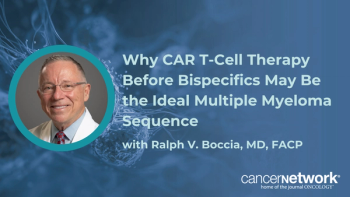
Ralph V. Boccia, MD, FACP, explained why CAR T-cell therapy followed by bispecific antibodies may be the preferred sequence at first relapse in multiple myeloma.
Matthew Matasar, MD, detailed how retrieval-augmented generation tools are already informing real tumor board decisions in hematologic malignancies.
Continuing The AI Oncology Revolution conversation with Matthew Matasar, MD, of Rutgers Cancer Institute, he walked Arturo Loaiza-Bonilla, MD, MSEd, FACP, through where artificial intelligence (AI) has already taken hold across oncology, from AI-based simulation in radiation planning to early surgical augmentation, before narrowing in on his own field of blood disorders. Matasar described how his team is already running retrieval-augmented generation (RAG) tools such as Doc GPT and OpenEvidence as part of live tumor board discussions, walking through a real case in which a patient being prepared for stem cell transplant had an incidental early-stage breast cancer finding. Where a question like that might once have relied solely on the collective memory of the most senior transplant physicians in the room, Matasar said RAG-based tools now let the team draw far more broadly and quickly on the evidence base, while he and Loaiza-Bonilla both cautioned that not all such systems are HIPAA compliant.
Loaiza-Bonilla is systemwide chief of hematology and oncology at St. Luke’s University Health Network and co-founder of Massive Bio. Matasar is chief of the Division of Blood Disorders at Rutgers Cancer Institute/Jack & Sheryl Morris Cancer Center and professor of medicine at Rutgers Robert Wood Johnson Medical School, where his clinical and research interests focus on lymphoma, and editorial advisory board member for the journal ONCOLOGY ®.
Loaiza-Bonilla: Today, as you know, this is The AI Oncology Revolution. We’re talking about AI in oncology, and in hematology specifically. And we haven’t had the chance yet to talk to someone like you, who is a hematologist with all this expertise in the field. Where do you see the field evolving with AI, and has AI touched your world, your day-to-day?
Matasar: It’s a good question, and it’s very interesting. You could think about what AI is doing for us right now, you could think about what we think it’s going to be doing over this next year, and what’s our aspiration for what AI could offer us in the future. To the question of whether it’s already touching what we’re doing, the answer is absolutely. AI is already here in the oncologic world. It’s already affected, in a foundational way, what my radiation colleagues are doing, they’re already incorporating AI-based simulation into their radiation oncology planning. A modern radiation oncologist without AI is not a modern radiation oncologist. The surgeons are a little bit closer than we are, and there’s a lot of very innovative work trying to deploy AI augmentation to the surgical approach to treating solid tumor malignancies. [It’s] outside of my scope, but I listen with great curiosity, and it’s fascinating to see what they’ve achieved in a very short period of time.
In my world of blood disorders, what are we doing with AI right now? I’d break it down into what we’re doing in clinic and what we’re doing in research. In the clinical space, we’re already using AI large language models in our tumor boards, particularly these so-called RAGs, retrieval-augmented generation systems, like Doc GPT or OpenEvidence. These are systems that are a bit more of a walled garden, where they’re drawing on true clinical data, knowledge, and evidence, and then using that to offer clinical guidance or insight. We’re running them as part of our tumor boards. Yesterday’s tumor board, we had a patient being prepared for a stem cell transplant who had an early-stage breast cancer identified in the evaluation. Well, what’s known about that? What’s the modulation of risk for breast cancer recurrence following an [allogenic] transplant? Two years ago, that would have meant asking our senior-most transplanters what their experience has been, and they’ve been doing this a long time, they’ve transplanted hundreds of people. We can do better than that now. You can generate far broader and quicker insight into whether this finding is going to modulate this individual patient’s treatment course, in a way that gives the whole team, and the patient, greater confidence in moving forward — on the basis of firm, foundational evidence.