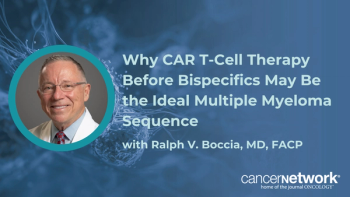
Ralph V. Boccia, MD, FACP, explained why CAR T-cell therapy followed by bispecific antibodies may be the preferred sequence at first relapse in multiple myeloma.
Matthew Matasar, MD, discussed his role leading the division of blood disorders at Rutgers Cancer Institute amid a transformative era in immunotherapy.
In the opening episode of the AI Oncology Revolution series with Matthew Matasar, MD, host Arturo Loaiza-Bonilla, MD, MSEd, FACP, welcomed the chief of the division of blood disorders at Rutgers Cancer Institute, to introduce the series’ focus on artificial intelligence (AI) in hematology. Matasar described his clinical and research focus on lymphoma alongside his broader oversight of blood cancer care, leukemia, lymphoma, and multiple myeloma, as well as Rutgers’ transplant and cellular therapy programs. The conversation set the stage for the episodes to follow by grounding the discussion in the current moment in blood cancer care: a period Matasar described as being “squarely in the era of immunotherapy,” marked by the rapid expansion of CAR T-cell therapy, bispecific antibodies, and safer approaches to allogeneic transplant.
Loaiza-Bonilla is systemwide chief of hematology and oncology at St. Luke’s University Health Network and co-founder of Massive Bio. Matasar is chief of the Division of Blood Disorders at Rutgers Cancer Institute/Jack & Sheryl Morris Cancer Center and professor of medicine at Rutgers Robert Wood Johnson Medical School, where his clinical and research interests focus on lymphoma, and editorial advisory board member for the journal ONCOLOGY ®.
Loaiza-Bonilla: Welcome, everyone, to the AI Oncology Revolution, and thank you so much for being here. For those who don’t know me, I’m Dr. Arturo Loaiza-Bonilla, a medical oncologist and an AI enthusiast, and I’m here to have a great conversation with Dr. Matthew Matasar, who is chief of the division of blood disorders at Rutgers Cancer Institute. Welcome.
Matasar: Thank you so much, Arturo. Thanks for having me today.
Loaiza-Bonilla: Of course. We would love to learn more about yourself. Just tell us about your practice and the things you’re doing, for those who may not know you.
Matasar: By trade, I would say I’m a lymphoma guy. Certainly, my clinical and research interests have focused on questions about lymphoma. At Rutgers, I also serve as our division chief, so I have some more broad oversight over questions of blood disorders, the blood cancers, leukemia, lymphoma, [multiple] myeloma, as well as our transplant and cellular therapy programs.
Loaiza-Bonilla: Well, thank you. As you’ve heard before, my brother was diagnosed with leukemia many years ago, and so I appreciate folks focusing on that specialty, because it’s not easy — the management of those patients, and the evolving field that comes along with it. It’s not easy, but the work that we do is an honor. What we do is very, very special, and I always see it as a privilege.
Matasar: Absolutely.
Loaiza-Bonilla: Talking about your research interests and the things you’re doing at Rutgers — tell me more about what you do daily, what your fellows do, and what are the things that you feel are helping us advance the field further.
Matasar: We’re the only comprehensive cancer center that’s NCI-designated in the state of New Jersey. We’re a soup-to-nuts major academic program that focuses around cancer diagnosis, cancer detection, cancer therapy, and certainly advancing clinical research. There’s a lot going on in research in blood disorders. Obviously, we’re in a very interesting moment in clinical research and advancing care, with this proliferation, particularly of potent immunotherapies, in the diseases that we treat — the proliferation of novel CAR T-cell therapies, bispecific antibody therapies, enhancements to our ability to deliver [allogenic] transplant safely and effectively. We are squarely in the era of immunotherapy, and it’s been [quite] a ride.