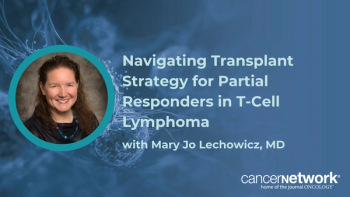
Mary Jo Lechowicz, MD, discussed how pre-transplant depth of response informs the choice between autologous and allogeneic HSCT in T-cell lymphoma.
Guilherme Perini, MD, PhD, explained the rationale behind the KEYFORM-008 trial, exploring how targeting LAG3 can reverse checkpoint inhibitor resistance.
At the
According to Perini, as checkpoint inhibitors move into earlier lines of therapy, treating patients who experience disease progression remains a critical unmet need. One prominent mechanism driving this resistance is the upregulation of alternative immune checkpoints such as LAG3, which accelerates T-cell exhaustion. To overcome this axis of resistance, he explained, KEYFORM-008 randomly assigned patients 1:1 to evaluate a coformulated dual-checkpoint inhibitor approach—the anti-LAG3 antibody favezelimab combined with pembrolizumab (Keytruda)—against standard single-agent investigator’s choice of chemotherapy.
KEYFORM-008 was a trial that compared the combination of pembrolizumab with favezelimab in patients who had already [experienced progression after] PD-1 inhibition. We know that checkpoint inhibitors are standard of care for relapsed/refractory Hodgkin lymphoma, and these agents are now utilized even in earlier lines of therapy. As a result, most patients will eventually be exposed to a PD-1 inhibitor, especially in the relapsed/refractory setting when it is used as monotherapy, as continuous therapy, or for at least 2 years. Some patients will eventually [experience progression] and lose response to pembrolizumab. One of the mechanisms of resistance to checkpoint inhibitors is upregulation of other immune checkpoints, including LAG3. LAG3 leads to T-cell exhaustion, so the idea of the trial was to inhibit the LAG3 axis and thereby regain sensitivity to pembrolizumab. This concept was first tested in a phase 1/2 study, and those results were very promising, which led to KEYFORM-008, a randomized, open-label, international phase 2 trial comparing pembrolizumab/favezelimab with investigator’s choice of chemotherapy.
Perini GF, Lavie D, Bröckelmann PJ, et al. Coformulated favezelimab/pembrolizumab versus chemotherapy in participants with relapsed or refractory classic Hodgkin lymphoma: results of the randomized phase 2 KEYFORM-008 study. Abstract presented at: European Hematology Association 2026 Congress; June 11-14, 2026; Stockholm, Sweden. Abstract S220.