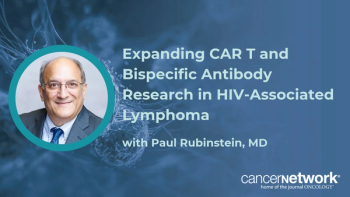
Paul Rubinstein, MD, discussed how cooperative groups are expanding CAR T and bispecific antibody research for patients with HIV-associated lymphoma.

According to Jeff P. Sharman, MD, determining whether a patient requires inpatient or outpatient admission is a critical concern in community practice.
The transition of bispecific antibodies into the community oncology setting presents significant logistical hurdles, particularly regarding the management of cytokine release syndrome (CRS) and immune effector cell-associated neurotoxicity syndrome (ICANS). For centers lacking 24-hour house staff, Jeff P. Sharman, MD, medical director of hematology research for US Oncology and Sarah Cannon Research Institute, stated that determining whether a patient requires inpatient admission or can be safely monitored as an outpatient—especially during overnight hours—is a critical challenge.
To improve the safety profile and accessibility of these therapies, several evidence-based strategies are currently being utilized, as follows:
Refining these approaches is essential for advancing the goal of delivering potent bispecific-containing diffuse large B-cell lymphoma (DLBCL) therapies within the community, where managing adverse effects remains the primary focus for broadening patient access.
That’s probably one of the biggest issues: The delivery of bispecifics is a challenge for many community oncology practices. [CRS] and ICANS can absolutely happen following these medications. In community practice centers where there’s perhaps no house staff on call, we’re invariably trying to figure out what to do for these patients in the middle of the night and whether they can be safely kept as outpatients, or whether they need to be admitted to the hospital.
There are [several] strategies to mitigate this. The context in which the drugs are given seems to matter a lot. We see far fewer episodes of [CRS and ICANS] in the frontline setting when 2 cycles of CHOP are administered before the initiation of the bispecific, and that suggests that somebody whose disease is better controlled may have less overall inflammatory response. We’ve also seen efforts [with] prophylactic dexamethasone or even prophylactic tocilizumab. These have been effective at reducing the rates of CRS, although not eliminating them altogether. There’s a lot of effort to figure out how these can be safely administered in the outpatient setting without requiring inpatient monitoring, and those are some of the steps that are being used to advance those goals.