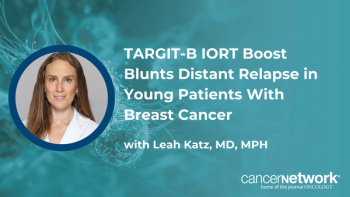
Leah Katz, MD, MPH, explained how an intraoperative tumor bed boost in TARGIT-B may reduce distant relapse in young patients with breast cancer.
Soumen Das, MBBS, MS, FACS, discussed the BC-RADS-2 study and its potential to transform early breast cancer detection in low- and middle-income countries.
In this video, Soumen Das, MBBS, MS, FACS, breast oncologist and surgeon at Tata Memorial Hospital in Kolkata, India, discussed the BC-RADS-2 study and its potential to transform early breast cancer detection in low- and middle-income countries (LMICs). The research, which received the Vanessa Moss Award at London Global Cancer Week, addresses the significant challenge of late-stage diagnosis in regions where mammography and other imaging tools are not readily accessible.
In many LMICs, patients with stage III or IV breast cancer often present with large, palpable tumors. Das explained that the Breast Clinical Reporting and Data System 2 (BC-RADS-2) provides a standardized, clinical version of the traditional Breast Imaging Reporting and Data System. This tool allows health care providers to evaluate lumps through a structured scoring system based on patient history, age, genetic predisposition, and physical examination findings such as skin changes or nipple asymmetry.
Additionally, according to Das, a BC-RADS-2 score of 7 or higher serves as an objective threshold for clinicians, signaling a high likelihood of malignancy. This score triggers a fast-track referral or an immediate biopsy, helping to reduce "secondary delays" that occur within the health care system after a patient seeks an initial consultation. The study reported a high clinical reliability, with a sensitivity of 93.2% and a specificity of 88.7%.
Beyond its diagnostic accuracy, BC-RADS-2 supports "task shifting" by demonstrating that trained nurses and nonphysician health workers can perform these evaluations as effectively as physicians. This workforce model is essential for expanding care in areas with limited medical personnel, such as low-resource settings.
Looking ahead, Das outlined plans for a mobile app and the integration of artificial intelligence to further refine diagnostic precision and reduce human error. By aligning with the World Health Organization Global Breast Cancer Initiative, the use of this system is aimed at shifting most diagnoses to stage I or II, significantly improving survival outcomes for patients globally.