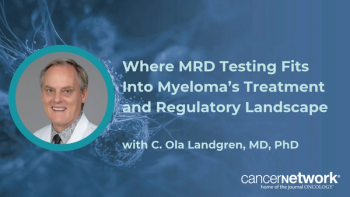
C. Ola Landgren, MD, PhD, discusses the FDA’s endorsement of MRD as an accelerated approval end point in multiple myeloma.

Treatment until progression may not be the way forward with bispecific antibodies, according to Hans Lee, MD.
As BCMA-directed T-cell–redirecting therapies expand in multiple myeloma, patients and clinicians increasingly face a choice between a bispecific antibody, requiring more chronic, ongoing treatment, and CAR T-cell therapy, a single infusion with more front-loaded intensity.
Hans Lee, MD, director of Myeloma Research at Sarah Cannon Research Institute in Nashville, Tennessee, spoke with CancerNetwork® about how he weighs that trade-off with patients and what has changed in managing bispecific-related toxicity.
Transcript:
CancerNetwork: How do you weigh the trade-off between a bispecific antibody’s more chronic, ongoing treatment burden vs CAR T-cell therapy’s single-infusion, front-loaded intensity when a patient is choosing between those classes of drugs?
This is a conversation I have with patients every day. The thought is that patients should get some form of BCMA T-cell–redirecting therapy as early as possible in the relapsed/refractory setting, either a BCMA bispecific antibody or BCMA CAR T-cell therapy, whichever is available to the patient. There are trade-offs: a single infusion of CAR T-cell therapy [requires] a lot more upfront activation energy needed to get a patient to CAR T, including apheresis, manufacturing, infusion, and monitoring, especially in the short term after infusion. I would also say that while CAR T-cell therapy is considered one-and-done, there is still a lot of supportive care needed afterward. It is important to be realistic with patients in that discussion, including infection monitoring, intravenous immunoglobulin [IVIG] after CAR T-cell therapy, cytopenias that can occur, and other issues. It is important to recognize that there are still additional steps involved in the post-CAR T setting that are mainly supportive care.
With bispecific antibodies, since they are off-the-shelf, they can be administered right away, so the activation energy to get a patient started is much less than with CAR T-cell therapy. There still needs to be a plan and a process in the local practice setting for monitoring early potential adverse events, mainly cytokine release syndrome [CRS] and, rarely, immune effector cell-associated neurotoxicity syndrome [ICANS]. The incidence and severity of CRS is lower with bispecific antibodies compared with CAR T-cell therapy. That’s one nice thing. We are also learning a lot more about how to mitigate these early adverse events, such as giving prophylactic tocilizumab [Actemra] prior to the first step-up dose, which has decreased the incidence of CRS from 50% to 70% down to less than 10% to 15%, enabling outpatient step-up dosing.
In the long term, infection monitoring is critical with bispecific antibodies, and giving monthly IVIG is important. We are also learning that treatment until progression is probably not the path forward; we are looking at fixed-duration treatment approaches, giving perhaps a year or 2 of bispecific antibody-based therapy. [Because] these therapies can elicit deep and durable responses quickly, it is probably not necessary for patients to stay on therapy forever, as has been the historical paradigm in myeloma.