Articles by Lori Leslie, MD

Case-Based Discussions and Program Wrap-Up
ByMegan Melody, MD, MS,Matthew Cortese, MD, MPH,Marco Davila, MD, PhD,Chelsea Peterson, DO,Lorenzo Falchi, MD,Lori Leslie, MD,Samuel Yamshon, MD The final portion of the program shifts to case-based discussion, with the panel applying earlier debates to real-world clinical scenarios in relapsed/refractory DLBCL. The first case, a fit 58-year-old with early relapse, prompts consensus around rapid movement to CAR-T therapy with bridging strategies such as polatuzumab-based regimens, whereas the second case highlights challenges related to primary refractory disease and inconsistent caregiver support. The program concludes with closing remarks and a debate winner announcement, reinforcing the collaborative nature of evolving treatment strategies in LBCL.
Debate Round 3: CAR-T vs Bispecifics in Relapsed LBCL – “Cure” vs Access
ByMegan Melody, MD, MS,Matthew Cortese, MD, MPH,Marco Davila, MD, PhD,Chelsea Peterson, DO,Lorenzo Falchi, MD,Lori Leslie, MD,Samuel Yamshon, MD The teams debate whether CAR-T or bispecific antibodies should be prioritized as the treatment paradigm evolves in relapsed large B-cell lymphoma, with Team NYC centering the argument on “cure” and the curative-intent potential/plateau of CAR-T outcomes. Team Roswell agrees cure is the goal but argues that real-world access barriers and “off-the-shelf” availability make bispecifics, and especially emerging combination strategies, crucial for patients who cannot reliably reach or complete CAR-T. The discussion highlights a key tradeoff: CAR T as a one-time, time-limited intervention vs bispecifics requiring ongoing dosing and infrastructure, with durability, infection risk, and sequencing still actively evolving.
Debate Round 2: Choosing a 2L CAR-T Product
ByMegan Melody, MD, MS,Matthew Cortese, MD, MPH,Marco Davila, MD, PhD,Chelsea Peterson, DO,Lorenzo Falchi, MD,Lori Leslie, MD,Samuel Yamshon, MD The panel debates how real-world differences in efficacy, vein-to-vein time, manufacturing reliability, and toxicity should influence selection between the two second-line CAR T options for early relapsed/refractory LBCL. One side argues that efficacy is broadly similar and that lower all-grade CRS/neurotoxicity, especially for outpatient delivery, favors the less toxic product, whereas the other emphasizes faster manufacturing, longer follow-up experience, and the importance of overall survival data in driving decisions. The discussion converges on individualized selection based on the patient in front of you (disease tempo, fitness, logistics, and center capacity), while acknowledging the lack of head-to-head randomized comparisons.
Debate Round 1: Should CAR-T Be Given Inpatient or Outpatient?
ByMegan Melody, MD, MS,Matthew Cortese, MD, MPH,Marco Davila, MD, PhD,Chelsea Peterson, DO,Lorenzo Falchi, MD,Lori Leslie, MD,Samuel Yamshon, MD Panelists engage in a structured debate on whether CAR T-cell therapy for aggressive large B-cell lymphoma should be administered in the inpatient or outpatient setting. Team NYC argues for inpatient treatment in higher-risk or socially complex cases, citing logistical barriers, caregiver limitations, and the need to manage serious toxicities such as CRS and ICANS. Team Roswell counters that outpatient programs can safely expand access, reduce hospital-related complications, and improve patient acceptance of CAR T, prompting a broader discussion on evolving safety data, real-world logistics, and changing regulatory requirements.
US Registry: Comparing Second-Line CAR-T Products in LBCL
ByMegan Melody, MD, MS,Matthew Cortese, MD, MPH,Marco Davila, MD, PhD,Chelsea Peterson, DO,Lorenzo Falchi, MD,Lori Leslie, MD,Samuel Yamshon, MD Team Roswell presents ABC Consortium real-world data from 15 US centers comparing second-line outcomes with axi-cel, liso-cel, and a third CAR T product in large B-cell lymphoma, including manufacturing timelines, bridging therapy, response, survival, and key toxicities. The discussion highlights faster vein-to-vein time and fewer out-of-spec products with axi-cel, broadly similar efficacy between axi-cel and liso-cel, and higher rates of cytokine release syndrome/neurotoxicity with axi-cel alongside lower acute toxicity with liso-cel. Team NYC cross-examines the interpretation, especially the limited sample for the third product, and the panel pivots to practical post–CAR T survivorship issues like infections, hypogammaglobulinemia, IVIg use, and the need for more standardized supportive-care practices.
Real-World CAR-T Comparisons: Axi-cel vs Liso-cel in 2L LBCL
ByMegan Melody, MD, MS,Matthew Cortese, MD, MPH,Marco Davila, MD, PhD,Chelsea Peterson, DO,Lorenzo Falchi, MD,Lori Leslie, MD,Samuel Yamshon, MD Team Roswell presents ABC Consortium real-world data from 15 US centers comparing second-line outcomes with axi-cel, liso-cel, and a third CAR T product in large B-cell lymphoma, including manufacturing timelines, bridging therapy, response, survival, and key toxicities. The discussion highlights faster vein-to-vein time and fewer out-of-spec products with axi-cel, broadly similar efficacy between axi-cel and liso-cel, and higher rates of cytokine release syndrome/neurotoxicity with axi-cel alongside lower acute toxicity with liso-cel. Team NYC cross-examines the interpretation, especially the limited sample for the third product, and the panel pivots to practical post–CAR T survivorship issues like infections, hypogammaglobulinemia, IVIg use, and the need for more standardized supportive-care practices.
Treatment Selection in Biologically Aggressive DLBCL
ByMegan Melody, MD, MS,Matthew Cortese, MD, MPH,Marco Davila, MD, PhD,Chelsea Peterson, DO,Lorenzo Falchi, MD,Lori Leslie, MD,Samuel Yamshon, MD Teams from Roswell Park and New York City discuss advances in CAR T-cell therapy for large B-cell lymphoma. Team Roswell presents real-world data comparing second-line CAR T therapy with standard salvage chemotherapy and transplant approaches, highlighting improved event-free and overall survival outcomes with CAR T. Team NYC challenges the findings, raising questions about patient selection, treatment bias, and how real-world data should be interpreted alongside randomized clinical trial results.
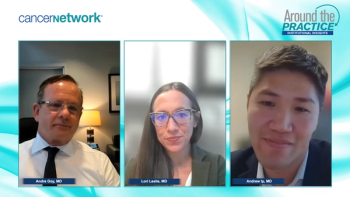
Experts comment on the future of CAR T-cell therapy development and the use of dual CAR-T and CAR-T retreatment.
Drs Goy, Ip, and Leslie close out their discussion with a look at the exciting developments and future of CAR T-cell therapies in lymphoma treatment.
Key opinion leaders describe when to refer a patient with lymphoma and at what point treatments should be switched, and the evolution of T-cell engaging therapies.
Dr Lori Leslie provides an overview of key clinical trial data on the use of CAR T-cell therapy in chronic lymphocytic leukemia.
Drs Goy and Leslie converse on the use of CAR T-cell therapy in acute lymphoblastic lymphoma, the first approved treatment for ALL.
Lori Leslie, MD, explains how CAR T-cell therapy fits into follicular lymphoma treatment sequencing, highlighting data from the ZUMA-5 trial.
Andre Goy, MD, and Andrew Ip, MD, give an overview of the approval of CAR T-cell therapy for mantle cell lymphoma treatment.
Dr Andrew Ip explains the major toxicities of CAR T-cell therapy in patients with large B-cell lymphoma and how to manage them.
Lymphoma physicians from John Theurer Cancer Center comment on the use of CAR T-cell therapy in large B-cell lymphoma and the implications of clinical trial data in this setting.
Dr Lori Leslie discusses how to assess if a patient with large B-cell lymphoma is a good candidate for CAR T-cell therapy.
Andrew Ip, MD, and Lori Leslie, MD, review clinical trial and real-world data on the efficacy and survival rates of CAR T-cell therapy in large B-cell lymphoma.
The medical oncologist from the John Theurer Cancer Center noted the importance of real-world data in determining potentially different toxicity profiles in these BTK-inhibitors.