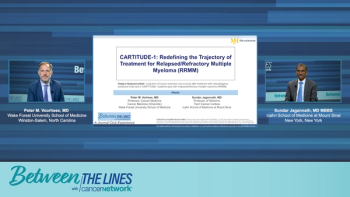
Panelists discuss how managing a high-risk patient aged 64 years who progressed after 11 months on talquetamab with decreased B-cell maturation antigen (BCMA) surface expression presents challenging options, including switching to GPRC5D-targeting agents like talquetamab, pursuing clinical trials, or potentially using sequential bispecifics despite T-cell exhaustion concerns, while noting that the MonumenTAL-1 trial’s prior BCMA-directed therapy cohort showed promising 12-month progression-free survival, although the data are confounded by intervening therapies between treatments.


![“Everyone—patients, doctors—we all want the same thing. We want [patients] to live longer,” said Kiran Turaga, MD, MPH, on patients with peritoneal surface malignancies.](https://cdn.sanity.io/images/0vv8moc6/cancernetwork/9b290688648a249e516474c175a3c06309426d15-2950x1568.png?w=350&fit=crop&auto=format)