
Virginia Kaklamani, MD and Heather McArthur, MD begin by discussing new data regarding the use of aromatase inhibitors and ovarian function suppression in women with HR+ early breast cancer.

Your AI-Trained Oncology Knowledge Connection!
Virginia Kaklamani, MD and Heather McArthur, MD begin by discussing new data regarding the use of aromatase inhibitors and ovarian function suppression in women with HR+ early breast cancer.
Harry P. Erba, MD, PhD, highlights key data on ziftomenib in patients with relapsed/refractory acute myeloid leukemia and its potential as part of a combination regimen.
Melissa Alsina, MD, shares her excitement for an upcoming program wherein she and other key opinion leaders from the Moffit Cancer Center review updated data and optimal treatment strategies in the setting of multiple myeloma.

Alexander Spira, MD, PhD, FACP, of the Virginia Cancer Specialists, discusses how the FDA approval of adagrasib for KRAS G12C–mutated non–small cell lung cancer can provide benefit for this patient population.
Dr Tanios Bekaii-Saab describes for which patient groups he would use anti-HER2 therapies as a second-line treatment for HER2+ metastatic colorectal cancer.

Expert panelists review data from the MOUNTAINEER study, which tested tucatinib alone or in combination with trastuzumab in patients with metastatic colorectal cancer.

Patient Elle Charnisky shares her experience with a conventional chemotherapy treatment for her HER2+ metastatic colorectal cancer before transitioning to targeted therapies.
Shared perspective on the use of trastuzumab deruxtecan in HER2+ metastatic colorectal cancer following results from the DESTINY-CRC01 trial.
Experts from the Cleveland Clinic provide an overview of recent updates in the treatment landscape for patients with multiple myeloma, discussing patient cases, clinical trials, and improving outcomes for patients.
Experts Matthew Campbell, MD, MS, and Brian Rini, MD, provide a brief review of recent clinical data in the setting of relapsed/refractory renal cell carcinoma.
A broad look at the data from several recent first-line clinical trials in the setting of advanced renal cell carcinoma and considerations for how they may impact real-world practice.

Robert Mutter, MD, of Mayo Clinic says that proton postmastectomy radiation therapy allows for excellent tissue sparing in the management of breast cancer.
Patients with multiple ipsilateral breast cancer might benefit from having a preoperative MRI before proceeding with breast conservation therapy, according to Judy C. Boughey, MD, of Mayo Clinic in Rochester, Minnesota.

Comprehensive insight to the treatment armamentarium for HER2+ metastatic breast cancer throughout several lines of therapy.
Expert panelists open their discussion on HER2+ breast cancer by reviewing a patient case of metastatic disease with no CNS involvement.

Dr Tuchman highlights exciting bispecific agents in investigation for the treatment of relapsed/refractory multiple myeloma.

Joyce O’Shaughnessy, MD, starts a discussion on maintenance therapy with trastuzumab deruxtecan in patient with HER2+ mBC.

Shared insight on key factors that determine the best selection of therapy in patients with relapsed/refractory multiple myeloma, with a focus on bispecific antibodies and CAR T-cell therapy.

After reviewing their third patient case, expert hematologist-oncologists highlight the treatment armamentarium for relapsed/refractory multiple myeloma.
Peter Voorhees, MD, starts a conversation on the best treatment options for patients with multiple myeloma after relapse.
Heather McArthur, MD, presents the case of a 69-year-old woman with stage II HER2+ mBC for discussion.
Dr Bekaii-Saab provides an overview of the first-line treatment options in metastatic colorectal cancer, and the factors that impact treatment decision-making.
Tanios Bekaii-Saab, MD, explains the barriers to molecular testing for patients with metastatic colorectal cancer, and how they can be addressed.

A panel of expert oncologists consider how HER2 expression can positively impact the selection of targeted therapies for patients with metastatic colorectal cancer.

Expert perspectives on the PARADIGM study, which highlighted the role of panitumumab in combination with frontline chemotherapy in patients with left-sided, RAS wild-type metastatic colorectal cancer.
Closing out their discussion on adverse event management in advanced renal cell carcinoma, Matthew Campbell, MD, MS, and Brian Rini, MD, consider overlapping toxicity in TKI/IO regimens.
Expert perspectives on the most common adverse events seen while managing advanced renal cell carcinoma, followed by advice on how best to manage these and counsel patients.
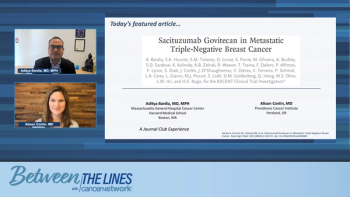
Expert oncologists highlight remaining unmet needs in the setting of metastatic triple-negative breast cancer and look toward future evolutions in care.
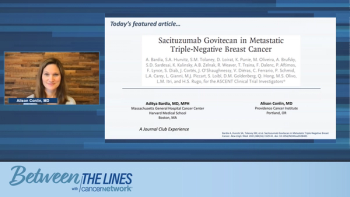
Centering discussion on sacituzumab govitecan use in metastatic triple-negative breast cancer, expert oncologists reflect on results from the phase 3 ASCENT study.
An expert from the University of Texas Southwestern Medical Center in Dallas describes the efficacy of stereotactic radiation in the treatment of patients with metastatic kidney cancer.