
An expert from the University of Texas Southwestern Medical Center in Dallas gives an overview of the multimodal use of stereotactic radiation for the treatment of patients with metastatic kidney cancer.

Your AI-Trained Oncology Knowledge Connection!
An expert from the University of Texas Southwestern Medical Center in Dallas gives an overview of the multimodal use of stereotactic radiation for the treatment of patients with metastatic kidney cancer.
An expert from the University of Texas Southwestern Medical Center in Dallas emphasized that stereotactic radiation provides oncologists with an alternative modality for treating patients with kidney cancer for whom standard ablative surgery is not an option.
With the increasing clinical use of circulating tumor DNA biomarker testing among community urologists, an expert from Tisch Cancer Institute at Mount Sinai in New York City suggests that more prospective data are needed to make the best decisions among patients with bladder cancer.

Sascha Tuchman, MD, discusses how frail patients with multiple myeloma are defined in his clinical practice, and what assessment models he utilizes.
Dr Sascha Tuchman explains how he measures an adequate or successful frontline treatment response in patients with transplant-ineligible NDMM.

Before closing out their module on transplant-ineligible newly diagnosed multiple myeloma, panelists reflect on best treatment practices in the setting of high-risk disease.

Practical perspectives on the optimal selection of therapy for transplant-ineligible NDMM, followed by considerations for duration of therapy and dosing.

Centering discussion on sacituzumab govitecan use in metastatic triple-negative breast cancer, expert oncologists reflect on results from the phase 3 ASCENT study.

Key opinion leaders Aditya Bardia, MD, MPH, and Alison Conlin, MD, provide a broad view of the current metastatic triple-negative breast cancer treatment landscape.
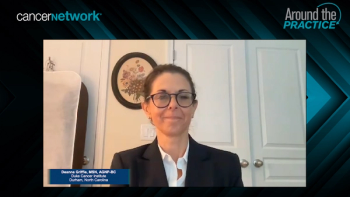
Elle Charnisky describes her experience with molecular testing, and Nurse Practitioner Deanna Griffie details how she explains testing to patients with metastatic colorectal cancer.
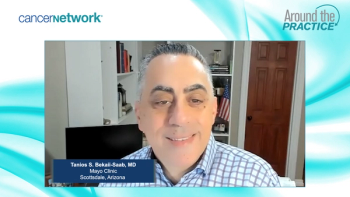
Shared insight on the optimal use of circulating tumor DNA and minimal residual disease in the identification and management of metastatic colorectal cancer.

Opening their discussion on metastatic colorectal cancer management, expert panelists reflect on the molecular testing paradigm in the setting of diagnosis and workup.
Dr Tanios Bekaii-Saab explains the rarity of HER2+ metastatic colorectal cancer and how his clinical practice detects HER2 alterations.

Following the results of the phase 3 CALLA trial, Jyoti S. Mayadev, MD, discusses the importance of global clinical multidisciplinary efforts in the locally advanced cervical cancer space.
Comprehensive insight on the factors that help determine optimal first-line therapy for a patient presenting with advanced renal cell carcinoma.
Expert oncologists Matthew Campbell, MD, MS, and Brian Rini, MD, open their discussion on advanced renal cell carcinoma management by defining cornerstone treatment approaches.
Ursula A. Matulonis, MD, spoke about the next steps for mirvetuximab soravtansine in the treatment of patients with folate receptor α–high platinum-resistant ovarian cancer.

The panel closes their discussions by highlighting current unmet needs in multiple myeloma treatment and what excites them on the horizon.
Dr Patel continues the conversation of novel treatments with an examination of CAR T-cell therapies in multiple myeloma.

Dr Christina Gasparetto compares the results of the MAIA and SWOG0777 trials and discusses how the data has been practice-changing.

Closing out their module on transplant-ineligible NDMM management, expert panelists consider best practices regarding duration of therapy and adjustments to drug regimens.
Dr Varga and Dr Tuchman explain the factors for consideration when choosing an initial treatment regimen for patients with transplant-ineligible NDMM.

Comprehensive discussion on the array of treatment regimens available for patients with transplant-ineligible NDMM and how best to sequence therapy.
The randomized, placebo-controlled, double-blind phase 3 CALLA trial assessed the combination of durvalumab and chemoradiotherapy vs placebo and chemoradiotherapy.

Expert perspectives on cornerstone induction therapy regimens used in patients with transplant-ineligible newly diagnosed multiple myeloma.

Switching their attention to the transplant-ineligible setting of newly diagnosed multiple myeloma, panelists center discussion around their second patient case.

PSMA-targeting PET ligand 18F-rhPSMA-7.3 yielded high detection rates for patients with recurrent prostate cancer regardless of factors such as PSA levels, PSA doubling time, or Gleason scores, according to Benjamin H. Lowenritt, MD, FACS.

Future research into the management of unresectable hepatocellular carcinoma may involve combining local therapies with checkpoint inhibitors like durvalumab and tremelimumab, according to Ghassan K. Abou-Alda, MD.

Patient Elle Charnisky shares the symptoms that led to her diagnosis of HER2+ metastatic colorectal cancer, and the online resources she used for education after.
Tanios Bekaii-Saab, MD, provides a brief overview of the typical presentation and diagnosis of metastatic colorectal cancer.