
Panelists discuss how early use of IDH inhibitors maximizes therapeutic benefit and address resistance mechanisms, noting that tumors typically develop bypass pathways rather than losing the IDH mutation itself.

Your AI-Trained Oncology Knowledge Connection!
Panelists discuss how early use of IDH inhibitors maximizes therapeutic benefit and address resistance mechanisms, noting that tumors typically develop bypass pathways rather than losing the IDH mutation itself.
Panelists discuss how dose modifications for ALK inhibitors can significantly improve quality of life issues like brain fog and weight gain while maintaining disease control, emphasizing the importance of multidisciplinary team support including palliative care from diagnosis.
Panelists discuss how the INDIGO trial's compelling results led to early FDA approval of vorasidenib for progressive IDH-mutant gliomas, and how they counsel patients on sequencing IDH inhibitors vs traditional radiation and chemotherapy while considering long-term quality of life implications.
Panelists discuss how managing a high-risk patient aged 64 years who progressed after 11 months on talquetamab with decreased B-cell maturation antigen (BCMA) surface expression presents challenging options, including switching to GPRC5D-targeting agents like talquetamab, pursuing clinical trials, or potentially using sequential bispecifics despite T-cell exhaustion concerns, while noting that the MonumenTAL-1 trial’s prior BCMA-directed therapy cohort showed promising 12-month progression-free survival, although the data are confounded by intervening therapies between treatments.
Elucidating nonresponses to bispecific T-cell engagers may be an important research consideration in the multiple myeloma field.
Barriers to access and financial toxicities are challenges that must be addressed for CAR T-cell therapies in LBCL, according to Jose Sandoval Sus, MD.

While there is no clear and cut way to transition patients from pediatric to adult care, Maria C. Velez, MD, has established a helpful network of willing clinicians.
Fixed treatment durations with bispecific antibodies followed by observation may help in mitigating infection-related AEs, according to Shebli Atrash, MD.
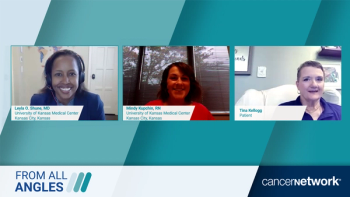
Panelists discuss how patients educate themselves about multiple myeloma through hospital pamphlets and magazines, online research, and positive attitude books about cancer while emphasizing the critical importance of peer support and mentorship programs where patients can meet with others who have successfully undergone treatments like stem cell transplants, creating comforting group meetings that help alleviate fear and provide hope by seeing healthy survivors share their stories and demonstrate that recovery is possible.
Epistemic closure, broad-scale distribution, and insurance companies are the 3 largest obstacles to implementing new peritoneal surface malignancy care guidelines into practice.
Panelists discuss how multidisciplinary care coordination for chimeric antigen receptor (CAR) T-cell therapy involves registered nurses serving as support persons and liaisons between academic centers and community oncologists, with streamlined communication through direct cell phone access, telehealth consultations to assess candidacy, and coordinated logistics for pretreatment testing, including PET scans, bone marrow biopsies, brain MRIs, and lumbar punctures, while emphasizing that CAR T approval has expanded from fourth-line treatment in 2022 to second-line therapy in 2024, allowing for faster patient access through insurance approval and outpatient T-cell collection processes.
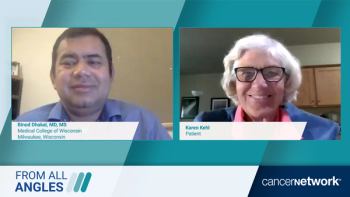
Panelists discuss how talquetamab demonstrates impressive clinical efficacy with approximately 70% response rates in the pivotal MONUMENTAL-1 trial, including patients previously treated with other immunotherapies, and how real-world data from studies like Real Italy corroborate these trial results with similar 67% response rates across diverse patient populations including high-risk subgroups.
Panelists discuss how clinical decision-making between GPRC5D and BCMA-targeting bispecific antibodies involves considering prior treatment history, target switching strategies, and patient-specific factors, with Karen explaining her preference for talquetamab's targeted approach that spares healthy cells, subcutaneous administration convenience, and the advantage of switching to a different antigen target after previous BCMA therapy.
Shebli Atrash, MD, stated that MRD should be considered carefully as an end point given potential recurrence despite MRD negativity.
While Maria C. Velez, MD’s, term as president of ASPHO is only 1 year, she is already confident in ASPHO’s strategic plans.
“This is something where this is written by the trainees, for the trainees, and, of course, for all the other clinicians who take care of patients,” said Kiran Turaga, MD, MPH.
An expert explains that real-world data from the REALiTEC study shows teclistamab remains highly effective in relapsed/refractory multiple myeloma—even among patients ineligible for clinical trials—demonstrating strong response rates, encouraging survival outcomes, and reinforcing the importance of therapy sequencing and broad access to bispecific antibodies in everyday clinical practice.
![“Everyone—patients, doctors—we all want the same thing. We want [patients] to live longer,” said Kiran Turaga, MD, MPH, on patients with peritoneal surface malignancies.](https://cdn.sanity.io/images/0vv8moc6/cancernetwork/9b290688648a249e516474c175a3c06309426d15-2950x1568.png?w=350&fit=crop&auto=format)
“Everyone—patients, doctors—we all want the same thing. We want [patients] to live longer,” said Kiran Turaga, MD, MPH, on patients with peritoneal surface malignancies.
Data from the phase 3 DeLLphi-304 trial at ASCO 2025 revealed a survival advantage with tarlatamab vs chemotherapy in second-line ES-SCLC.
The new peritoneal surface malignancy care guidelines had clinicians gather from every disease state to show increased representation.
The FDA approval of tarlatamab in SCLC has received much press attention, according to Daniel R. Carrizosa, MD, MS.
These new guidelines aim to alleviate some of the problems caused by patients with peritoneal metastases being diagnosed with the disease in late stages.
A combined cohort composed of patients from the TROPION-Lung01 and TROPION-Lung-05 trials showed a survival advantage with dato-DXd vs docetaxel.
The National ICE-T Conference may inspire future collaboration between community and academic oncologists in the management of different cancers.
Panelists discuss how proactive monitoring for ALK inhibitor adverse effects through regular lipid panels, liver function tests, and patient education about red flag symptoms like bradycardia or cognitive changes enables early intervention and successful dose management.
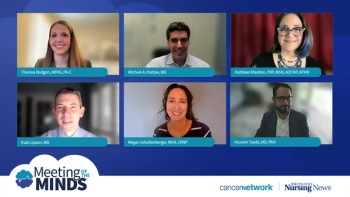
This is an actor portrayal of a hypothetical patient profile developed for educational purposes based on characteristics of patients with multiple myeloma as seen in clinical practice. The hypothetical case was co-developed by staff medical writers with Cancer Network/ONN.”
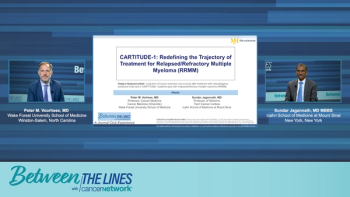
Panelists discuss how long-term CARTITUDE-1 data may change clinical practice by validating earlier use of ciltacabtagene autoleucel (cilta-cel) and informing personalized treatment strategies based on risk and disease biology.
Panelists discuss how they evaluate patients postsurgically by weighing factors like tumor location, extent of resection, patient age, and quality of life considerations to determine whether to pursue immediate treatment or surveillance, while emphasizing that microscopic disease always remains despite apparent gross total resection.
Panelists discuss how despite the significant progress with bispecifics in relapsed/refractory multiple myeloma (R/R MM), major unanswered questions remain including optimal sequencing strategies (which represent the biggest challenge), how to implement bispecifics earlier in the treatment paradigm, and how to integrate them with other existing therapies in the evolving treatment landscape.
Panelists discuss the importance of patient-centered communication in metastatic melanoma care, emphasizing how clinicians convey the trade-offs between rapid responses from targeted therapies and the durable, immune-driven benefits of immunotherapy, while guiding patients through realistic expectations, personalized goals, and the long-term potential of treatment.