
Key takeaways from the CARTITUDE-1 study and the KarMMA study evaluating CAR T-cell therapies for relapsed/refractory multiple myeloma.
Key takeaways from the CARTITUDE-1 study and the KarMMA study evaluating CAR T-cell therapies for relapsed/refractory multiple myeloma.
An overview of BCMA-targeting bispecific agents in development for multiple myeloma, including talquetamab and teclistamab.
A panel of doctors discuss the available treatment options for early and late relapsed multiple myeloma, including approved novel BCMA-targeting agents.

A look at the patient outcomes with daratumumab use in the frontline vs second-line setting in patients with transplant-ineligible multiple myeloma, and the pros and cons of subcutaneous vs intravenous daratumumab.
Marina Frimer, MD, spoke about what the future holds for the treatment of patients with platinum-sensitive recurrent uterine cancer.
David Aggen, MD, PhD identifies patient populations who may benefit from single-agent therapy and reviews NCCN recommendations for first-line treatment of metastatic clear cell RCC.
Robert Alter, MD, weighs in on the evolution of combination therapy as the first-line standard of care for patients with metastatic clear cell RCC.
Sam Klempner, MD, spoke about the importance of expanding minimal residual disease platforms for patients with gastrointestinal cancers.
David Aggen, MD, PhD touches on the availability of newer first-line combination treatment options for metastatic disease.
Robert Alter, MD compares older, single-agent first line therapies for patients with metastatic clear cell RCC.
Dr Sara Hurvitz provides an overview of HER2+ breast cancer, and Dr Ruta Rao details the frontline treatment options available for metastatic cases.
Ruta Rao, MD, presents the case of a 36-year-old woman with metastatic HER2+ breast cancer and brain metastases.
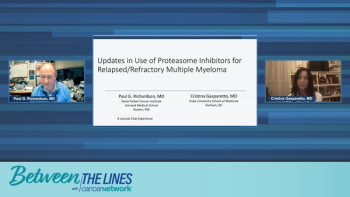
Experts share their excitement for upcoming PFS trial data to be presented on the combination of ixazomib, pomalidomide, and dexamethasone in multiple myeloma.
Before closing out their discussion on intermediate-risk RCC, experts review frontline triplet combinations and possible treatment options following relapse after nivolumab-ipilimumab.
Comprehensive discussion on how to best treat patients with renal cell carcinoma and brain or bone metastasis.
Brian Slomovitz, MD, spoke about previously conducted trials that used regimens involving pembrolizumab and chemotherapy for patients with newly diagnosed high-risk endometrial cancer at SGO 2022.
Nicolas Girard, MD, highlighted key findings from the CheckMate 816 trial, examining nivolumab and chemotherapy vs chemotherapy alone in resectable non–small cell lung cancer.
Frederick Lock, MD, spoke about how axicabtagene ciloleucel has improved survival in patients with large B-cell lymphoma.
Gennady Bratslavsky, MD, spoke about the role of adjuvant therapy in renal cell carcinoma at the 15th Annual Interdisciplinary Prostate Cancer Congress® and Other Genitourinary Malignancies.
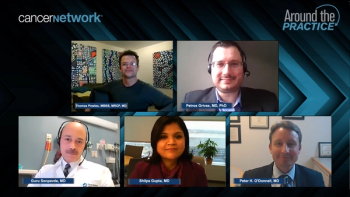
Petros Grivas, MD, PhD, introduces a patient profile of a woman with metastatic UC and invites panel members to comment on how they might approach initial treatment and management of the patient.
Ira Winer, MD, PhD, FACOG, spoke about high response rates observed in patients with pretreated platinum-resistant ovarian cancer from the phase 1/2 ARTISTRY-1 trial.
Petros Grivas, MD, PhD, Shilpa Gupta, MD, Peter H. O’Donnell, MD, Thomas Powles, MBBS, MRCP, MD, and Guru Sonpavde, MD, summarize recent treatment advances for patients with urothelial cancer (UC).
Phillip S. Low, PhD, spoke about what the future holds for treatments like 177Lu-PSMA-617 being developed for patients with prostate cancer.
Panelists consider key risk factors for chronic GVHD, including the degree of donor transplant matching, patient age, intensity of conditioning, use of ablative doses of total-body radiation, and presence of acute GVHD.
Pashna N. Munshi, MD, and Yi-Bin Chen, MD, examine key differences in the pathologic features of acute and chronic GVHD.
Ursula A. Matulonis, MD, discusses key data with mirvetuximab soravtansine for patients with folate receptor α–high platinum-resistant ovarian cancer that read out of the phase 3 SORAYA trial.
Matthew Krebs, MB, PhD spoke about the reasoning for the phase 1 PALOMA trial in patients with solid tumors who received a subcutaneous formulation of amivantamab.
Shared insight on the selection of specific androgen receptor inhibitors for patients with nonmetastatic castration-resistant prostate cancer.
Centering the discussion around a patient with nonmetastatic castration-resistant prostate cancer, experts share insight on optimal work-up and testing.
Stéphane Champiat, MD, PhD, spoke about the results of the AURELIO-03 trial with SOT101 and pembrolizumab for patients with advanced solid tumors.