
Marina Frimer, MD, spoke about the goals of a phase 2 trial and how it can impact patients with platinum-sensitive recurrent uterine serous carcinoma.
Marina Frimer, MD, spoke about the goals of a phase 2 trial and how it can impact patients with platinum-sensitive recurrent uterine serous carcinoma.
Thomas Hutson, DO, PharmD, and Scott Tykodi, MD, PhD, discuss their takeaways from the CLEAR trial and how risk category stratification affected the study.
Brian Shimkus, MD, shares his opinion of data on lenvatinib and pembrolizumab from the CLEAR trial.
Oncologists debate whether TKI monotherapy has a place in renal cell carcinoma treatment after the CLEAR trial.

A multidisciplinary panel of health care professionals and a patient advocate comment on their excitement about novel therapies in the pipeline for HER2-positive metastatic breast cancer.
Improvements regarding the identification and management of radiation necrosis in patients with HER2-positive metastatic breast cancer.
Lori Wirth, MD, provides an overview of differentiated thyroid cancer including patient presentation and disease course.
Chung-Han Lee, MD, PhD discusses how genetic mutations inform patient prognosis and decision-making for patients with kidney cancer.
Robert Alter, MD opines on the current prognostic value of biomarkers for RCC and the need for additional data in the field.
Mehmet Asim Bilen, MD weighs in on various biomarker testing methodologies, sample considerations, and emerging data on novel biomarkers.
David Aggen, MD, PhD reviews how he currently approaches biomarker testing in patients with RCC.
Mehmet Asim Bilen, MD comments on the prognosis of patients with metastatic RCC and how recent advances have improved outcomes.
Robert Alter, MD comments on the use of prognostic models for determining risk status and informing treatment options in patients with RCC.
Candice Roth, MSN, RN, CENP, spoke about how the electronic treatment pathways have evolved over time.
Ira Winer, MD, PhD, FACOG, spoke about which presentations during The Society of Gynecologic Oncology 2022 Annual Meeting he most enjoyed.
Laurence Albigès, MD, PhD, discusses how immunotherapy combinations have affected the treatment landscape for previously untreated advanced or metastatic renal cell carcinoma.
Brian Slomovitz, MD, Reviews Adjuvant Pembrolizumab and Chemo +/– Radiotherapy in Endometrial Cancer
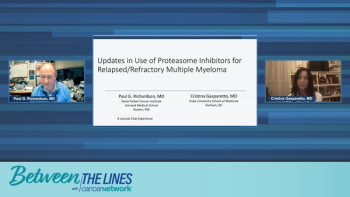
Experts Paul Richardson, MD, and Cristina Gasparetto, MD, discuss trial data analyzing the in-class transition from bortezomib to ixazomib for patients with multiple myeloma.

Expert insights on selecting the appropriate patients and dose for treatment with the lenvatinib plus pembrolizumab regimen in patients with renal cell carcinoma.
Expert perspectives on data from the TOURMALINE-MM1 trial, which tested ixazomib therapy in patients with relapsed/refractory multiple myeloma.
Experts open their discussion on RCC by reviewing the clinical scenario of a patient with favorable-risk disease who is treated with the TKI/IO regimen of lenvatinib and pembrolizumab.
Tanios Bekaii-Saab, MD; Kristen Ciombor, MD, MSCI; and John Strickler, MD, detail key developments and needs in the gastrointestinal cancers landscape.
Laurence Albigès, MD, PhD, spotlighted 2-year follow-up data from the phase 3 CheckMate 9ER trial, which looked at nivolumab and cabozantinib in patients with previously untreated advanced or metastatic renal cell carcinoma.
Laurence Albigès, MD, PhD, speaks to how patients with treatment-naïve advanced or metastatic renal cell carcinoma can benefit from treatment with nivolumab and ipilimumab.
Yi-Bin Chen, MD, shares insight on unmet needs and the future treatment landscape for patients with chronic GVHD and steroid-refractory GVHD.
Yi-Bin Chen, MD, evaluates the safety and efficacy of ruxolitinib for second-line treatment for steroid-refractory chronic GVHD and discusses clinical implications from the REACH3 trial.

A discussion on choosing between triplet or quadruplet induction therapy for transplant-eligible newly diagnosed multiple myeloma.
An overview of the triplet and quadruplet induction treatment regimens available for patients with transplant-eligible multiple myeloma and key clinical trials studying daratumumab and isatuximab presented at ASH 2021, with emphasis on the GRIFFIN, MASTER and GMMG-HD7 studies.
Experts discuss how data from the CLEAR trial affects the management of advanced renal cell carcinoma in their clinical practices.
Rana McKay, MD, and Tom Powles, MBBS, MRCP, MD, highlight key data from the CLEAR trial and offer their overall opinions on the combination of lenvatinib plus pembrolizumab for the treatment of renal cell carcinoma [RCC].