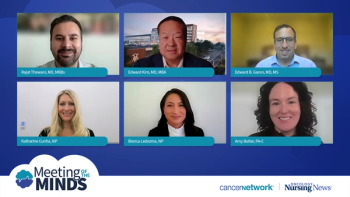
GI medical oncologists discuss MRD testing practices in colorectal cancer and provide insights on challenges associated with testing.

Your AI-Trained Oncology Knowledge Connection!


GI medical oncologists discuss MRD testing practices in colorectal cancer and provide insights on challenges associated with testing.

Robert A. Winn, MD, gives insight into how institutions and community practices can improve access to cancer care.

The panelists conclude their discussion by offering future perspectives on CLL treatment, emphasizing remaining areas of unmet needs in the treatment landscape.

A panel of oncology experts discuss recent advancements surrounding novel therapies for CLL, exploring their potential impact on future treatment paradigms.

Dr. Gregory Gan introduces Case 2, featuring an 82-year-old former smoker with poorly differentiated lung adenocarcinoma and a PD-L1 level of 85%, initiating a conversation on the role of a multidisciplinary approach to treatment and consideration factors for surgical and radiotherapy interventions.

Gregory Gan, MD, presents Case 1 involving a 72-year-old former smoker with Stage-IIIA NSCLC and a PD-L1 level of 90%, initiating a discussion on the treatment and management of the case.

Carey Anders, MD, offers insights into the BRIDGET trial, a study investigating the role of tucatinib in the prevention of secondary brain metastases in patients with advanced HER2-positive breast cancer.

Carey Anders, MD, examines strategies for treating stable and active brain metastases in individuals with advanced HER2-positive breast cancer, highlighting key data from the HER2CLIMB trial.

Carey Anders, MD, discusses the scenario of a 34-year-old patient diagnosed with HER2-positive breast cancer, who develops brain metastases after undergoing initial therapy with dual HER2 blockade.

Heather Moore, CPP, PharmD, presents a comprehensive summary of targeted therapies for HER2-positive breast cancer and provides expert insights into the management of adverse effects associated with these treatments.

Virginia Kaklamani, MD, offers clinical insights on treatment toxicity considerations in HR+ breast cancer, and the Oncology Brothers outline key takeaways from the discussion.

Medical oncologists provide comprehensive insights on the standard-of-care treatment practices for patients with advanced/metastatic HR+ breast cancer.

Arvind N. Dasari, MD, MS, provides clinical insights on MRD testing modalities, highlighting factors that inform the decision on which platform to use in practice.

The Oncology Brothers and Virginia Kaklamani, MD, outline the treatment algorithm for patients with locally advanced HR+ breast cancer.

Virginia Kaklamani, MD, joins Rohit Gosain, MD, and Rahul Gosain, MD, to discuss treatment paradigms for patients with early-stage HR+ breast cancer, highlighting the differences in treatment for premenopausal and postmenopausal patients.

A panel of medical oncologists introduce themselves and provide an overview of circulating tumor DNA (ctDNA) and how it relates to MRD (minimal residual disease) testing in colorectal cancer (CRC).

Patients with KRAS G12C-mutated non–small cell lung cancer who have brain metastases or intolerability of intravenous infusion may be more suitable to receive a small molecule inhibitor compared with chemotherapy, says Sandip P. Patel, MD.

Sameer A Parikh, MD, leads an expert discussion regarding emerging resistance data and its potential impact on treatment sequencing.

Sikander Ailawadhi, MD, review real-world data findings recently presented at ASH 2023, highlighting their potential implications on the treatment landscape.

University of Kansas experts offer guidance for community practitioners treating non-small cell lung cancer (NSCLC).

Dr. Reddy offers expert insights on employing concurrent immunotherapy with chemoradiotherapy, discussing the approach's role and drawing from recent data, such as results from the KEYNOTE-799, PACIFIC-6, and DOLPHIN studies, to inform treatment strategies.

Treatment with sotorasib or adagrasib appears to be more tolerable among patients with KRAS G12C-mutated non–small cell lung cancer compared with docetaxel, according to Sandip Patel, MD.

Susan Dent, MD, delves into treatment approaches for triple-positive breast cancer in the second-line and beyond, highlighting findings from the DESTINY-Breast03 trial.

Carey Anders, MD, and Susan Dent, MD, discuss the role of radiotherapy in patients with HER2-positive breast cancer and brain metastases.

A panel of oncology experts review meta-analysis data evaluating bleeding risk with covalent BTKis, discuss the impact of these data on treatment decision making, and explore strategies in managing BTKi-related bleeding risk.

Sikander Ailawadhi, MD, offers expert insight into managing the risk of atrial fibrillation in CLL patients receiving BTKis.

A group of experts in oncology investigates the feasibility of combination adjuvant immunotherapy in NSCLC consolidation, assessing the utilization of multiple immune checkpoint inhibitors and scrutinizing the rationale, with a focus on findings from the COAST study and PACIFIC-8 studies.

Vinay Raja, MD, explores the management of patients with Stage-III disease and actionable EGFR/ALK aberrations, as well as the treatment approach for patients with PD-L1 <1%.

Harold J. Burstein, MD, PhD, discusses the management of adverse events in patients with HER2+ breast cancer, and the Oncology Brothers provide closing thoughts on the entire discussion.

Medical oncologists discuss the various treatment options for patients with metastatic HER2+ breast cancer and where they fit into the treatment algorithm.