
Ongoing research may clarify the potential benefit of avelumab when administered in combination with other agents in advanced urothelial carcinoma.
Ongoing research may clarify the potential benefit of avelumab when administered in combination with other agents in advanced urothelial carcinoma.
Spatial analyses may help determine factors that influence responses to sacituzumab govitecan-containing regimens in urothelial carcinoma.
Adverse effects associated with oral azacitidine in low- or intermediate-risk MDS are typically transient, according to Mikkael A. Sekeres, MD, MS.
Attending educational sessions may help with understanding how to manage toxicities associated with enfortumab vedotin in rare genitourinary cancers.
Ongoing genomic profiling analyses in the ASC4FIRST trial may further determine which patients with CML may benefit from treatment with asciminib.
Byoung Chul Cho, MD, PhD, highlights ongoing trials assessing intravenous and subcutaneous amivantamab in EGFR-mutant non–small cell lung cancer.
An AI-based system may reduce the time needed to match patients with cancer to suitable clinical trials.
Surbhi Sidana, MD, provides clinical insights on treatment sequencing strategies for patients with relapsed/refractory multiple myeloma.
Experts on multiple myeloma provide their impressions of the CARTITUDE-4 and KarMMa-3 studies, which led to the approval of cilta-cel and ide-cel in earlier lines of treatment for patients with relapsed/refractory disease.
Myeloma specialists have a comprehensive discussion on CAR T-cell therapy, highlighting treatment selection considerations, adverse event management strategies, unmet needs, and ongoing research.
Myeloma specialists discuss clinical trials investigating CAR T-cell therapies in patients with relapsed/refractory disease.
This segment focuses on the key efficacy data on progression-free survival, response rates, and duration of response from MARIPOSA-2.
In this segment the panelist reviews the baseline patient and disease characteristics across the three treatment arms in MARIPOSA-2.
The use of CT scans may help practices adaptively plan and adjust radiotherapy courses for patients with non–small cell lung cancer.
Patients with NSCLC who have comorbidities or frailty may also be able to receive treatment with fewer toxicities via proton beam radiotherapy.
Terrence T. Sio, MD, MS, emphasizes multidisciplinary collaboration for treating patients with NSCLC who may require more than 1 type of therapy.
The panel discusses recent updates on bispecific antibodies for patients with relapsed/refractory multiple myeloma, highlighting studies investigating talquetamab, teclistamab, and elranatamab.
Focusing on later lines of therapy for patients with relapsed/refractory multiple myeloma, the panel provides key takeaways on the CARTITUDE-1 and KarMMa trials that investigated cilta-cel and ide-cel.
A panel of experts on multiple myeloma introduce themselves and discuss recent CAR T-cell therapy approvals in earlier treatment lines for patients with relapsed/refractory disease.
Yi Lin, MD, PhD, provides insights on the impact of CAR T-cell therapy on the evolving multiple myeloma treatment landscape.
This segment discusses the details of the phase 3 randomized MARIPOSA-2 trial design evaluating amivantamab plus chemotherapy vs amivantamab, lazertinib and chemotherapy vs chemotherapy alone in osimertinib-resistant EGFR-mutant NSCLC.
This segment introduces a discussion on the MARIPOSA-2 trial evaluating amivantamab plus chemotherapy or amivantamab, lazertinib and chemotherapy in EGFR-mutant NSCLC after osimertinib progression.
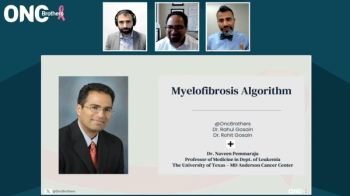
Naveen Pemmaraju, MD, discusses adverse effects associated with JAK inhibitors in the treatment of myelofibrosis, and the Oncology Brothers recap the entire discussion.
An expert on myelofibrosis discusses anemia and splenomegaly management practices for patients with myelofibrosis.
Naveen Pemmaraju, MD, gives a comprehensive overview of JAK inhibitors available for the treatment of patients with myelofibrosis.
A hematology specialist provides clinical insights on supportive care practices for patients with myelofibrosis.
Naveen Pemmaraju, MD, joins Rohit Gosain, MD, and Rahul Gosain, MD, to discuss diagnostic practices and prognostic factors for patients with myelofibrosis.
Rahul Banerjee, MD, FACP, discusses how the emergence of CAR T-cell therapy has impacted the multiple myeloma treatment landscape by addressing unmet needs and improving patients’ quality of life.
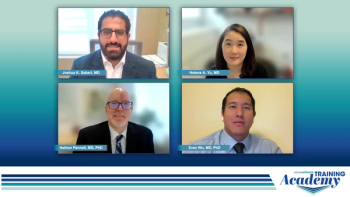
The expert panel concludes with thoughts on unmet needs and future perspectives on the treatment of patients with EGFR-mutated non–small cell lung cancer.
A panel of experts on multiple myeloma discuss the rationale for CAR T-cell therapy, highlighting BCMA as a target and treatment administration practices.