

An overview of the design and rationale for the phase 2 BRIDGET study looking at the addition of tucatinib to HER2-directed antibody therapy in breast cancer.
An overview of the design and rationale for the phase 2 BRIDGET study looking at the addition of tucatinib to HER2-directed antibody therapy in breast cancer.
An expert on metastatic breast cancer provides clinical insights gleaned from the HER2CLIMB-02 trial and discusses the design and rationale of the ongoing HER2CLIMB-05 study.
Following SABCS 2023, Carey K. Anders, MD, reviews recent updates from the KATHERINE and APHINITY clinical trials in HER2+ breast cancer.

The panelists conclude their discussion on HER2-positive breast cancer by underscoring the importance of preventive measures for brain metastases, enhanced strategies for managing leptomeningeal disease, and improved approaches to handle treatment-related toxicity.
Heather Moore, CPP, PharmD, shares expert insights on managing T-DXd-related adverse effects, including prophylactic measures for nausea and strategies for monitoring and management of ILD.
Rani Bansal, MD explores recent findings suggesting a risk of radiation necrosis in patients undergoing treatment with ADCs and concurrent radiotherapy for brain metastases and discusses the potential implications for future treatment approaches.

The use of a single-port robot may allow for surgically treating more patients with head and neck cancer in a more timely manner, according to Hilary McCrary, MD, MPH.
The expert panel provides a comprehensive overview of the COSMOS-CRC-03 study and touch on the importance of also looking at real-world data.
An overview of prospective trial data surrounding MRD testing in early-stage CRC and the impact of these findings on the overall treatment landscape.
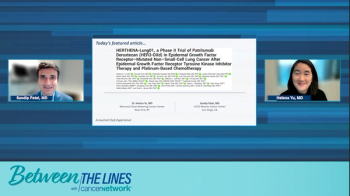
Expert medical oncologists examine remaining unmet needs in managing EGFR-positive lung cancer, including overcoming resistance to initial EGFR-directed therapy. The panel discusses ongoing trials targeting these needs.
Dr. Yu and Dr. Patel provide an overview of current standards and recent advances in the treatment landscape for EGFR-mutated NSCLC, emphasizing the critical role of comprehensive genomic profiling in guiding optimal therapy selection and sequencing.

Dr. Gregory Gan presents Case 4, featuring a 71-year-old diagnosed with Stage IIIA NSCLC experiencing pneumonitis following Chemo-IO treatment, prompting a discussion with expert insight on the monitoring and management of this condition.
Dr. Gregory Gan introduces Case 2, involving a 70-year-old former smoker with Stage IIIB NSCLC and a PD-L1 level of 10%, prompting discussion with emphasis on the importance of shared decision-making with the patient and their caregivers.
Benjamin Maughan, MD, PharmD, examines efficacy outcomes from the CLEAR trial of lenvatinib plus pembrolizumab vs sunitinib in metastatic clear cell RCC, including how overall survival, progression free survival, and response rates compare across different baseline tumor size groups.
Elizabeth Plimack, MD, discusses the long term follow up data from the Checkmate 214 study evaluating nivolumab plus ipilimumab versus sunitinib in first line treatment of clear cell renal cell carcinoma, including overall survival, progression free survival, response rates, and safety data.
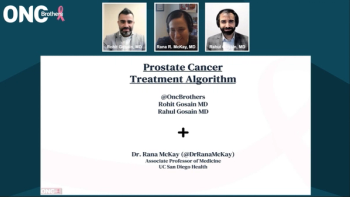
Focusing on patient-centered care, Rana R. McKay, MD, and the Oncology Brothers discuss the role of PSA and PSMA PET scans in guiding treatment for patients with prostate cancer.
Medical oncologists provide clinical insights on treatment paradigms for patients with castration-resistant prostate cancer, highlighting how next-generation sequencing informs treatment decisions.
The Oncology Brothers and Rana R. McKay, MD, have a comprehensive discussion on the treatment of patients with castration-sensitive prostate cancer.
Rana R. McKay, MD, joins Rohit Gosain, MD, and Rahul Gosain, MD, to discuss the treatment algorithm for patients with localized prostate cancer.
Rani Bansal, MD, discusses progressive developments in treating brain metastases in HER2-positive breast cancer, highlighting insights from the TUXEDO and DEBORAH trials, and examines the potential role of T-DXd in managing leptomeningeal disease.
Rani Bansal, MD, discusses the case of a 54-year-old post-menopausal patient who develops liver and brain metastases after undergoing prior therapy with trastuzumab/pertuzumab and T-DM1.
Heather Moore, CPP, PharmD examines the role of topical diclofenac gel in the management of hand and foot syndrome associated with capecitabine, highlighting key insights from the D-TORCH trial.
Heather Moore, CPP, PharmD, shares expert insights on the effective management of adverse effects related to tucatinib and other HER2 tyrosine kinase inhibitors (TKIs).

The AACR Health Disparities Report highlights the changes needed to achieve health equity for patients with cancer.
Michael Foote, MD, presents the case of a 50-year-old man with stage III colorectal cancer, highlighting the role of MRD testing in patient monitoring and treatment management.
GI medical oncologists discuss MRD testing practices in colorectal cancer and provide insights on challenges associated with testing.
Robert A. Winn, MD, gives insight into how institutions and community practices can improve access to cancer care.

The panelists conclude their discussion by offering future perspectives on CLL treatment, emphasizing remaining areas of unmet needs in the treatment landscape.
A panel of oncology experts discuss recent advancements surrounding novel therapies for CLL, exploring their potential impact on future treatment paradigms.
Dr. Gregory Gan introduces Case 2, featuring an 82-year-old former smoker with poorly differentiated lung adenocarcinoma and a PD-L1 level of 85%, initiating a conversation on the role of a multidisciplinary approach to treatment and consideration factors for surgical and radiotherapy interventions.