
Medical oncologists review updated data from the PAPILLON trial on amivantamab plus chemotherapy and discuss the treatment of patients with NSCLC with EGFR exon 20 insertions.
Medical oncologists review updated data from the PAPILLON trial on amivantamab plus chemotherapy and discuss the treatment of patients with NSCLC with EGFR exon 20 insertions.
In their closing remarks, the panel reflects on the presented patient cases and shares insights on the future of non-small cell lung cancer (NSCLC) treatment.
Medical experts explore the advantages and disadvantages of next-generation sequencing testing, highlighting the disparities in the quantity of tissue samples being sent for analysis, which can lead to inconclusive results when insufficient sample sizes are provided.
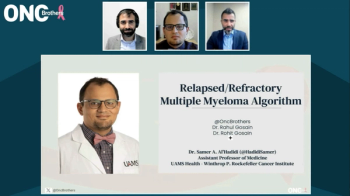
Samer Al'Hadidi, MD, offers advice to community oncologists who treat patients with relapsed/refractory multiple myeloma, and the Oncology Brothers recap the entire discussion.
Rohit Gosain, MD, and Rahul Gosain, MD, are joined by Samer Al'Hadidi, MD, to discuss treatment decision-making strategies for patients with relapsed/refractory multiple myeloma.
In a discussion with the Oncology Brothers on the treatment of patients with relapsed/refractory multiple myeloma, Samer Al'Hadidi, MD, discusses adverse effects associated with CAR T-cell therapy and bispecific antibodies.
An expert on the treatment of multiple myeloma discusses the role of CAR T-cell therapy in relapsed/refractory disease.
Samer Al'Hadidi, MD, discusses monitoring strategies for patients with relapsed/refractory multiple myeloma who are receiving lenalidomide.
An overview of the treatment landscape for patients with non–small cell lung cancer with EGFR exon 20 insertion mutations.
Following a review of the MARIPOSA-2 trial, experts on non–small cell lung cancer discuss treatment approaches in the second line.
The panel discusses adverse effects associated with stereotactic body radiation therapy, and the Oncology Brothers provide a recap of the entire discussion.
Focusing on liver-directed therapy, the panel provides clinical insights on the treatment of patients with hepatocellular carcinoma who have liver-confined disease and are not candidates for transplant.
Providing the interventional radiologist perspective, Harris Chengazi, MD, gives an overview of available treatment strategies.
Radiation oncologists Nina Sanford, MD, and Jeffrey M. Ryckman, MD, provide an overview of treatment modalities, highlighting SRS, SBRT, proton therapy, and how options have improved.
Estelamari Rodriguez, MD, MPH, presents a case of a 50-year-old African American woman, non-smoker, with pleural metastases; the panel discusses interstitial lung disease management, the use of antibody-drug conjugates, disease timing, and strategies for providing symptomatic relief, specifically considering drug holds if steroids only offer partial relief.
Christine Bestvina, MD, presents a case of a 34-year-old non-smoker diagnosed with Stage IIIA NSCLC after presenting with chest wall pain; the panel then explores their approaches to managing toxicities, including rashes and sores, by employing dose reductions and steroids to control adverse reactions.
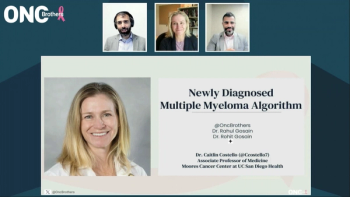
Caitlin Costello, MD, offers concluding remarks and guidance to healthcare providers on optimizing multiple myeloma patient care.
A medical expert shares her treatment approach for a high-risk multiple myeloma patient, considering transplant eligibility, dose escalations, and maintenance therapy based on induction regimen and patient risk factors.
Caitlin Costello, MD, shares insights on the role of minimal residual disease (MRD) assessment in the multiple myeloma treatment process, including its impact on induction therapy and disease monitoring.
A medical expert discusses tailoring treatment strategies for standard-risk and high-risk multiple myeloma patients, considering patient characteristics and transplant eligibility when selecting treatment combinations.
Caitlin Costello, MD, explores the evolving role of biomarkers in the early diagnosis and treatment of multiple myeloma, highlighting their impact on the changing landscape of the disease.
Focusing on the MARIPOSA trial, the panel provides thoughts the potential role of amivantamab and lazertinib, and discusses treatment decisions upon progression.
Medical oncologists review the FLAURA2 study looking at osimertinib with or without chemotherapy in EGFR-mutated NSCLC and discuss patients for whom they would consider the therapy.
Collaboration among nurses, social workers, and others may help in safely administering outpatient bispecific T-cell engager therapy to patients.
Immunotherapy may be an “elegant” method of managing colorectal cancer, says Gregory Charak, MD.

D. Ross Camidge, MD, PhD, spoke about how the approval of alectinib is the beginning of multiple other approvals for patients with ALK-positive NSCLC.
Nurses should be educated on cranial nerve impairment that may affect those with multiple myeloma who receive cilta-cel, says Leslie Bennett, MSN, RN.
Alexander Spira, MD, PhD, FACP, presents a case of a 45-year-old male with stage IV NSCLC, bone and liver metastases, and an EGFR exon 20 insertion; the panel then discusses their approach to treating brain metastases using stereotactic radiosurgery radiation therapy.
The panelists explore the importance of communicating with patients, nurses, and caregivers about potential adverse reactions and injection site reactions, while emphasizing the need to offer ongoing reassurance and support throughout the treatment journey.

Treatment with cilta-cel may give patients with multiple myeloma “more time,” according to Ishmael Applewhite, BSN, RN-BC, OCN.