
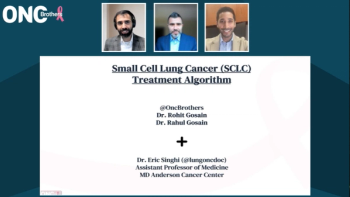
The Oncology Brothers and Eric Singhi, MD, provide clinical insights on the treatment of patients with small cell lung cancer with driver mutations.
The Oncology Brothers and Eric Singhi, MD, provide clinical insights on the treatment of patients with small cell lung cancer with driver mutations.
Eric Singhi, MD, joins the Oncology Brothers to discuss adverse event management practices for patients with small cell lung cancer.
Medical oncologists provide comprehensive insights on treatment practices for patients with extended-stage small cell lung cancer.
Following recent data from the ADRIATIC study, the Oncology Brothers and Eric Singhi, MD, discuss the role of prophylactic cranial irradiation (PCI) in patients with small cell lung cancer.
Eric Singhi, MD, joins the Oncology Brothers, Rahul Gosain, MD, and Rohit Gosain, MD, to discuss the treatment algorithm for patients with limited-stage small cell lung cancer (SCLC), highlighting the ADRIATIC study.
GI medical oncologists review recent findings from the INTERCEPT study evaluating the prognostic performance of circulating tumor DNA in clinical practice.
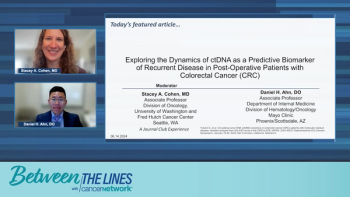
Stacey A. Cohen, MD, and Daniel H. Ahn, DO, discuss the role of circulating tumor DNA (ctDNA) as a biomarker in colorectal cancer and provide clinical insights on screening modalities.
A phase 1/2 trial assessed the use of menin inhibitor DSP-5336 in patients with acute leukemia overexpressing HOXA9 and MEIS1.
A phase 1 trial assessed the use of PSCA-directed CAR T cells in patients with metastatic castration-resistant prostate cancer.
A pooled analysis trial assessed the impact of acalabrutinib in patients with chronic lymphocytic leukemia across treatment lines.
Experts on multiple myeloma discuss the safety profile of DARA-VRd in patients with newly diagnosed multiple myeloma.
Samer Al'Hadidi, MD, provides an overview of recent updates presented at ASCO 2024 from the MajesTEC-1 trial evaluating teclistamab in patients with relapsed/refractory multiple myeloma.
Myeloma specialists provide comprehensive insights on key data from the PERSEUS trial evaluating MRD status in patients receiving DARA-VRd and VRd.
Hans Lee, MD, discusses recent updates from the MonumenTAL-2 study investigating talquetamab in patients with relapsed/refractory multiple myeloma.
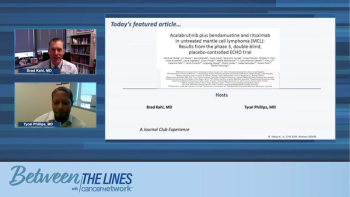
Medical experts evaluate unmet needs, key insights from the Phase 3 ECHO trial, and potential obstacles in integrating the findings into existing treatment protocols.
Medical experts analyze and provide insights on safety findings from the Phase 3 ECHO trial, offering their professional interpretations of the data.
The key opinion leaders share their approaches for communicating about circulating tumor DNA and minimal residual disease to patients, emphasizing the significance of ctDNA testing in detecting MRD.
Experts outline circulating tumor (ct) DNA analysis, detailing the two main techniques and their respective advantages and disadvantages.
Findings from a phase 1 study may inform future trial designs intended to yield longer responses with PSCA-targeted CAR T cells.
Experts on multiple myeloma provide clinical insights on unmet needs associated with CAR T-cell therapy, focusing on patient access across academic and community settings.
The panel provides clinical insights on talking with patients about complications associated with CAR T-cell therapy.
A phase 1 trial assessed the use of PSCA-directed CAR T cells in patients with metastatic castration-resistant prostate cancer.
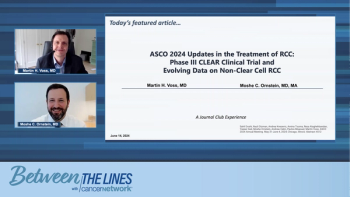
Key opinion leaders analyze the latest advancements and research findings specific to Non-Clear Cell Renal Cell Carcinoma presented at the American Society of Clinical Oncology 2024 conference.
Key opinion leaders examine the application of tyrosine kinase inhibitors (TKIs) and evaluate first-line therapeutic approaches for renal cell carcinoma.
Kamran Idrees, MD, MSCI, MMHC, FACS, discusses how factors such as vessel involvement can influence the decision to proceed with surgical therapy.
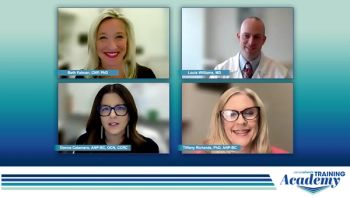
Continuing the discussion on supportive care strategies, the panel discusses the management of cytopenias and HLH/MAS following CAR T-cell therapy.
Experts on multiple myeloma provide clinical insights on supportive care strategies for patients experiencing infections or secondary malignancies following CAR T-cell therapy.
All patient populations benefitted from glofitamab in a phase 1/2 trial, but the design excluded capture of high-risk features present in similar studies.
Milad Baradaran, PhD, DABR, outlines the design of Mobetron as an option for administering intraoperative radiation therapy in pancreatic cancer care.
Amrita Y. Krishnan, MD, and Binod Dhakal, MD, discuss the clinical implications of data from MajesTEC-1 and provide key takeaways on the evolving relapsed/refractory multiple myeloma treatment landscape.