
The phase 3 RUBY trial evaluated dostarlimab in combination with carboplatin/paclitaxel in patients with primary advanced or recurrent endometrial cancer.
The phase 3 RUBY trial evaluated dostarlimab in combination with carboplatin/paclitaxel in patients with primary advanced or recurrent endometrial cancer.
Accelerated approval of afami-cel may expand access to therapy for patients who are unable to live near certain treatment centers.
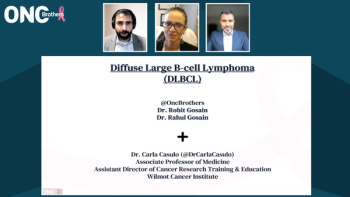
Medical oncologists conclude their discussion with a review of the toxicity profiles of treatments for diffuse large B-cell lymphoma.
Carla Casulo, MD, and the Oncology Brothers review the treatment algorithm for patients with relapsed/refractory DLBCL.
The Oncology Brothers and Carla Casulo, MD, discuss treatment practices for patients with stage III or IV diffuse large B-cell lymphoma.
A hematologist-oncologist joins the Oncology Brothers do discuss first-line treatment practices for patients with stage I or II diffuse large B-cell lymphoma.
Carla Casulo, MD, joins Rahul Gosain, MD, and Rohit Gosain, MD, to provide clinical insights on biopsy practices and discuss the importance of cell of origin in treating diffuse large B-cell lymphoma (DLBCL).
Panelists offer concluding perspectives on the future role of circulating tumor DNA in colorectal cancer management.
Treatment with afami-cel may offer improved quality of life to patients with metastatic synovial sarcoma compared with continuous chemotherapy.
The panel concludes its discussion with key takeaways on the evolving treatment landscape for multiple myeloma.
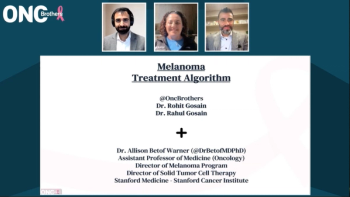
Allison Betof Warner, MD, PhD, and the Oncology Brothers share clinical insights on treatment decisions for patients with metastatic melanoma.
Medical oncologists provide comprehensive insights on neoadjuvant therapy options for patients with melanoma.
Allison Betof Warner, MD, PhD, joins Rahul Gosain, MD, and Rohit Gosain, MD, to discuss treatment practices for patients with stage IIB and beyond melanoma.
Medical professionals analyze gaps in current colorectal cancer patient care, with a focus on minimal residual disease testing.
The panel examines challenges in interpreting circulating tumor DNA results and their impact on clinical decision-making processes.
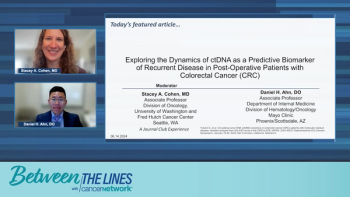
Stacey A. Cohen, MD, and Daniel H. Ahn, DO, share their key takeaways on the clinical utility of ctDNA in the treatment of patients with colorectal cancer.
Experts on colorectal cancer brainstorm ways to optimize clinical research on ctDNA and discuss patient perceptions of ctDNA testing.
Experts on multiple myeloma look to the future treatment landscape and discuss exciting updates presented at the 2024 ASCO Annual Meeting, highlighting belantamab mafodotin and combination therapies.
Samer Al'Hadidi, MD, provides a comprehensive overview of adverse event management practices for patients with multiple myeloma who receive CAR T-cell therapy.
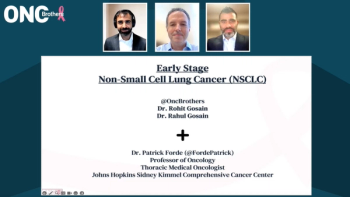
Patrick Forde, MBBCh, and the Oncology Brothers discuss treatment practices for patients with unresectable non–small cell lung cancer.
Medical oncologists share expert perspectives on treatment paradigms for patients with early-stage NSCLC and actionable mutations.
The Oncology Brothers and Patrick Forde, MBBCh, outline immunotherapy options for patients with non–small cell lung cancer and the role of PD-L1 in informing treatment decisions.
Patrick Forde, MBBCh, joins the Oncology Brothers, Rahul Gosain, MD, and Rohit Gosain, MD, to discuss treatment practices for patients with stage IB and beyond non–small cell lung cancer (NSCLC).
Medical professionals explore methods for integrating circulating tumor DNA results with radiographic and pathologic findings to optimize patient care.
The panel examines a clinical scenario, detailing their approach to circulating tumor DNA testing, including turnaround times, and providing insights on patient counseling.
A retrospective study sought to assess CRS and ICANS onset and duration, as well as non-relapse mortality causes in patients infused with CAR T-cell therapies.

Following a spirited debate, Joshua K. Sabari, MD, presents the winning team with the coveted title of victors of this CancerNetwork® Face-Off event.
Experts on non–small cell lung cancer reflect on clinical trial data to weigh treatment options for patients with EGFR-mutated non–small cell lung cancer.
Jyoti D. Patel, MD, and Rajat Thawani, MBBS, tackle the question of whether neoadjuvant therapies will replace surgery plus adjuvant treatment for patients with resectable non–small cell lung cancer.
Robert B. Cameron, MD, PhD, offers insights on a patient with KRAS G12C non–small cell lung cancer.