
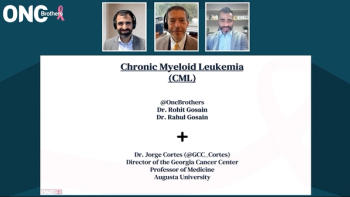
An expert on chronic myeloid leukemia provides clinical insights on treatment practices following progression.
An expert on chronic myeloid leukemia provides clinical insights on treatment practices following progression.
A hematologist-oncologist and the Oncology Brothers outline treatment paradigms for chronic phase CML and discuss patient monitoring practices.
Jorge Cortes, MD, joins Rahul Gosain, MD, and Rohit Gosain, MD, to discuss patient workup and risk stratification practices in chronic myeloid leukemia (CML).
Claire Saxton shares insights on how physicians and caregivers can best assist patients with CML who have switched therapies.
A panel of experts on chronic myeloid leukemia discuss common patient concerns, adverse effect considerations, and best practices for setting clear expectations.
Experts give an overview of long-term follow-up efficacy data from the MonumenTAL-1 study.
Medical experts give an overview of relapsed/refractory multiple myeloma, focusing on diagnosis and current management strategies
Medical oncologists discuss the overall research landscape in advanced EGFR-mutant NSCLC, highlighting exciting trials and emerging data in the evolving treatment space.
Martin Dietrich, MD, PhD, shares expert perspectives on recent data from TROPION-Lung05 and HERTHENA-Lung01 in advanced EGFR-mutant NSCLC.
Wade T. Iams, MD, provides clinical insights on proactive management strategies for patients receiving amivantamab for advanced EGFR-mutant NSCLC.
Focusing on treatment practices for patients with advanced EGFR-mutant NSCLC, Martin Dietrich, MD, PhD, discusses how the availability of subcutaneous amivantamab can potentially address current treatment barriers.
Wade T. Iams, MD, outlines insights gleaned from recently presented data from the PALOMA-3 trial in advanced EGFR-mutant non–small cell lung cancer.
Martin Dietrich, MD, PhD, discusses the secondary analysis from MARIPOSA evaluating first-line amivantamab plus lazertinib in patients with advanced EGFR-mutant NSCLC.
Following the 2024 ASCO Annual Meeting, medical oncologists share insights on how the availability of the FLAURA2 treatment regimen has impacted the treatment of patients with advanced EGFR-mutant non–small cell lung cancer (NSCLC).
Experts provide concluding insights on CAR-T cell therapy and offer their perspectives on the evolving treatment landscape for multiple myeloma, highlighting potential future directions and innovations in patient care.
A panel of experts examines the impact and potential of CAR T-cell therapy in earlier treatment lines for multiple myeloma, evaluating its efficacy, safety.
Multiple myeloma experts analyze recent developments in transplant-ineligible newly diagnosed multiple myeloma treatment, focusing on the latest updates presented at EHA 2024 and their potential impact on patient care.
Key opinion leaders evaluate the clinical implications of updated data presented at EHA 2024, interpreting how these findings may influence future treatment strategies in multiple myeloma.
Multiple myeloma specialists analyze recent findings presented at EHA 2024, offering expert perspectives on the PERSEUS and IsKIA clinical trials and their implications for patient care.
Medical experts explore the current standard of care and evolving treatment landscape for transplant eligible multiple myeloma, a complex hematological malignancy.
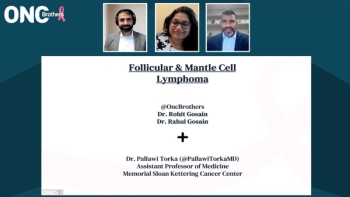
Pallawi Torka, MD, and the Oncology Brothers discuss the therapeutic landscape for patients with relapsed/refractory mantle cell lymphoma.
Focusing on the initiation of treatment for newly diagnosed patients with CML, Jorge E. Cortes, MD, details important factors to consider when starting treatment and Claire Saxton discusses strategies that optimize communication when considering treatment options.
Experts on chronic myeloid leukemia discuss how caregivers can collaborate with the health care team and support newly diagnosed patients.
A hematologist-oncologist provides comprehensive insights on the treatment of newly diagnosed patients with mantle cell lymphoma.
The Oncology Brothers and Pallawi Torka, MD, review treatment options for patients with relapsed/refractory follicular lymphoma.
Joannie Clements, a patient advocate, provides insights on helping newly diagnosed patients with CML and their caregivers navigate the complexities of diagnosis, and Claire Saxton outlines resources available for them.
A panel of experts on introduce a discussion on chronic myeloid leukemia (CML) with an overview of the disease, focusing on its subtypes and characteristics.
Pallawi Torka, MD, joins the Oncology Brothers to discuss patient workup and treatment practices in follicular lymphoma, highlighting the PRIMA study and the role of maintenance therapy.
Ritu Salani, MD, discussed investigational endometrial cancer treatment options for patients with varying subtypes of endometrial cancer.
The second interim analysis of the phase 3 RUBY trial found the safety profile was consistent with the first interim analysis and no new deaths due to AEs were observed.