
Hematologist-oncologists discuss GPRC5D-targeting treatments that are currently in development for patients with relapsed/refractory multiple myeloma.
Hematologist-oncologists discuss GPRC5D-targeting treatments that are currently in development for patients with relapsed/refractory multiple myeloma.
Focusing on the MonumenTAL-1 study, Mary Steinbach, APRN, provides clinical insights on nail, skin, and oral toxicities associated with talquetamab.
Noopur Raje, MD, shares clinical perspectives on her experience treating patients with prior BCMA bispecific exposure and provides insights on adverse event management practices in patients receiving talquetamab.
Lisa Hwa, APRN, DNP, CNP, FAPO, describes the unique challenges in managing adverse events associated with GPRC5D therapy compared with other bispecifics.
The panel concludes its discussion with insights on challenges and unmet needs in the CML treatment landscape, highlighting ways to better support patients and caregivers.
CancerNetwork co-hosts Kristie L. Kahl and Andrew Svonavec highlight abstracts to look out for surrounding the multidisciplinary approach at the upcoming ESMO Congress in Barcelona, with some additional tidbits to round out the main event.
Experts explore additional toxicities observed with B-cell maturation antigen–targeting bispecifics, such as infections, neurotoxicity, and hematological issues, and discuss how these are managed in practice.
Experts explain the administration of step-up and treatment doses for GPRC5D at your institution, including whether they are given in clinic or in the community, and will discuss how patients are monitored for cytokine release syndrome and immune effector cell–associated neurotoxicity syndrome during the step-up phase.
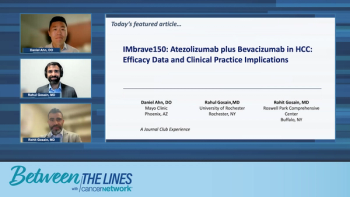
Key opinion leaders share their impressions of the IMBrave150 trial data and discuss their real-world clinical experiences using atezolizumab plus bevacizumab in practice.
The panel presents the latest safety and efficacy updates from the IMbrave 150 trial.
Alessio Pigazzi, MD, PhD, FACS, FASCRS, provides advice for upcoming surgeons starting out in the colorectal cancer field.
Alessio Pigazzi, MD, PhD, FACS, FASCRS, discussed how robot-assisted surgery for colorectal cancers has evolved over the past 20 years.
Medical experts discuss streamlining referrals to reduce treatment delays, optimizing resources, comparing outcomes in collaborative vs noncollaborative settings, and managing patient reluctance about academic center referrals.v
Medical experts highlight the critical role of collaboration between academic and community physicians in managing multiple myeloma, focusing on coordinating care, maintaining communication, and ensuring centers are prepared for patient transitions.
Alessio Pigazzi, MD, PhD, FACS, FASCRS, discussed surgical and medical oncology developments in the colorectal cancer field.
Medical experts explore the main challenges in treating non–clear cell RCC compared with clear cell RCC, discussing how these difficulties vary between community and academic settings.
Medical experts give an overview of renal cell carcinoma (RCC), detailing the differences between clear cell and non–clear cell subtypes, the various forms of non–clear cell RCC, and the demographic and risk factor profiles associated with each subtype, while also discussing how histological differences influence prognosis.
Larysa J. Sanchez, MD, discusses recent efficacy data presented at EHA 2024 from the long-term follow-up results of the phase 1/2 MonumenTAL-1 study investigating talquetamab in relapsed/refractory multiple myeloma.
A panel of experts on multiple myeloma discuss the importance of GPRC5D as a target of interest in relapsed/refractory disease and discuss their experiences with talquetamab in clinical practice.

Antibody-drug conjugates and small molecule inhibitors may show utility in the neuro-oncology field, according to Nader Sanai, MD.
Experts on chronic myeloid leukemia delve into the important role of informed shared decision-making in the optimal treatment of patients with CML.
Jorge E. Cortes, MD, details clinical scenarios that indicate a need to switch therapies for patients with chronic myeloid leukemia.
The phase 3 Gliofocus trial aims to meaningfully improve survival and quality of life with niraparib among patients with newly diagnosed glioblastoma.
Findings from a proof-of-concept study show a potential survival benefit with niraparib/radiotherapy in patients with newly diagnosed glioblastoma.
Experts address the unique challenges in managing adverse events associated with GPRC5D therapies compared to other cancer treatments, while Samantha will discuss strategies for preparing and educating patients undergoing GPRC5D therapy.
Experts give an overview of safety data from the MonumenTAL-1 study.
Ellen Marin, PA-C, provides an overview of adverse effects associated with BCMA-directed bispecific therapy in multiple myeloma.
Surbhi Sidana, MD, spoke about multiple myeloma developments with the potential to impact clinical practice, particularly early line use of bispecific antibodies.
A panel of experts on multiple myeloma discuss long-term follow-up data from the MajesTEC-1 and MagnetisMM-3 clinical trials.
The panel analyzes how patient characteristics from the IMbrave 150 trial compare to those in other hepatocellular carcinoma studies.