
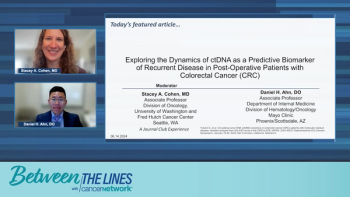
Medical oncologists discuss whether ctDNA clearance can serve as an acceptable surrogate end point in the treatment of patients with colorectal cancer.
Medical oncologists discuss whether ctDNA clearance can serve as an acceptable surrogate end point in the treatment of patients with colorectal cancer.
Experts from Vanderbilt University Medical Center emphasize gathering a second opinion to determine if a tumor is resectable in patients with pancreatic cancer.
Following ASCO 2024, Samer Al'Hadidi, MD, discusses recent updates from the PERSEUS trial evaluating the role of testing for minimal residual disease (MRD) in guiding treatment for relapsed/refractory multiple myeloma.
Experts on multiple myeloma provide comprehensive insights on treatment spacing and step-up dosing practices and discuss the long-term utilization of bispecific antibodies.
Experts from Vanderbilt University Medical Center discuss the use of intraoperative radiation therapy in a 64-year-old patient with pancreatic cancer.
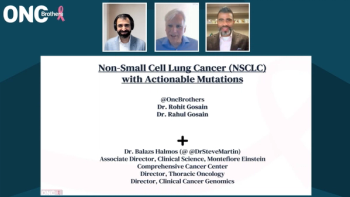
Balazs Halmos, MD, and the Oncology Brothers discuss therapeutic practices for patients with NSCLC, highlighting how MET exon 14 skipping mutations and RET rearrangements inform treatment decisions.
The Oncology Brothers and Balazs Halmos, MD, provide clinical insights on therapeutic options for patients with NSCLC with rare mutations, including ROS1, BRAF V600E, and NTRK.
Medical oncologists discuss therapeutic practices for patients with non–small cell lung cancer with ALK mutations.
A thoracic medical oncologist provides insights on the treatment of patients with non–small cell lung cancer with uncommon EGFR mutations.
Key opinion leaders evaluate the selection of available assays and platforms in relation to specific clinical objectives.
Medical experts examine how recent data on circulating tumor DNA-based minimal residual disease testing may impact the clinical management and treatment of colorectal cancer.
Balazs Halmos, MD, joins the Oncology Brothers, Rahul Gosain, MD, and Rohit Gosain, MD, to discuss the treatment algorithm for patients with non–small cell lung cancer (NSCLC) with common sensitizing EGFR mutations.
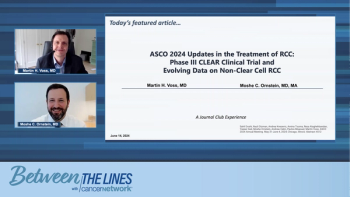
Medical experts in renal cell carcinoma provide an overview of abstract 4512 presented at ASCO 2024.
The expert panel explores predictors of chromophobe renal cell carcinoma recurrence and other critical factors that inform treatment decisions for patients.
Although no responses were observed in 11 patients receiving abemaciclib monotherapy, combination therapies with abemaciclib may offer clinical benefit.
Daniel H. Ahn, DO, and Stacey A. Cohen, MD, engage in a comprehensive discussion on recent findings from the GALAXY study in CIRCULATE-Japan.
Experts on colorectal cancer share insights on optimizing the frequency of ctDNA detection and discuss potential ways to overcome challenges associated with MRD detection.
Findings show no difference in overall survival between various treatments for metastatic RCC previously managed with immunotherapy and TKIs.
An epigenomic profiling approach may help pick up the entire tumor burden, thereby assisting with detecting sarcomatoid features in those with RCC.
The expert panel shares clinical insights on sequencing CAR T-cell therapies and bispecific antibodies for patients with relapsed/refractory multiple myeloma.
Naresh Bumma, MD, and Hans Lee, MD, recap recent updates on the MagnetisMM-30 an MagnetisMM-32 studies investigating elranatamab, a BCMA-directed bispecific antibody.
Frits van Rhee, MD, PhD, and Cesar Rodriguez, MD, provide key takeaways on findings from the PERSEUS trial and discuss unmet needs that remain in the multiple myeloma treatment landscape.

Investigators are assessing the use of IORT in patients with borderline resectable or unresectable pancreatic cancer as part of the phase 2 PACER trial.
Key opinion leaders analyze recent findings from the BESPOKE study.
The panel examines recent studies from the INTERCEPT program investigating the utility of circulating tumor DNA (ctDNA) for minimal residual disease (MRD) detection in colorectal cancer (CRC).
Renal cell carcinoma specialists provide a comprehensive overview of chromophobe renal cell carcinoma (ChRCC), including its definition, background, and distinctive characteristics.
Key opinion leaders examine the Phase II PAPMET clinical trial, focusing on its design and progression-free survival outcomes.

The panel concludes its discussion with insights on practices for educating health care teams on CAR T-cell therapy administration, highlighting the evolving role of advanced practice providers.

The panel concludes by offering key takeaways on the treatment of patients with relapsed/refractory multiple myeloma who receive CAR T-cell therapy.

The approval for epcoritamab in patients with R/R follicular lymphoma was supported by encouraging efficacy findings from the phase 1/2 EPCORE NHL-1 trial.