
Drs. Gupta and Brown share their thoughts on the next steps that can aid in uptake of maintenance therapy in different tumor types.
Drs. Gupta and Brown share their thoughts on the next steps that can aid in uptake of maintenance therapy in different tumor types.
At ASH 2021, CancerNetwork® spoke with Ruben Mesa, MD, of UT Health San Antonio MD Anderson Cancer Center, about which data he is most excited to see for patients with myelofibrosis.
Shared insight on how best to discuss maintenance therapy with patients being treated for metastatic urothelial carcinoma.
Panelists consider whether the use of maintenance therapy is as prevalent after complete response or in patients with lesser PD-L1 expression.
CancerNetwork® spoke with Rafael Fonseca, MD, about real-world use of daratumumab-containing regimens as either frontline or second-line therapy for transplant-ineligible multiple myeloma.
Nina Shah, MD, discusses the potential therapies that could emerge in 2022 for multiple myeloma.
Susan M. O’Brien, MD, on potential upcoming approvals in 2022 for treating chronic lymphocytic leukemia with combination therapies.
Nina Shah, MD, looks to the future of treating patients with multiple myeloma.
At ASH 2021, CancerNetwork® spoke with Ruben Mesa, MD, of UT Health San Antonio MD Anderson Cancer Center, about which presentation from the conference could be practice changing for patients with myelofibrosis.
Susan M. O’Brien, MD, on upcoming 2022 trends in chronic lymphocytic leukemia treatment.
Nina Shah, MD, discusses maintenance therapies in emerging clinical trials for multiple myeloma.
Susan M. O’Brien, MD, on why clinical trial enrollment is so important for patients with chronic lymphocytic leukemia.
Luciano Costa, MD, PhD, spoke about the potential application of daratumumab, carfilzomib, lenalidomide, and dexamethasone for multiple myeloma in a real-world setting.
At ASH 2021, CancerNetwork® spoke with Ruben Mesa, MD, of UT Health San Antonio MD Anderson Cancer Center, about FDA approvals for myelofibrosis that may impact the standard of care.
Nina Shah, MD, discusses some of the important phase 3 trials to emerge from the previous year in multiple myeloma.
Nina Shah, MD, touched on novel immunotherapies and other emerging therapies for patients with multiple myeloma.
Susan M. O’Brien, MD, highlights ongoing trials from 2021 examining combination therapies for patients with chronic lymphocytic leukemia.
Matthew S. Davids, MD, spoke about which abstracts presented at ASH 2021 he felt were most important.
Nina Shah, MD, details the process to choose optimal therapeutic options for patients with relapsed/refractory multiple myeloma.
Nina Shah, MD, on BCMA-directed treatments for patients with multiple myeloma.
Susan M. O’Brien, MD, discusses novel mechanisms of action and BTK inhibitors for patients with chronic lymphocytic leukemia.
Nina Shah, MD, discussed how adverse events impact treatment decision-making for patients with multiple myeloma.
Lindsey Roeker, MD, spoke about data presented at ASH 2021 and what she thought to be most interesting.
Drs Orenstein and Braun close out the program by examining unmet needs in the advanced renal cell carcinoma treatment space, as well as emerging options.
A panel of experts explain what they do within their clinical practices to select second- or later-line therapies for patients with advanced renal cell carcinoma.
Neeraj Agarwal, MD, and Simon Chowdhury, MD, examine the efficacy and safety data presented in the recent publication, “Apalutamide in Patients with Metastatic Castration-Sensitive Prostate Cancer: Final Survival Analysis of the Randomized, Double-Blind, Phase III TITAN Study.”
Susan M. O’Brien, MD, on common toxicities and adverse effects when treating patients with chronic lymphocytic leukemia.

Dr. Atish Choudhury provides an overview of advances and changes in management of patients with metastatic castration sensitive prostate cancer (mCSPC) in the last decade.
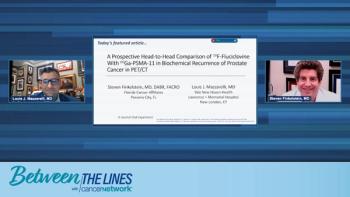
Drs Steven Finkelstein and Louis J. Mazzarelli comment on limitations associated with conventional imaging modalities in prostate cancer and highlight the roles of newer tests such as 18F-fluciclovine and 68Ga-PSMA-11.
Daniel Petrylak, MD and Donald Barry Boyd, MD, MS, examine real-world data presented in the recent publication, “Avelumab first-line maintenance in locally advanced or metastatic urothelial carcinoma: Applying clinical trial findings to clinical practice.”