
Impressions of the case of a 51-year-old man with newly diagnosed multiple myeloma and considerations that impact candidacy for an autologous stem cell transplant.
Impressions of the case of a 51-year-old man with newly diagnosed multiple myeloma and considerations that impact candidacy for an autologous stem cell transplant.

Looking forward, Andrzej Jakubowiak, MD, PhD, anticipates CAR T-cell therapy with ciltacabtagene autoleucel will establish its place across various indications for multiple myeloma.
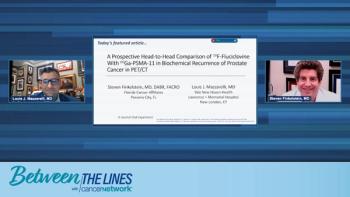
Drs Steven Finkelstein and Louis J. Mazzarelli highlight data revealed in the article “A Prospective Head-to-Head Comparison of 18F-Fluciclovine With 68Ga-PSMA-11 in Biochemical Recurrence of Prostate Cancer in PET/CT,” by Birgit Pernthaler, et al.
Yael Cohen, MD, sat down with CancerNetwork® to spotlight a number of promising treatments that are under investigation for patients with heavily-pretreated multiple myeloma.
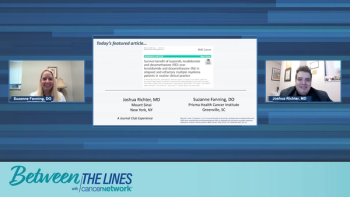
Multiple myeloma experts share background for discussion of the recent publication, “Survival benefit of ixazomib, lenalidomide and dexamethasone [IRD] over lenalidomide and dexamethasone [Rd] in relapsed and refractory multiple myeloma patients in routine clinical practice.”
Genitourinary oncology experts discuss clinical trials of maintenance therapy for urothelial carcinoma and their clinical impacts.
CancerNetwork®, sat down with Yael Cohen, MD, to discuss the research that lead up to the phase 2 CARTITUDE-2 trial, examining the use of ciltacabtagene autoleucel for those with lenalidomide–refractory multiple myeloma
Closing their discussion on metastatic urothelial carcinoma, panelists reflect on novel agents and the future treatment paradigm.
Expert perspectives on the selection of second-line therapy after a patient has progressed on maintenance avelumab.
Neeraj Agarwal, MD, and Simon Chowdhury, MD, comment on the secondary end points from the final analysis of the TITAN trial.
Lindsey Roeker, MD, spoke about identifying the correct population of patients with chronic lymphocytic leukemia who will benefit from umbralisib and ublituximab plus ibrutinib.
CancerNetwork® spoke with Rafael Fonseca, MD, about findings from a simulation using real-world data sets to compare the utility of daratumumab-containing regimens as either frontline or second-line therapy.
At ASH 2021, CancerNetwork® spoke with Ruben Mesa, MD, of UT Health San Antonio MD Anderson Cancer Center, about key takeaways learned in the treatment of myelofibrosis during 2021.
In an interview at the 2021 ASH Annual Meeting, Andrzej Jakubowiak, MD, PhD, dives into response outcomes in different patient subsets of the phase 1/2b CARTITUDE-1 trial of ciltacabtagene autoleucel for relapsed/refractory multiple myeloma.
At ASH 2021, CancerNetwork® spoke with Ruben Mesa, MD, of UT Health San Antonio MD Anderson Cancer Center, about clinical trials and treatments being utilized in 2022.
Matthew S. Davids, MD, MMSc, spoke about using venetoclax plus acalabrutinib in the phase 3 MAJIC study for patients with chronic lymphocytic leukemia or small lymphocytic lymphoma.
Drs Agarwal and Chowdhury analyze the survival data from the phase 3 TITAN study of apalutamide in men with mCSPC.
Experts discuss the changing field of advanced urothelial carcinoma and consider sequencing of therapy.
At the 2021 ASH Annual Meeting, Yelena Ginzburg, MD, spoke about presentations she found most groundbreaking.
At ASH 2021, CancerNetwork® spoke with Ruben Mesa, MD, of UT Health San Antonio MD Anderson Cancer Center, about recommendations to healthcare providers about enrolling their patients into clinical trials for myelofibrosis.
Focused discussion on the duration of maintenance avelumab for metastatic urothelial carcinoma and considerations for switching therapy.
A brief review of whether FGFR status in metastatic urothelial carcinoma should impact treatment approaches.
In an interview at the 2021 ASH Annual Meeting, Andrzej Jakubowiak, MD, PhD, describes how CAR T-cell therapy for patients with heavily pretreated myeloma has the potential significantly impact response and survival outcomes.
Lindsey Roeker, MD, spoke about phase 2 trial results which demonstrated efficacy of the combination of umbralisib and ublituximab added to ibrutinib for patients with chronic lymphocytic leukemia.
At ASH 2021, CancerNetwork® spoke with Ruben Mesa, MD, of UT Health San Antonio MD Anderson Cancer Center, about phase 3 trial results regarding myelofibrosis that he is most excited about.
In an interview at the 2021 ASH Annual Meeting, Andrzej Jakubowiak, MD, PhD, talks about daratumumab-based quadruplet therapies being evaluated in clinical trials and the potential impact they’ll have on the multiple myeloma treatment landscape.
Drs Donald Barry Boyd and Daniel Petrylak consider the advantages and disadvantages of checkpoint inhibitor maintenance therapy in advanced urothelial carcinoma.
Experts provide clinical pearls to the audience on treating patients with breast cancer.
The panelists share their insights on managing toxicities and special considerations in the treatment of HER2+ breast cancer.
Lindsey Roeker, MD, spoke about using a combination that includes a Bruton tyrosine kinase inhibitor, PI3K inhibitor, and an anti-CD20 monoclonal antibody for patients with chronic lymphocytic leukemia.