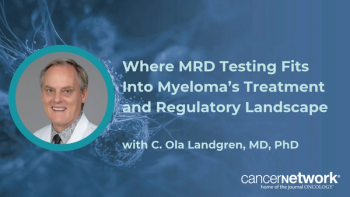
C. Ola Landgren, MD, PhD, discusses the FDA’s endorsement of MRD as an accelerated approval end point in multiple myeloma.
Properly training staff members and ensuring patient education are critical to ensuring the outpatient use of bispecific antibodies in the community setting.
Following the 2026 National ICE-T (Immune Cell Effector Therapy) Conference in Charlotte, North Carolina, Prerna Mewawalla, MD, spoke with CancerNetwork® about important considerations for administering bispecific antibodies to those with multiple myeloma in the outpatient setting. She spoke in the context of a presentation she gave at the meeting that explored the current landscape of bispecifics in this patient population.1
According to Mewawalla, prophylactic tocilizumab (Actemra) may assist with mitigating cytokine release syndrome (CRS) while ensuring efficient outpatient therapy with bispecific antibodies. She pointed to findings from a study demonstrating the feasibility of administering reduced doses of tocilizumab to manage CRS and limit potential costs of outpatient care. Additionally, she emphasized forming strong standardized operating procedures (SOPs), sufficiently training staff members, and educating patients and caregivers to facilitate outpatient therapy with bispecifics.
Mewawalla is an associate professor at Drexel University College of Medicine and director of stem cell transplant and cellular therapy and medical director of apheresis at Allegheny Health Network.
Transcript:
When it comes to moving bispecifics outpatient, prophylactic [tocilizumab] will go a long way because it significantly decreases your CRS rates to less than 15%. In fact, there was a paper published from the Memorial Sloan Kettering Cancer Center group that showed that using half the dose of [tocilizumab]—instead of our 8 [mg/kg], using 4 [mg/kg]—was able to mitigate CRS in these patients.2 It would significantly improve the cost of using [tocilizumab] outpatient as well and get these patients into the community.
There are other things to go about to get bispecifics in the community; all the sites have to be REMS [Risk Evaluation and Mitigation Strategy] certified. At our network, we have been able to move bispecifics to all our community infusion sites within an hour of our academic site by making sure all the staff are trained, the caregiver is trained, and the patients are very educated. We have a call number. There’s one number that patients have to call if they do develop CRS or any symptoms at all. It’s so important to have well-defined SOPs while also choosing which patients can get ramp-up [dosing] outpatient. All these things together will truly get bispecifics out in the community.