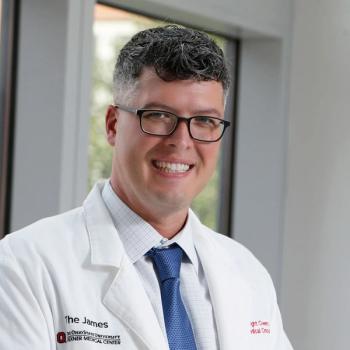
"As we combine more treatments…they have overlapping toxicities, and they may have the ability to synergize in a negative way," said Dwight H. Owen, MBBCh, MS.

“If it is successful, you should be able to access this combination wherever you are,” said Natalie S. Callander, MD, of the UW Carbone Cancer Center.
T-cell redirecting therapies, including chimeric antigen receptor (CAR) T-cell therapy and bispecific antibodies, have transformed the treatment of relapsed/refractory multiple myeloma. However, patients whose disease progresses after these therapies have few effective options, and conventional combinations often provide only brief disease control.
At the Big Ten Cancer Research Consortium (Big Ten CRC) Summit, CancerNetwork® spoke with Natalie S. Callander, MD, a professor in the Division of Hematology, Medical Oncology and Palliative Care at the University of Wisconsin–Madison and director of the UW Carbone Cancer Center Myeloma Clinical Program. She discussed the phase 1b/2 BTCRC-MM21-528 trial (NCT07479979), which is evaluating selinexor (Xpovio), carfilzomib (Kyprolis), subcutaneous isatuximab (Sarclisa), and dexamethasone (SCID) in this population.1 Callander described:
Callander: What has happened in the past 30 years in multiple myeloma has really been a revolution in therapeutic options. We did not have anything for many years. If you go back to 1960, we had melphalan and a drug called cyclophosphamide, and we had nothing more for almost 40 years after that. Stem cell transplants came around in the 1990s, but it was the serendipitous discovery of thalidomide in the late 1990s that broke things open.
Particularly in the last 15 years, we have had the development of proteasome inhibitors such as bortezomib and carfilzomib, and of other IMiD [immunomodulatory] drugs like lenalidomide and pomalidomide. A very important approach has been to target a receptor called CD38. CD38 is found on B cells, T cells, and natural killer cells, and it is quite important in the function of these cells, not only in communication with other cells but also in antibody production by B cells. In the early 2000s, there were competing efforts at drug development targeting CD38. One product was daratumumab; the other was isatuximab. Isatuximab fell by the wayside to a certain extent because it did not have a subcutaneous formulation, only a long intravenous infusion, even though there are in vivo and in vitro data suggesting that isatuximab is the superior CD38 antibody.
One of the newest frontiers is T-cell redirecting therapies, such as CAR T-cell therapy and bispecific engagers. However, once a patient relapses after those therapies, their options are quite limited. Recent studies show that if you use conventional drug combinations, the median progression-free survival, or the time before you need another therapy, is about 3 months. So we thought we needed to take some of our best drugs and put them together.
The exportin 1 inhibitor selinexor is very important here, because one theory about why patients become resistant to T-cell redirecting therapies is that their T cells are exhausted or not functioning properly, and there is some interesting information suggesting that selinexor may be able to restore some of that function. Some of these drugs had been combined before as doublets, but we thought putting all 4 together with the steroid made logical sense to test, particularly in a population that is very hard to treat once they relapse.
The availability of this subcutaneous device, called an on-body injector, is a great innovation for a couple of reasons. Isatuximab used to be about a 2-hour infusion. For nurses, the device is quite easy to use. It is a fixed dose, so one vial goes in. It is a little circle that almost looks like a thermostat in your house. You take off the tape, a very small needle goes into the abdominal wall, and the dose is injected over 5 to 10 minutes.
I have had patients who have received this device vs a shot of the other CD38 antibody, and this wins hands down. Our patients on the study have liked it a lot so far. Because of that, it was actually very
One of the concerns is that if you have been treated before with an anti-CD38 antibody, and a lot of patients have, you can lose that receptor for a period of time. So we built in a refractory period of about 6 months. Based on some in vitro data, we felt that 6 months after the last dose of an anti-CD38 antibody, patients would be receptive to it again.
The population we are targeting has relapsed and refractory disease; in myeloma, refractory means that you are progressing on, or within 60 days of, your last therapy. Of the 3 patients we have enrolled so far, the median number of prior lines of therapy is 7, and most of these individuals have had myeloma for at least 10 years. All of them have received BCMA [B-cell maturation antigen]–targeted therapy and progressed on it. This is a hard-to-treat population, and we think it is very representative.
We also know that patients with 1q amplification, meaning 4 or more copies, or 1q gain, meaning 3 copies, can be harder to treat, and there are data regarding isatuximab's efficacy in that population. So again, we think this combination makes sense in these very hard-to-treat individuals.
That question hits the nail on the head. We are going to see more and more T-cell redirecting therapies moved up front, and we think they may produce longer periods of disease control as initial therapy. But we know that if you take one of these T-cell redirecting therapies and follow it with another as the next line of treatment, the second often does not work. So we definitely need more powerful regimens, like the SCID regimen, we believe, to help this group of patients who are going to need more options in the future.
There is so much more to learn about how to treat many hematologic malignancies, and myeloma is one. There is sometimes the attitude that it is not worthwhile looking at other ideas or going back to drugs we already have, but there is always the opportunity to take the tools we have and combine them.
The other thing we like about this protocol is that if it turns out to be helpful, these drugs are going to be accessible to everybody. It is not going to be available only in an academic center, and you will not have to be at a transplant center. If it is successful, you should be able to access this combination wherever you are.