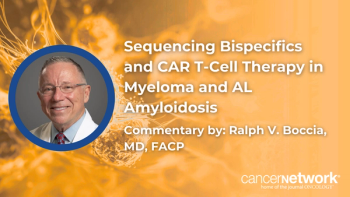
Ralph V. Boccia, MD, FACP, discusses CAR T and bispecific sequencing, fixed-duration therapy, MRD, and bispecifics in AL amyloidosis.
Aminolevulinic acid plus red lamp therapy was given an sNDA by the FDA for the treatment of superficial basal cell carcinoma.
A supplemental new drug application (sNDA) has been accepted by the FDA for aminolevulinic acid hydrochloride (Ameluz) plus RhodoLED red light lamp series for patients with superficial basal cell carcinoma, according to a press release from Biofrontera.1
A Prescription Drug User Fee Act date of September 28, 2026, has been set by the FDA. This treatment, if approved, would offer clinicians and patients a noninvasive option that is aligned with real-world practice needs.
“We are proud of the investments we continue to make in this specialty. This milestone represents an important step forward in our strategy to expand the clinical utility of [aminolevulinic acid hydrochloride] and reinforce photodynamic therapy as a versatile platform in dermatology. The FDA’s acknowledgment of no filing deficiencies in our sNDA reflects the strength of the data package and allows us to move forward with confidence toward a potential new indication that addresses a meaningful unmet medical need,” said Hermann Luebbert, PhD, CEO of Biofrontera.
A phase 3 trial (NCT03573401) assessed 145 patients with photodynamic therapy (PDT) plus 10% aminolevulinic acid (ALA) gel vs 42 patients who received PDT plus a vehicle.2 Overall, the median age at inclusion was 64 years, 58.3% of patients were male, and 100% were White. The location of the main target lesion included 2.1% on the face/scalp, 52.4% on the neck/trunk, and 45.5% on the extremities.
The primary end point was the composite clinical and histological clearance of main target lesions at the histological or clinical assessment. Secondary end points included clearance of main target lesions, participant complete clinical clearance, and participant complete clearance.
After the last cycle of PDT, the clearance rates of the main target lesions were 83.4% with the gel and 21.4% with the vehicle (P < .0001). Similar results were also observed for histological clearance, with 75.9% for the gel and 19.0% for the vehicle (P < .0001). Additionally, the composite clinical and histological clearance rates were 65.5% and 4.8% (P < .0001).
The study results found that in the gel group, the clinical and histological clearance was independent of the lesion location, with the neck/trunk being 83.3% vs 72.2%, respectively, and the extremities being 83.1% vs 78.9%, respectively. Of note, the baseline size of main target lesions did affect clearance rates, with clinical clearance of 90.7% at 81 mm2 or less, 88.0% at 84 to 160 mm2, and 73.1% at 165 mm2 or more; histological clearance was 86.0%, 74.0%, and 69.2% at the same values.
After the completion of the first PDT cycle, 57.2% of patients with main target lesions were treated with the gel compared with 14.3% who were given the vehicle and showed complete clinical clearance (P < .0001).
Esthetic outcomes showed that 89.3% of lesions treated with the gel were good or very good compared with 58.0% in the vehicle group. Patients also rated their satisfaction with the esthetic outcomes as very good or good, with 88.1% vs 74.0% for the gel and the vehicle, and 95.0% vs 100%, respectively, would choose the treatment again.
The most common treatment-emergent adverse effects included application site pain (95.2% vs 28.6%), application site erythema (69.0% vs 35.7%), application site pruritus (50.3% vs 26.2%), application site edema (29.0% vs 11.9%), and application site paresthesia (24.1% vs 11.9%).