
Opinion|Videos|February 10, 2025
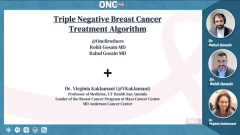
Navigation of Triple-Negative Breast Cancer Treatment Toxicities
Panelists discusses how triple-negative breast cancer (TNBC) treatment toxicities require careful monitoring and management. Common adverse effects include fatigue, nausea, hair loss, neuropathy from chemotherapy, and radiation-induced skin changes. Health care teams employ preventive strategies, dose modifications, and supportive care to minimize complications while maintaining treatment efficacy.
Advertisement
Advertisement
Related to this article
More than half of patients with microsatellite-stable metastatic colorectal cancer without active liver metastases survived at least 18 months with botensilimab plus balstilimab.
Investigators will present detailed findings from a phase 2 study assessing a tambiciclib-based regimen in patients with relapsed/refractory AML at ASH 2026.

Bhanu Prasad Venkatesulu, MBBS, MD, discussed why fewer radiation oncologists perform brachytherapy, and one setting where he considers it the better option.

Chinmay Jani, MD, discusses ASCO 2026 data on lung cancer trends in younger adults and why this group has been overlooked.

Data from the OrigAMI-4 trial support the accelerated approval of amivantamab and hyaluronidase-lpuj for this HNSCC population.

Bhanu Prasad Venkatesulu, MBBS, MD, discussed why fewer radiation oncologists offer prostate brachytherapy and the patients for whom he still recommends it.

Chinmay Jani, MD, explains how air pollution and asbestos contribute to lung cancer deaths beyond tobacco.

Claudine Isaacs, MD, and community oncologists weigh ASCENT-03 and ASCENT-04 data, crossover, and toxicity management with sacituzumab govitecan in TNBC.
Advertisement
Advertisement
Trending on CancerNetwork
1
FDA Approves SC Amivantamab for Recurrent/Metastatic HNSCC
2
FDA Sets PDUFA Date for Rivoceranib/Camrelizumab Resubmission After Third CRL in Unresectable HCC
3
Sacituzumab Govitecan Efficacy, Safety Debated in First-Line Metastatic TNBC
4
Air Pollution Emerges as Second Leading Risk Factor for Lung Cancer Deaths
5