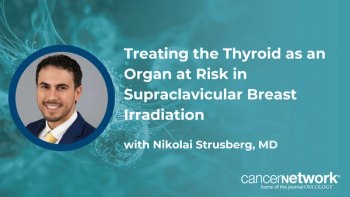
Nikolai Strusberg, MD, discussed other toxicities of proton vs photon breast RT, practice implications, and next steps in capsular contracture research.
The expansion of clinical trials evaluating proton-based radiotherapy could elucidate its benefits and increase its access across the US.
According to Jason Molitoris, MD, PhD, running clinical trials examining the disparities in outcomes between photon and proton therapy may help elucidate where each modality benefits patients.
In an interview with CancerNetwork®, Molitoris discussed socioeconomic and geographic challenges associated with the delivery of proton therapy. This was contextualized by a presentation on this modality in patients with oropharyngeal cancers, such as oropharyngeal squamous cell carcinoma (OPSCC), he gave at the
Specifically, his center uses a cost-neutral system which bills proton and photon therapy similarly and provides transportation and lodging services near proton therapy centers for patients. He explained that these measures have resulted in the highest approval rating for proton therapy in the country.
Molitoris further explained that clinical trials comparing proton and photon therapy may bolster uptake of proton therapy in patients who may benefit from its use, highlighting that the University of Maryland has opened numerous phase 3 clinical trials to help generate this data. He concluded by explaining that these clinical trials have facilitated the development of more proton-specific centers being built, which he believes will increase availability for this modality across the US.
Molitoris is an associate professor of Radiation Oncology and the director of the Clinical Hyperthermia Program at the University of Maryland.
Transcript:
At the University of Maryland, we do a number of things to help with socioeconomic and geographic challenges associated with the delivery of proton therapy. It’s well known that there are fewer proton therapy centers throughout the country than there are photon therapies, and it can be geographically limiting to patients. Our center has a cost-neutral system where we bill insurance companies at the same rate for proton therapy and photon therapy. This has led to the highest approval ratings for proton therapy-treated patients in the country. We also provide transportation services as well as lodging near our proton therapy center so that we can give proton therapy to patients who truly benefit from that treatment.
More broadly, there are things that we can do to help with uptake of proton therapy. First, we can run clinical trials comparing proton therapy with photon therapy. We need to find the areas where proton therapy truly benefits patients. Our center has opened all the phase 3 randomized control trials comparing protons with photons because we believe strongly in generating data for patients across cancer subsites. There are more proton therapy centers being built, and data [from studies] like [a] phase 3 randomized controlled trial that we’ve been discussing will lead to more availability of proton therapy across the country.
Reference
Molitoris J. Proton therapy for oropharyngeal cancer. Presented at: American College of Radiation Oncology 2026 Radiation Oncology Summit; February 4-6, 2026; Orlando, FL.