
Opinion|Videos|January 27, 2026
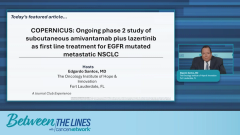
Prophylaxis and Practical Implementation of the COPERNICUS Approach
Author(s)Edgardo Santos, MD, FACP, FASCO
Fact checked by: Justin Mancini
This study explores the efficacy and safety of amivantamab plus lazertinib for patients with EGFR mutations and brain metastasis.
Advertisement
Episodes in this series
The final section integrates the full COPERNICUS strategy, focusing on proactive toxicity prevention and real-world applicability. Edgardo Santos, MD, FACP, FASCO, details the structured prophylactic regimens designed to minimize common adverse events associated with amivantamab and lazertinib. Administration reaction prophylaxis includes dexamethasone based on SKIPPirr data, whereas venous thromboembolism prevention is addressed through prophylactic anticoagulation.
Dermatologic prophylaxis, informed by COCOON, is presented as a cornerstone of the study. Strategies include early use of oral antibiotics, topical therapies, nail care, moisturization, and sun protection. Santos emphasizes that these measures are practical and familiar to oncology teams, making them feasible to implement outside of clinical trials.
The section concludes by reinforcing the broader clinical relevance of COPERNICUS. Subcutaneous amivantamab administered every 4 weeks, combined with oral lazertinib and comprehensive supportive care, represents a patient-centered approach that builds on established efficacy while addressing real-world challenges. COPERNICUS is positioned as a meaningful step toward optimizing how effective therapies are delivered in everyday oncology practice.
Advertisement
Related to this article

“When we give the most effective therapy at the time of new diagnosis, we get the most value out of the effort and time that we and our patients are spending,” said Neeraj Agarwal, MD, FASCO.

An aglatimagene besadenovec-based radiotherapy combination increased intratumoral lymphocyte fraction in intermediate- to high-risk localized prostate cancer.

The ROADS investigators reported no differences between cesium-131 tile-based radiation therapy and SRT in quality of life, functional status, or neurocognitive function.
William A. Hall, MD, discussed the SOFT Preop study of preoperative SBRT vs conventional chemoradiation for pancreatic adenocarcinoma.

Chih-Yi “Andy” Liao, MD, discusses how oncologists are sequencing pemigatinib, futibatinib, and lirafugratinib and how their tolerability differs.

“It should be protocol that 100% of your patients with metastatic prostate cancer get germline testing. Full stop. No exceptions,” said Neal D. Shore, MD, FACS.

Chih-Yi “Andy” Liao, MD, discusses the FDA approval of lirafugratinib and what the field has learned about resistance to FGFR2 inhibitors.

In the phase 3 NRG-CC009 trial, SRS led to longer overall survival vs HA-WBRT plus memantine with similar neurocognitive failure in SCLC brain metastases.
Advertisement
Advertisement
Trending on CancerNetwork
1
Multimodal Biopsy Combo Shows Low Morbidity in Suspected Prostate Cancer
2
BCMA/GPRC5D CAR T-Cell Therapy Shows Early Efficacy in R/R Multiple Myeloma
3
Integrating Talazoparib Plus Enzalutamide Into HRR-Mutated mHSPC Care
4
Aglatimagene Combo Shows Sustained Immune Remodeling in Prostate Cancer
5