
Opinion|Videos|January 20, 2026
End Points and Objectives: Capturing Efficacy, Safety, and Patient Experience
Author(s)Edgardo Santos, MD, FACP, FASCO
Fact checked by: Justin Mancini
Discover how Copernicus enhances patient care with innovative treatments and supportive practices for advanced EGFR mutation cases.
Advertisement
Episodes in this series
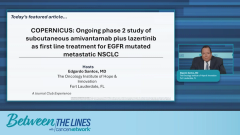
In this section, Edgardo Santos, MD, FACP, FASCO, outlines the primary and secondary end points of COPERNICUS, highlighting a balanced assessment of efficacy, safety, and patient-centered outcomes. Overall survival is emphasized as the key end point, supported by measures such as objective response rate, duration of response, and intracranial efficacy.
The discussion places particular focus on brain metastases, which occur more frequently in patients with EGFR mutations and are associated with poor prognosis. Santos explains that evaluating intracranial response and progression-free survival is critical to understanding the full impact of treatment. Safety end points include monitoring venous thromboembolic events and dermatologic toxicity, reflecting known risks associated with amivantamab-based regimens.
Biological objectives are also incorporated, including analysis of circulating tumor DNA to explore resistance mechanisms and tumor evolution under dual EGFR inhibition. Patient-reported outcomes are highlighted as an essential component of the study, reinforcing the emphasis on how patients perceive treatment burden, tolerability, and overall experience. This section positions COPERNICUS as a comprehensive evaluation of both clinical benefit and real-world impact.
Advertisement
Related to this article

“When we give the most effective therapy at the time of new diagnosis, we get the most value out of the effort and time that we and our patients are spending,” said Neeraj Agarwal, MD, FASCO.

An aglatimagene besadenovec-based radiotherapy combination increased intratumoral lymphocyte fraction in intermediate- to high-risk localized prostate cancer.

The ROADS investigators reported no differences between cesium-131 tile-based radiation therapy and SRT in quality of life, functional status, or neurocognitive function.
William A. Hall, MD, discussed the SOFT Preop study of preoperative SBRT vs conventional chemoradiation for pancreatic adenocarcinoma.

Chih-Yi “Andy” Liao, MD, discusses how oncologists are sequencing pemigatinib, futibatinib, and lirafugratinib and how their tolerability differs.

“It should be protocol that 100% of your patients with metastatic prostate cancer get germline testing. Full stop. No exceptions,” said Neal D. Shore, MD, FACS.

Chih-Yi “Andy” Liao, MD, discusses the FDA approval of lirafugratinib and what the field has learned about resistance to FGFR2 inhibitors.

In the phase 3 NRG-CC009 trial, SRS led to longer overall survival vs HA-WBRT plus memantine with similar neurocognitive failure in SCLC brain metastases.
Advertisement
Advertisement
Trending on CancerNetwork
1
Multimodal Biopsy Combo Shows Low Morbidity in Suspected Prostate Cancer
2
BCMA/GPRC5D CAR T-Cell Therapy Shows Early Efficacy in R/R Multiple Myeloma
3
Integrating Talazoparib Plus Enzalutamide Into HRR-Mutated mHSPC Care
4
Aglatimagene Combo Shows Sustained Immune Remodeling in Prostate Cancer
5