
Opinion|Videos|January 6, 2026
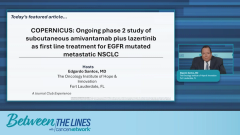
Supportive Care Evidence Shaping COPERNICUS: Lessons From PALOMA three, COCOON, and SKIPPirr
Author(s)Edgardo Santos, MD, FACP, FASCO
Explore the innovative Copernicus trial, evaluating subcutaneous Amivantamab plus Lazertinib for treating EGFR-mutated metastatic lung cancer.
Advertisement
Episodes in this series
This section focuses on the key supportive care studies that directly informed the design of COPERNICUS. Dr Santos reviews PALOMA three, COCOON, and SKIPPirr, highlighting how each addressed specific tolerability and delivery challenges associated with amivantamab based therapy.
PALOMA three evaluated the subcutaneous formulation of amivantamab and demonstrated pharmacokinetic equivalence to intravenous administration, along with fewer administration related reactions and reduced clinic time. These findings provided the foundation for adopting subcutaneous delivery in COPERNICUS. COCOON addressed dermatologic toxicity, showing that proactive prophylaxis significantly reduced moderate to severe skin adverse events. This marked a shift from reactive management to prevention, which Dr Santos describes as essential when using dual EGFR inhibition.
SKIPPirr examined the use of dexamethasone to prevent infusion related reactions during early treatment. The study demonstrated a substantial reduction in these reactions, supporting early prophylaxis rather than treatment interruption. Dr Santos emphasizes that together, these studies highlight the importance of integrating supportive care strategies upfront.
By embedding these evidence based interventions into COPERNICUS, the study aims to improve tolerability, adherence, and long term treatment success. This section reinforces the idea that supportive care is not secondary to efficacy but a central component of effective cancer therapy in real world settings.
Advertisement
Related to this article

“When we give the most effective therapy at the time of new diagnosis, we get the most value out of the effort and time that we and our patients are spending,” said Neeraj Agarwal, MD, FASCO.

An aglatimagene besadenovec-based radiotherapy combination increased intratumoral lymphocyte fraction in intermediate- to high-risk localized prostate cancer.

The ROADS investigators reported no differences between cesium-131 tile-based radiation therapy and SRT in quality of life, functional status, or neurocognitive function.
William A. Hall, MD, discussed the SOFT Preop study of preoperative SBRT vs conventional chemoradiation for pancreatic adenocarcinoma.

Chih-Yi “Andy” Liao, MD, discusses how oncologists are sequencing pemigatinib, futibatinib, and lirafugratinib and how their tolerability differs.

“It should be protocol that 100% of your patients with metastatic prostate cancer get germline testing. Full stop. No exceptions,” said Neal D. Shore, MD, FACS.

Chih-Yi “Andy” Liao, MD, discusses the FDA approval of lirafugratinib and what the field has learned about resistance to FGFR2 inhibitors.

In the phase 3 NRG-CC009 trial, SRS led to longer overall survival vs HA-WBRT plus memantine with similar neurocognitive failure in SCLC brain metastases.
Advertisement
Advertisement
Trending on CancerNetwork
1
Multimodal Biopsy Combo Shows Low Morbidity in Suspected Prostate Cancer
2
BCMA/GPRC5D CAR T-Cell Therapy Shows Early Efficacy in R/R Multiple Myeloma
3
Integrating Talazoparib Plus Enzalutamide Into HRR-Mutated mHSPC Care
4
Aglatimagene Combo Shows Sustained Immune Remodeling in Prostate Cancer
5