

Opinion|Videos|May 5, 2025
The Role of ctDNA Testing in Colorectal Cancer Management: Exploring Its Use Alongside Imaging in Challenging Cases
Author(s)John L. Marshall, MD, Mark Lewis, MD
Panelists discuss how circulating tumor DNA (ctDNA) testing serves as a complementary tool to traditional imaging in challenging colorectal cancer cases, offering molecular-level insights that can detect disease recurrence earlier, resolve ambiguous radiographic findings, and inform treatment decisions when conventional assessment methods yield inconclusive results.
Advertisement
Episodes in this series
Advertisement
Related to this article
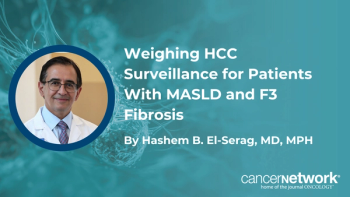
At The Liver Meeting 2026, Hashem B. El-Serag, MD, MPH, discussed when patients with MASLD and F3 fibrosis may merit HCC surveillance.

At The Liver Meeting 2026, Pierre Gholam, MD, explained why liver tumor board plans often break down at implementation and how navigators can help.

Surveillance guidelines limited to cirrhosis may miss up to a third of patients with MASLD-related HCC, according to Daniel Q. Huang, MBBS, PhD.

Hashem B. El-Serag, MD, MPH, discussed fibrosis-based HCC surveillance, ultrasound limits, chemoprevention, and alcohol screening for patients with MASLD.

At The Liver Meeting® 2026, Andrew Moon, MD, MPH, discussed research revealing gaps between clinician and patient priorities in HCC treatment choice.

Chinmay Jani, MD, describes how he counsels patients with and without a smoking history on a lung cancer diagnosis.

In the VERIFY trial, rusfertide produced a clinical response in 77% of phlebotomy-dependent patients with polycythemia vera receiving standard-of-care therapy.

Pierre Gholam, MD, discussed how navigation, molecular profiling, and hub-and-spoke models can help liver tumor boards turn recommendations into care.
Advertisement
Advertisement
Trending on CancerNetwork
1
Weighing Immunotherapy for Bridging and Downstaging Before HCC Transplant
2
What Separates a Next-Generation Liver Tumor Board From the Traditional Model?
3
MASLD Raises Liver and Other Cancer Risks, Supporting Selective HCC Surveillance
4
BOT+BAL Yields Long-Term Survival in Patients With Refractory MSS mCRC
5