Ajay K. Nooka, MD, MPH, FACP
Articles by Ajay K. Nooka, MD, MPH, FACP
The faculty turn to the safety and practical aspects of using belantamab mafodotin, drawing on earlier experience with the drug. They discuss how lines of therapy are defined and whether the definition needs refinement, and how efficacy endpoints translate into clinical relevance. Health-related quality of life is reviewed, with the view that good disease control is a driver of better quality of life. The panel describes holding the drug for eye symptoms, restarting at a lower dose, and adjusting dosing frequency to keep responding patients on therapy. They also note the overall response rate and MRD negativity in the study and discuss their interpretation of the data.

The moderator asks whether any of the patient’s baseline comorbidities from the clinical scenario in the previous episode are a concern.
One panelist addresses neuropathy in a patient who has received bortezomib, describing a symptom-driven approach.
The faculty discuss the DREAMM-7 eligibility and exclusion criteria, including the exclusion of patients refractory to daratumumab or bortezomib. They consider how well the trial population reflects patients seen in practice, given limited prior anti-CD38 exposure. The conversation then turns to the enrolled population vs the approved indication of at least 2 prior lines, which was based on a subgroup. Finally, the faculty share their views on that restriction and discuss the survival benefit seen in the study.
Experts explain how myeloma regimens manage eye toxicity with baseline exams, dose holds, reductions, and longer belantamab dosing intervals to improve safety.
Practical guidance for starting belantamab: confirm eligibility, coordinate ophthalmology exams, manage reversible eye toxicity with dose holds, and educate patients for confident dosing.
DREAMM-7 reveals belantamab combo extends myeloma PFS, with reversible eye effects, REMS monitoring, and fewer severe infections.
Experts explain who benefits from belantamab in relapsed myeloma and how REMS eye exams and dose tweaks keep treatment on track.
The faculty describe the approval of belantamab mafodotin with bortezomib and dexamethasone for patients who have had at least 2 prior lines of treatment including a proteasome inhibitor (PI) and an immunomodulatory drug (IMiD), noting the boxed warning for ocular adverse effects.
The hosts open the program and set out what the discussion will cover in relapsed or refractory multiple myeloma: the area of unmet need in patients who have already received a proteasome inhibitor (PI) and an immunomodulatory drug (IMiD), the regulatory path that led from monotherapy to a combination, the DREAMM-7 trial design and efficacy outcomes, safety and monitoring, and where an antibody-drug conjugate (ADC) fits among the many options available at early relapse.

Ajay K. Nooka, MD, MPH, FACP, says multiple myeloma treatment is entering an immunotherapy deluge, with more data on bispecifics ahead.
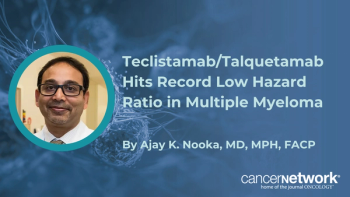
Ajay K. Nooka, MD, MPH, FACP, says the teclistamab-talquetamab combination reduced progression risk by 89% in MonumenTAL-6.
Looking Forward: Future Directions, Early-Line Trials, and the Prospect of Cure
BySundar Jagannath, MBBS,Ajay K. Nooka, MD, MPH, FACP,Mohan Krishnamachary, MD,Nisha Joseph, MD,Donna Catamero, MSN, ANP-BC, OCN, CBCN The final segment synthesizes the discussion and looks ahead to the future of BCMA bispecifics. Jagannath recaps the extraordinary strides made thus far, from strong response rates to improved safety management, and highlights the growing role of combinations with agents like daratumumab and the expansion into newly diagnosed and smoldering myeloma clinical trials.
Duration of Therapy and De-escalation: Navigating the Unknowns
BySundar Jagannath, MBBS,Ajay K. Nooka, MD, MPH, FACP,Mohan Krishnamachary, MD,Nisha Joseph, MD,Donna Catamero, MSN, ANP-BC, OCN, CBCN Here, the panel turns to one of the most debated questions surrounding bispecific antibodies: how long should patients remain on therapy? Jagannath raises a scenario involving a patient who achieves MRD-negative complete remission after 1 and 2 years of therapy, prompting discussion about whether to continue, taper, or discontinue treatment.
Treatment Sequencing: Choosing Between CAR T and Bispecifics Across Clinical Scenarios
BySundar Jagannath, MBBS,Ajay K. Nooka, MD, MPH, FACP,Mohan Krishnamachary, MD,Nisha Joseph, MD,Donna Catamero, MSN, ANP-BC, OCN, CBCN This segment tackles one of the most nuanced decisions in modern myeloma treatment: determining when to use BCMA CAR T-cell therapy versus a BCMA bispecific antibody.
Academic–Community Coordination: Ensuring Safe Transitions of Care
BySundar Jagannath, MBBS,Ajay K. Nooka, MD, MPH, FACP,Mohan Krishnamachary, MD,Nisha Joseph, MD,Donna Catamero, MSN, ANP-BC, OCN, CBCN This segment addresses one of the most rapidly evolving challenges in myeloma therapeutics: how to safely transition bispecific-treated patients between academic and community settings.
Preparing the Care Team: Operationalizing Bispecific Delivery and Infectious Risk Management
BySundar Jagannath, MBBS,Ajay K. Nooka, MD, MPH, FACP,Mohan Krishnamachary, MD,Nisha Joseph, MD,Donna Catamero, MSN, ANP-BC, OCN, CBCN This segment focuses on the practical, multidisciplinary coordination required to safely administer bispecific antibodies.
Case Discussion: Selecting a Bispecific for a High-Risk, Rapidly Progressing Patient
BySundar Jagannath, MBBS,Ajay K. Nooka, MD, MPH, FACP,Mohan Krishnamachary, MD,Nisha Joseph, MD,Donna Catamero, MSN, ANP-BC, OCN, CBCN Explore the complexities of treating a 72-year-old woman with relapsed refractory multiple myeloma using bispecific antibody therapy.
Comparing the Approved BCMA Bispecifics: Efficacy, Toxicity, and Treatment Burden
BySundar Jagannath, MBBS,Ajay K. Nooka, MD, MPH, FACP,Mohan Krishnamachary, MD,Nisha Joseph, MD,Donna Catamero, MSN, ANP-BC, OCN, CBCN Explore the latest advancements in bispecific antibodies for treating BCMAs, highlighting their efficacy, administration frequency, and toxicity profiles.
Bispecific Antibodies vs CAR T-Cells: Mechanistic and Practical Distinctions
BySundar Jagannath, MBBS,Ajay K. Nooka, MD, MPH, FACP,Mohan Krishnamachary, MD,Nisha Joseph, MD,Donna Catamero, MSN, ANP-BC, OCN, CBCN Explore the differences between bispecific antibodies and CAR T-cell therapy, highlighting their unique benefits and administration processes in cancer treatment.
Setting the Stage: The Rise of BCMA Bispecific Antibodies in Myeloma
BySundar Jagannath, MBBS,Ajay K. Nooka, MD, MPH, FACP,Mohan Krishnamachary, MD,Nisha Joseph, MD,Donna Catamero, MSN, ANP-BC, OCN, CBCN Experts discuss the rapid advancements in BCMA-directed bispecific antibodies for relapsed/refractory multiple myeloma, highlighting improved response rates and treatment integration.
Bispecifics in R/R MM: Key Takeaways
ByAjai Chari, MD,Ajay K. Nooka, MD, MPH, FACP,Muhamed Baljevic, MD,Gurbakhash Kaur, MD, Anupama Kumar, MD Panelists discuss how their key takeaways emphasize the importance of communication and collaboration between academic centers and community practices to ensure equitable access to bispecific therapies, highlighting that it’s an exciting time in myeloma treatment with patient-friendly options that can be administered closer to home, and concluding that virtually no patient should be denied exposure to bispecific therapy before discontinuing treatment, while anticipating that de-escalated Q4 weekly schedules and trispecific agents will transform current practice patterns in the coming years.
Clinical Scenario 2 With Bispecifics in R/R MM
ByAjai Chari, MD,Ajay K. Nooka, MD, MPH, FACP,Muhamed Baljevic, MD,Gurbakhash Kaur, MD, Anupama Kumar, MD Panelists discuss how a woman aged 69 years with standard-risk relapsed/refractory multiple myeloma (R/R MM), significant comorbidities including chronic obstructive pulmonary disease (COPD) and chronic kidney disease (CKD), and history of respiratory infections would be a reasonable candidate for talquetamab despite infection concerns, citing that GPRC5D-targeting agents show much lower infection rates (less than 10%) compared with B-cell maturation antigen (BCMA) bispecifics (around 50%) due to preferential expression on malignant cells rather than normal B cells, with no requirement for prophylaxis and evidence of preserved humoral immunity including COVID-19 vaccine responses.
Clinical Scenario 1 With Bispecifics in R/R MM
ByAjai Chari, MD,Ajay K. Nooka, MD, MPH, FACP,Muhamed Baljevic, MD,Gurbakhash Kaur, MD, Anupama Kumar, MD Panelists discuss how managing a high-risk patient aged 64 years who progressed after 11 months on talquetamab with decreased B-cell maturation antigen (BCMA) surface expression presents challenging options, including switching to GPRC5D-targeting agents like talquetamab, pursuing clinical trials, or potentially using sequential bispecifics despite T-cell exhaustion concerns, while noting that the MonumenTAL-1 trial’s prior BCMA-directed therapy cohort showed promising 12-month progression-free survival, although the data are confounded by intervening therapies between treatments.
Bispecifics in R/R MM: Unanswered Questions
ByAjai Chari, MD,Ajay K. Nooka, MD, MPH, FACP,Muhamed Baljevic, MD,Gurbakhash Kaur, MD, Anupama Kumar, MD Panelists discuss how despite the significant progress with bispecifics in relapsed/refractory multiple myeloma (R/R MM), major unanswered questions remain including optimal sequencing strategies (which represent the biggest challenge), how to implement bispecifics earlier in the treatment paradigm, and how to integrate them with other existing therapies in the evolving treatment landscape.
Optimal Sequencing Strategies With Bispecifics in R/R MM
ByAjai Chari, MD,Ajay K. Nooka, MD, MPH, FACP,Muhamed Baljevic, MD,Gurbakhash Kaur, MD, Anupama Kumar, MD Panelists discuss how optimal sequencing strategies suggest using chimeric antigen receptor (CAR) T-cell therapy first when eligible, followed by switching targets (from B-cell maturation antigen [BCMA] to GPRC5D) upon relapse rather than staying with the same target, while acknowledging that sequential bispecific use may be challenging due to T-cell exhaustion and recommending “sandwiching” T-cell sparing agents like cereblon E3 ligase modulators (CELMoDs) between bispecifics to allow T-cell recovery. However, they note that monthly dosing schedules and treatment holidays may change these dynamics in the future.
MonumenTAL-1: Safety Outcomes
ByAjai Chari, MD,Ajay K. Nooka, MD, MPH, FACP,Muhamed Baljevic, MD,Gurbakhash Kaur, MD, Anupama Kumar, MD Panelists discuss how the extended follow-up data from MonumenTAL-1 show consistent safety outcomes for talquetamab with manageable discontinuation rates due to skin changes and weight loss, while acknowledging that GPRC5D targeting creates unique toxicities including nail and skin changes that require proactive management strategies, particularly as treatment transitions from academic centers to community practice where quality-of-life considerations become increasingly important.
Teclistamab: OPTEC Trial Overview
ByAjai Chari, MD,Ajay K. Nooka, MD, MPH, FACP,Muhamed Baljevic, MD,Gurbakhash Kaur, MD, Anupama Kumar, MD Panelists discuss how the OPTEC trial and other studies demonstrate that outpatient teclistamab administration with prophylactic tocilizumab is feasible and safe, with no cytokine release syndrome (CRS) events reported in community settings, while acknowledging that Risk Evaluation and Mitigation Strategies (REMS) requirements remain a significant barrier to broader community adoption despite the reality that most CRS is now grade 1-2 and manageable with supportive care, suggesting the field needs to follow lymphoma’s example of bispecifics without REMS restrictions.
Talquetamab: Real-World Outcomes With Outpatient Dosing
ByAjai Chari, MD,Ajay K. Nooka, MD, MPH, FACP,Muhamed Baljevic, MD,Gurbakhash Kaur, MD, Anupama Kumar, MD Panelists discuss how real-world outpatient talquetamab data from Mayo Clinic show that 85% of patients can start treatment as outpatients with about 50% completing the entire step-up process without hospitalization, while different centers are developing varying approaches to cytokine release syndrome (CRS) management—from no prophylaxis with 50% admission rates to prophylactic tocilizumab with 3% admission rates—suggesting that practice preferences may ultimately determine which bispecific agents are favored based on factors like median time to CRS onset.
Optimal Dosing of Talquetamab (Part 2)
ByAjai Chari, MD,Ajay K. Nooka, MD, MPH, FACP,Muhamed Baljevic, MD,Gurbakhash Kaur, MD, Anupama Kumar, MD Panelists discuss how outpatient administration of talquetamab is becoming more feasible with proper patient selection, noting that although there are few absolute medical contraindications to bispecifics, they exercise caution in patients with dialysis dependency (due to different pharmacokinetics), spinal cord compression (due to inflammatory response concerns), decompensated heart failure, or active infections, while emphasizing that most myeloma patients who desire continued therapy should not be denied bispecific treatment.