The second clinical scenario considers a 72-year-old patient with multiple myeloma who is triple-class exposed and has experienced disease progression after a BCMA-directed T-cell-engaging therapy.
The second clinical scenario considers a 72-year-old patient with multiple myeloma who is triple-class exposed and has experienced disease progression after a BCMA-directed T-cell-engaging therapy.
The discussion continues with the first clinical scenario involving lenalidomide-refractory multiple myeloma.
The first clinical scenario focuses on a 66-year-old patient with multiple myeloma who develops biochemical progression during lenalidomide maintenance after frontline therapy and autologous stem cell transplantation.
The discussion expands to investigational CELMoDs in multiple myeloma, focusing on cemsidomide and the ongoing MOMENTUM trial.
The discussion turns to the immunomodulatory effects of CELMoDs in multiple myeloma, with Dr. Goldsmith describing preclinical evidence suggesting that CELMoDs can enhance T-cell and NK-cell activity through effects on cytokine signaling and immune-mediated mechanisms.
Dr. Mikhael asks Dr. Goldsmith to further explain the clinical relevance of the differences in cereblon engagement between CELMoDs and established IMiDs for clinicians treating multiple myeloma.
Dr. Mikhael begins the scientific foundation by asking Dr. Richardson to define CELMoDs and explain how they engage the cereblon E3 ubiquitin ligase complex to promote targeted degradation of Ikaros and Aiolos, key transcription factors involved in myeloma-cell biology.
Dr. Joseph Mikhael welcomes the audience to the Cancer Network Training Academy program and introduces Dr. Paul Richardson and Dr. Scott Goldsmith, who bring clinical and research expertise in multiple myeloma.
Muhamed Baljevic, MD, FACP, and Paul Richardson, MD, discuss using CELMoDs to debulk tumor or restore T-cell fitness between T-cell–redirecting therapies in relapsed/refractory multiple myeloma.

Muhamed Baljevic, MD, FACP, and Paul Richardson, MD, discuss how sparing patients from IMiD-related GI toxicity and neutropenic infections with CELMoDs may extend treatment duration and progression-free survival.
Paul Richardson, MD, and Muhamed Baljevic, MD, FACP, discuss the immunologic and mechanistic synergy between CELMoDs and standard myeloma backbone therapies.
Paul Richardson, MD, and Muhamed Baljevic, MD, FACP, explain how mezigdomide’s complete cereblon E3 ligase engagement overcomes IMiD resistance in heavily pretreated multiple myeloma.
Paul G. Richardson, MD, presented data from the phase 3 DETERMINATION study at 2022 ASCO and theorized how these findings could extend to similar regimens in newly diagnosed multiple myeloma.
Paul G. Richardson, MD, looks at MRD data from the DETERMINATION study for its potential to guide treatment selection in newly diagnosed multiple myeloma.
Paul G. Richardson, MD, uses results of the DETERMINATION study that were presented at 2022 ASCO to justify choice of appropriate therapy for individual patients with treatment-naïve multiple myeloma.
At 2022 ASCO, Paul G. Richardson, MD, dives into results of the DETERMINATION study, which examined triplet therapy with lenalidomide plus either lenalidomide maintenance until progression or autologous stem transplantation in newly diagnosed multiple myeloma.
At 2022 ASCO, Paul G. Richardson, MD, reviewed the rationale of the phase 3 DETERMINATION study that set out to determine the benefit of lenalidomide maintenance with or without autologous stem transplantation in newly diagnosed multiple myeloma.
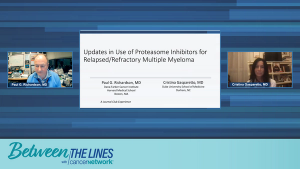
Paul G. Richardson, MD, and Christina Gasparetto, MD, offer insights into the use of proteasome inhibitors in relapsed or refractory multiple myeloma.
Experts share their excitement for upcoming PFS trial data to be presented on the combination of ixazomib, pomalidomide, and dexamethasone in multiple myeloma.
Expert perspectives on the triplet combination of ixazomib, pomalidomide, and dexamethasone in multiple myeloma presented at the 2021 ASH [American Society of Hematology] Annual Meeting.
Continuing their discussion on the management of multiple myeloma, experts Paul Richardson, MD, and Cristina Gasparetto, MD, consider the value of minimal residual disease as a marker.
Insight on the ASH 2021 update highlighting response rates and discontinuation in patients who received in-class transition from bortezomib to ixazomib for multiple myeloma.
Reflections on the patient-reported adherence and outcome data with IRd (ixazomib, lenalidomide, dexamethasone) therapy after an in-class transition from bortezomib to ixazomib for patients with multiple myeloma.
Experts Paul Richardson, MD, and Cristina Gasparetto, MD, discuss trial data analyzing the in-class transition from bortezomib to ixazomib for patients with multiple myeloma.
Expert perspectives on data from the TOURMALINE-MM1 trial, which tested ixazomib therapy in patients with relapsed/refractory multiple myeloma.
Shared insight on how real-world experience and data with proteasome inhibitors in multiple myeloma compare to what was seen in clinical trials.
A broad look at the historical use of proteasome inhibitor therapy in patients with multiple myeloma centered on 3 agents: bortezomib, carfilzomib, and ixazomib.
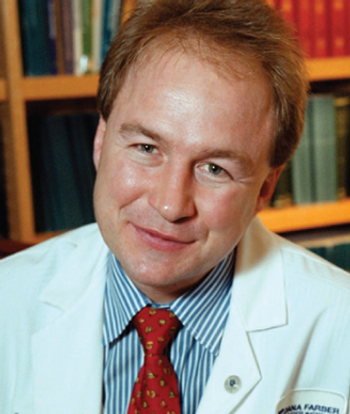
Myeloma is clearly not one disease but several. In terms of treatment choices, it is increasingly evident that one size of treatment does not fit all. Moreover, as therapy is tailored to each individual patient, with the ability to mobilize and collect stem cells and retain them after successful induction/remission therapy, younger patients have choices.

This management guide covers the symptoms, diagnosis, screening, staging, and treatment of multiple myeloma, smoldering myeloma, and other plasma cell dyscrasias.
The real promise of improving patient outcomes in IgD and IgE multiple myeloma lies in multi-drug combinations, next-generation agents, and immunotherapy.
April 11th 2022