






Lung Cancer
Latest News
Advertisement
Latest Videos






































































Advertisement
More News

To improve quality of life for patients with depression, researchers indicated it is crucial to provide referral and follow-up mental health care for patients with non-small cell lung cancer.
Integrated analyses showed entrectinib to be both effective and well tolerated in patients with rare ROS1 and NTRK gene fusions.

Patients with metastatic non-small cell lung cancer who harbor HER2-mutations may develop brain metastases more frequently during treatment.
The Food and Drug Administration approved the first generic for everolimus, which can provide a safe, effective, lower cost alternative to the brand-name drug it references.
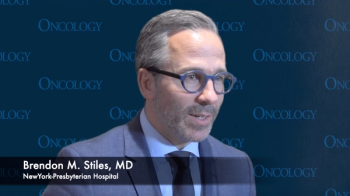
The thoracic surgeon from NewYork-Presbyterian Hospital discusses a trial at the institution in which they give low-dose radiation therapy along with immunotherapy at the Annual New York Lung Cancers Symposium®.
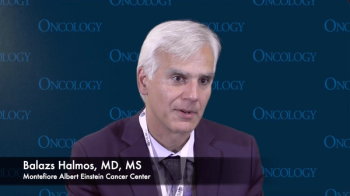
Balazs Halmos, MD, MS, from Montefiore Albert Einstein Cancer Center, discussed advancements in treatment of metastatic non-small cell lung cancer at the Annual New York Lung Cancers Symposium®.

Ashish Saxena, MD, PhD, from Weill Cornell Medicine, discussed how immunotherapy may lead to an increase in overall survival of patients at the Annual New York Lung Cancers Symposium®.
The FDA approved atezolizumab in combination with chemotherapy for the first-line treatment of adults with metastatic non-squamous non-small cell lung cancer with no EGFR or ALK genomic tumor aberrations.
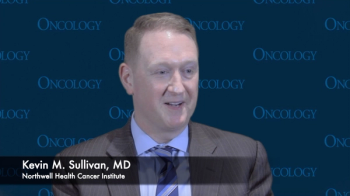
Kevin M. Sullivan, MD, from the Northwell Health Cancer Institute, discussed how the options for treatment of patients with lung cancer have expanded greatly at the Annual New York Lung Cancers Symposium®.
The FDA accepted a supplemental biologics license application and granted a priority review to durvalumab for the treatment of patients with previously untreated extensive-stage small cell lung cancer.

Takeda announced that their ongoing phase III ALTA-1L trial of brigatinib reduced the risk of disease progression or death in adults with advanced ALK-positive non-small cell lung cancer.

Predictive models demonstrated the ability to anticipate adverse opioid-related outcomes among cancer survivors.

The radiation oncologist from Memorial Sloan Kettering Cancer Center, discusses several ongoing trials combining immunotherapy and radiation at the 14th Annual New York Lung Cancers Symposium®.

Biomarker testing allows doctors to go beyond what’s under the microscope, helping to determine the best patient therapy.
The MSK expert discusses exciting advancements in the field of immunotherapy for treating lung cancer at the Annual New York Lung Cancers Symposium®.

Four cancer centers are joining forces on a new clinical trial designed to test medically tailored meals for patients with lung cancer to combat malnutrition.
Beth Eaby-Sandy, a nurse practitioner, discussed AEs associated with immunotherapy treatment in patients with lung cancer.
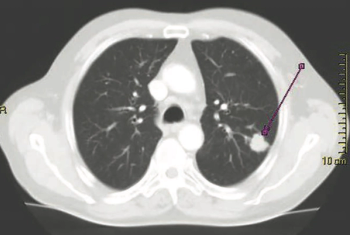
Five notable abstracts from the 2019 World Conference on Lung Cancer (WCLC).

In our lung cancer quiz, you'll get a chance to test your knowledge of the management of sarcopenia in patients with lung cancer.
Atezolizumab monotherapy improved overall survival compared with platinum-based chemotherapy as a first-line treatment in patients with wild-type non–small cell lung cancer with PD-L1 expression ≥50%.
MCLA-128 showed radiological and clinical responses in patients with certain types of cancer who harbored neuregulin 1 gene fusions.

About a fifth of patients with lung cancer in the United States receive no treatment at all, while approximately 6 in 10 receive the minimal treatments recommended by the National Comprehensive Cancer Network.

Proton therapy’s direct and precise application of radiation for mid-stage lung cancer is being investigated in an ongoing phase III trial at the University of Cincinnati.

The probiotics and prebiotics of yogurt and fiber consumption is associated with decreased risk of lung cancer.
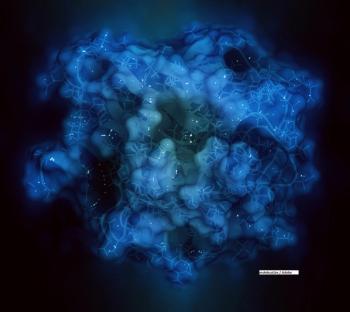
A compound called MRTX849 is showing signs of being the first effective inhibitor of the KRAS G12C-mutant subtype of non-small cell lung and colorectal cancers.
Advertisement
Advertisement
Trending on CancerNetwork
1
Lutetium Lu 177 Dotatate Biosimilar Earns Final FDA Approval in GEP-NETs
2
PANXEON Liquid Biopsy Demonstrates Potential for Detecting Early Pancreatic Cancer
3
Rusfertide Earns Category 1 NCCN Recommendation in Polycythemia Vera
4
AdenoVerse Platform Receives FDA Designation for HPV-Associated Cancers
5