
Dr. Binod Dhakal and Dr. Carol Ann Huff discuss how anti-CD38 exposure versus true anti-CD38 refractoriness influences treatment selection in relapsed/refractory multiple myeloma (RRMM).
Dr. Binod Dhakal and Dr. Carol Ann Huff discuss how anti-CD38 exposure versus true anti-CD38 refractoriness influences treatment selection in relapsed/refractory multiple myeloma (RRMM).
Dr. Ajai Chari and NP Samantha Shenoy review the CEPHEUS trial and discuss its contribution to the evolving frontline treatment landscape in newly diagnosed multiple myeloma (NDMM). The faculty summarize the study design and examine the rationale for incorporating daratumumab into a quadruplet regimen for patients without planned upfront transplant. The discussion focuses on the achievement of deeper responses and higher rates of minimal residual disease (MRD) negativity observed with the daratumumab-containing regimen, as well as the clinical relevance of sustained MRD negativity and response depth over time. Dr. Chari and NP Shenoy explore how MRD assessment may provide additional insight into long-term disease control and discuss the potential implications of these findings for treatment duration and future management strategies. The conversation emphasizes interpretation of emerging data while considering how evolving evidence may influence clinical decision-making in patients with NDMM.

Dr. Sunshine provides ophthalmologic perspective on Dato-DXd's unique ocular surface events, representing a new toxicity profile for breast oncology practitioners. The management approach begins with baseline patient education and ophthalmologic examination, establishing foundation for both patient awareness and professional monitoring.
Amer Zeidan, MBBS, MD, and Raji Shameem, MD, discussed using IPSS-M criteria to detect hidden high-risk biology in lower-risk MDS.

Muhamed Baljevic, MD, FACP, and Paul Richardson, MD, discuss how sparing patients from IMiD-related GI toxicity and neutropenic infections with CELMoDs may extend treatment duration and progression-free survival.
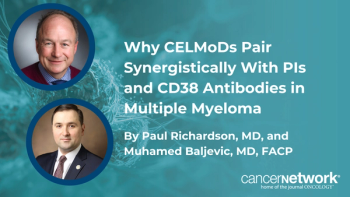
Paul Richardson, MD, and Muhamed Baljevic, MD, FACP, discuss the immunologic and mechanistic synergy between CELMoDs and standard myeloma backbone therapies.
Amer Zeidan, MBBS, MD, and Raji Shameem, MD, discuss how long-term COMMANDS data support the use of luspatercept.
Paul Richardson, MD, and Muhamed Baljevic, MD, FACP, explain how mezigdomide’s complete cereblon E3 ligase engagement overcomes IMiD resistance in heavily pretreated multiple myeloma.
Dr. Ajai Chari and Dr. Rahul Banerjee review the clinical development of talquetamab in relapsed/refractory multiple myeloma (RRMM), focusing on key findings from the MonumenTAL-1 study and the evolution of GPRC5D-directed therapy.
Dr. Ajai Chari and Dr. Rahul Banerjee discuss the growing need for therapeutic targets beyond BCMA in relapsed/refractory multiple myeloma (RRMM) and examine the rationale for GPRC5D-directed therapies.
Amer Zeidan, MBBS, MD, discussed when to start luspatercept at the full 1.75 mg/kg dose in lower-risk MDS based on the MAXILUS trial.
Nicholas Hornstein, MD, PhD, ranks RASolute 302, BREAKWATER, MATTERHORN, and more in a real-time discussion on Double Blind.

At EHA, Benoit Tessoulin, MD, PhD, shared data showing the epcoritamab/R² combination benefitted all relapsed/refractory follicular lymphoma subgroups.
Asciminib reshapes frontline CML care with fewer side effects and deeper molecular responses, while clinicians watch long-term safety and TFR results
According to Chinmay Jani, MD, a current goal in thoracic oncology is to turn lung cancer into a “chronic disease” where patients can live for decades.
Dr Shadman addresses tumor lysis syndrome, a longstanding concern with BCL2 inhibition, in light of the absence of any tumor lysis syndrome events in this study.
Dr. Mazyar Shadman discusses the scientific rationale for combining sonrotoclax with zanubrutinib for the treatment of patients with relapsed or refractory chronic lymphocytic leukemia (CLL).
Dr Shadman frames the clinical need for treatment mechanisms beyond conventional BTK inhibition in patients with relapsed or refractory B-cell malignancies.
Dr Shadman outlines the key open questions and later-phase data to watch for both programs.
Dr Shadman contextualizes the efficacy of the BTK degrader catadegbrutinib in relapsed or refractory Waldenström macroglobulinemia, where it produced an overall response rate of 83.7%, a major response rate of 76.7%, and a very good partial response rate of 30.2% at a median follow-up of 16.6 months.
Dr Shadman explains how BTK degradation differs mechanistically from BTK inhibition.
Dr Shadman frames the clinical need for treatment mechanisms beyond conventional BTK inhibition in patients with relapsed or refractory B-cell malignancies.
Dr. Shadman explains that high-risk definitions evolve as treatments change.
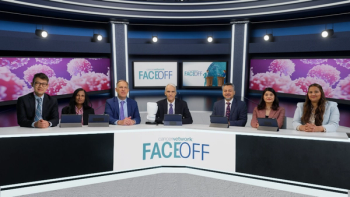
Dr. Saad Usmani reviews key findings from the phase 3 CARTITUDE-4 trial and discusses the growing role of ciltacabtagene autoleucel (cilta-cel) in patients with second-line and earlier-relapse relapsed/refractory multiple myeloma. The discussion highlights the study population, including patients with lenalidomide-refractory disease and high-risk clinical features, as well as the significant progression-free survival benefit observed with BCMA-directed CAR T-cell therapy compared with standard triplet regimens. Dr. Usmani and the panel examine the depth and durability of response, including high rates of complete response and sustained MRD negativity, and discuss the concept of treatment-free remission as a unique advantage of CAR T-cell therapy. Faculty also explore practical considerations such as patient selection, manufacturing timelines, bridging therapy, disease burden control, and quality-of-life outcomes. The conversation further addresses important safety considerations, including cytokine release syndrome, neurotoxicity, Parkinsonism-like events, immune effector cell-associated enterocolitis, access challenges, and the logistical barriers associated with delivering CAR T-cell therapy in real-world multiple myeloma practice.

Experts weigh first-line HER2+ metastatic breast cancer options, when to start T-DXd plus pertuzumab, and how patient risks shape durable response.
Clinicians weigh T-DXd plus pertuzumab vs CLEOPATRA, balancing lung risk, fitness and de novo disease to personalize HER2+ care.
Dr. Thomas Martin opens this Cancer Network FACE-OFF program by introducing a debate-style discussion focused on one of the most rapidly evolving areas in relapsed/refractory multiple myeloma: treatment selection between BCMA-directed CAR T-cell therapy and bispecific antibody-based approaches in second-line and earlier-relapse disease. He outlines the unique format of the program, which combines clinical data review, expert debate, and case-based discussion to explore real-world treatment decision-making. Dr. Martin introduces Team Myeloma Mavericks, led by Dr. Saad Usmani and featuring Dr. Surbhi Sidana and Dr. Gurbakhash Kaur, and Team Myeloma Masters, led by Dr. Peter Voorhees with Dr. Amrita Krishnan and Dr. Hans Lee. The segment concludes with an overview of the pivotal studies that will frame the discussion, including CARTITUDE-4, MajesTEC-3, and MajesTEC-9, highlighting how emerging efficacy, durability, safety, and sequencing data are reshaping treatment strategies for patients with relapsed/refractory multiple myeloma.
Dr. Mazyar Shadman introduces the program on first-line CLL therapy in the era of BTK inhibition, joined by Dr. Andrew Lipsky.
The COPERNICUS study, an ongoing phase two trial, evaluated amivantamab-based regimens in EGFR-mutant non-small cell lung cancer across two cohorts, first-line and post-osimertinib progression, with a key focus on implementing mandatory prophylactic skin and DVT regimens, resulting in dramatically lower rash rates (4% grade 3+) compared to the original MARIPOSA trial.
Panelists discuss the pivotal MARIPOSA trial, which examined combining amivantamab with lazertinib versus osimertinib monotherapy, showing improvements in progression-free survival (23.7 vs. 16.6 months), overall survival, CNS efficacy, and particularly strong benefits in high-risk subgroups such as TP53-mutant patients. Safety data from the trial highlighted the importance of prophylactic measures, especially for rash and other adverse events, noting that with current prophylaxis protocols, serious toxicity rates have been significantly reduced compared to the original study.