
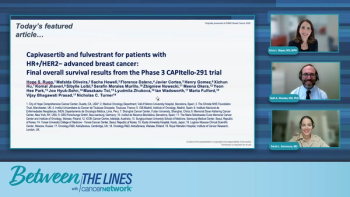
Erica L. Mayer, MD, MPH, of Dana-Farber Cancer Institute, closes with the competitive landscape around capivasertib plus fulvestrant in hormone receptor positive, human epidermal growth factor receptor 2 (HER2)-negative advanced breast cancer.
Erica L. Mayer, MD, MPH, of Dana-Farber Cancer Institute, closes with the competitive landscape around capivasertib plus fulvestrant in hormone receptor positive, human epidermal growth factor receptor 2 (HER2)-negative advanced breast cancer.
Erica L. Mayer, MD, MPH, of Dana-Farber Cancer Institute, reviews final safety data from CAPItello-291, the phase 3 trial of capivasertib plus fulvestrant in hormone receptor positive, human epidermal growth factor receptor 2 (HER2)-negative advanced breast cancer, reporting no new signals: diarrhea in nearly 80% of patients with about 10% grade 3 and no prophylactic antidiarrheal in the protocol, rash in about 40%, and all-grade hyperglycemia of 17% despite allowing hemoglobin A1c up to 8%.
Erica L. Mayer, MD, MPH, of Dana-Farber Cancer Institute, presents exploratory overall survival data from CAPItello-291 in patients with prior cyclin-dependent kinase (CDK) 4/6 inhibitor exposure, showing about a 7-month difference favoring capivasertib plus fulvestrant in the PIK3CA/AKT1/PTEN-altered population of this hormone receptor positive, human epidermal growth factor receptor 2 (HER2)-negative advanced breast cancer trial, without statistical significance.
Sarah L. Sammons, MD, of the University of Maryland Greenebaum Comprehensive Cancer Center, and Seth A. Wander, MD, PhD, of Massachusetts General Hospital, join Erica L. Mayer, MD, MPH, of Dana-Farber Cancer Institute, to debate how post-progression therapy shapes survival interpretation in hormone receptor positive, human epidermal growth factor receptor 2 (HER2)-negative advanced breast cancer.
Erica L. Mayer, MD, MPH, of Dana-Farber Cancer Institute, reviews final overall survival in the overall population of CAPItello-291, the phase 3 trial of capivasertib plus fulvestrant in hormone receptor positive, human epidermal growth factor receptor 2 (HER2)-negative advanced breast cancer.
Erica L. Mayer, MD, MPH, of Dana-Farber Cancer Institute, presents the key secondary endpoint of overall survival in the PIK3CA/AKT1/PTEN-altered population of CAPItello-291, the phase 3 trial of capivasertib plus fulvestrant in hormone receptor positive, human epidermal growth factor receptor 2 (HER2)-negative advanced breast cancer.
Erica L. Mayer, MD, MPH, of Dana-Farber Cancer Institute, explains the statistical framework behind the final overall survival analysis of CAPItello-291, the phase 3 trial of capivasertib plus fulvestrant in hormone receptor positive, human epidermal growth factor receptor 2 (HER2)-negative advanced breast cancer.
Erica L. Mayer, MD, MPH, of Dana-Farber Cancer Institute, recaps the primary analysis of CAPItello-291 in hormone receptor positive, human epidermal growth factor receptor 2 (HER2)-negative advanced breast cancer, in which capivasertib plus fulvestrant improved progression-free survival from 3.1 to 7.3 months (hazard ratio, 0.50) in the PIK3CA/AKT1/PTEN-altered population and from 3.6 to 7.2 months (hazard ratio, 0.60) overall, with benefit regardless of ESR1 alteration or prior cyclin-dependent kinase (CDK) 4/6 inhibitor exposure, findings that supported the original approval.
Erica L. Mayer, MD, MPH, of Dana-Farber Cancer Institute, reviews the design of CAPItello-291, a phase 3, double-blind, placebo-controlled trial in hormone receptor positive, human epidermal growth factor receptor 2 (HER2)-negative advanced breast cancer after endocrine progression, allowing up to 2 prior endocrine lines and 1 prior chemotherapy, requiring a majority of patients to have received a prior cyclin-dependent kinase (CDK) 4/6 inhibitor, permitting hemoglobin A1c up to 8%, and enrolling without biomarker selection.
Matthew Matasar, MD, discussed an AI-embedded deterioration index study, Epic’s patient-facing chatbot, and how AI is already absorbing routine documentation work.

Matteo S. Carlino, MD, PhD, FRACP, discussed immune-related adverse event rates with V940 added to pembrolizumab.

In this segment, Elizabeth Bohannon reflects on the challenges of living with relapsed/refractory multiple myeloma over the long term and emphasizes the importance of finding a supportive community.
In this segment, Isabel Curtin, LCSW, discusses how social workers and the broader multidisciplinary care team can help patients and families navigate uncertainty and complex treatment decisions in relapsed/refractory multiple myeloma.

Learn how liquid and tissue biopsies uncover ESR1 and PI3K mutations to personalize metastatic breast cancer second-line therapy choices.
Learn how biomarker testing guides second-line choices after CDK4/6 therapy in HR+ HER2- metastatic breast cancer, including PI3K/AKT/mTOR options.

This episode takes up the practical mechanics of molecular testing in community oncology, beginning with turnaround time.
This episode opens with a distinction that matters more in lung cancer than many oncologists expect.
Matthew Matasar, MD, outlined his wish list for AI in oncology, and detailed AI-bolstered tools already active across his 14-hospital health system.
Matteo S. Carlino, MD, PhD, FRACP, reviewed efficacy data for V940 plus pembrolizumab in resected melanoma.

Panelists discuss how patient education should be timed and reinforced across first-line regimens for epidermal growth factor receptor (EGFR)-mutated advanced non-small cell lung cancer (NSCLC).
Panelists discuss the baseline workup nurses and advanced practice providers should complete before the first dose of first-line therapy for epidermal growth factor receptor (EGFR)-mutated advanced non-small cell lung cancer (NSCLC).
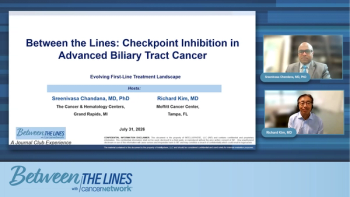
The panel reviews the KEYNOTE-966 long-term follow-up data.
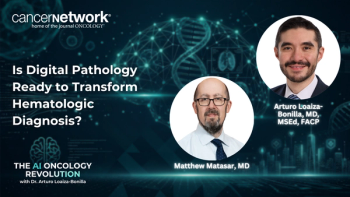
Matthew Matasar, MD, explained why AI-assisted digital pathology may meaningfully improve diagnostic precision in hematologic malignancies.

Matthew Matasar, MD, provided practical advice for oncologists who want to start testing generative AI and RAG tools in their own practice.
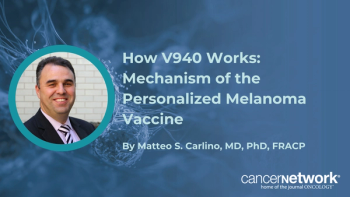
Matteo S. Carlino, MD, PhD, FRACP, explains how the individualized neoantigen therapy V940 is designed and delivered in melanoma.
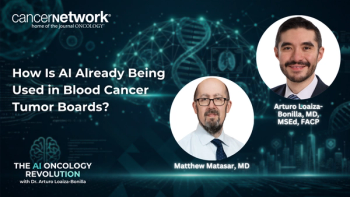
Matthew Matasar, MD, detailed how retrieval-augmented generation tools are already informing real tumor board decisions in hematologic malignancies.

The faculty discuss how to individualize the choice between chimeric antigen receptor (CAR) T-cell therapy and bispecific antibodies in relapsed multiple myeloma.
This opening segment introduces a discussion on ciltacabtagene autoleucel (cilta-cel) in multiple myeloma and frames the questions the program sets out to answer: how chimeric antigen receptor (CAR) T-cell therapy should be sequenced among the available options, and how care can be coordinated across a network spread between referring practices and treating centers.

Dr. Mikhael begins the scientific foundation by asking Dr. Richardson to define CELMoDs and explain how they engage the cereblon E3 ubiquitin ligase complex to promote targeted degradation of Ikaros and Aiolos, key transcription factors involved in myeloma-cell biology.
Erica L. Mayer, MD, MPH, of Dana-Farber Cancer Institute, reviews the rationale for capivasertib in hormone receptor positive, human epidermal growth factor receptor 2 (HER2)-negative advanced breast cancer, noting phosphatidylinositol 3-kinase (PI3K)/AKT pathway alterations in nearly half of patients, activation through PIK3CA or AKT alterations or PTEN loss, and guideline recommendations for capivasertib plus fulvestrant in altered disease after endocrine progression.