
Ayal Aizer, MD, MHS, describes an adaptive planning trial using synthetic CT to improve same-day treatment accuracy for anatomically unstable brain metastases.
Ayal Aizer, MD, MHS, describes an adaptive planning trial using synthetic CT to improve same-day treatment accuracy for anatomically unstable brain metastases.

The availability of iberdomide as an easy-to-give, orally available drug “is tremendous” for patients with multiple myeloma, according to Surbhi Sidana, MD.

The second FACE-OFF debate explores whether currently available BCMA bispecific antibodies should be considered a therapeutic class or whether meaningful clinical differences exist among individual agents used to treat relapsed/refractory multiple myeloma (R/R MM).
The program transitions to the first FACE-OFF debate, where the faculty discuss whether CAR-T cell therapy or BCMA bispecific antibodies should be prioritized as BCMA-directed therapies move into earlier lines of treatment for relapsed/refractory multiple myeloma (R/R MM).

Lizza Hendriks, MD, PhD, discussed why every patient with CNS metastases deserves a multidisciplinary team discussion.
Starting lenvatinib at 14 mg instead of the trial’s 20-mg dose helps patients remain on therapy, according to Susana Campos, MD, MPH.

In this segment, Elizabeth reflects on the period following her stem cell transplant, when she was able to maintain an active lifestyle for a time before her disease progressed again.

Ayal Aizer, MD, MHS, discusses radiation necrosis as the next major challenge in stereotactic radiosurgery for brain metastases and how clinicians can address it.
In this segment, Elizabeth Bohannon reflects on how her treatment goals and outlook evolved as she progressed through different stages of relapsed/refractory multiple myeloma.
Because it is not biomarker directed, lenvatinib plus pembrolizumab remains broadly useful even as HER2-targeted ADCs enter recurrent uterine cancer.
Ayal Aizer, MD, MHS, explains how expanded trial data have broadened eligibility for stereotactic radiosurgery in patients with brain metastases, including higher tumor counts.
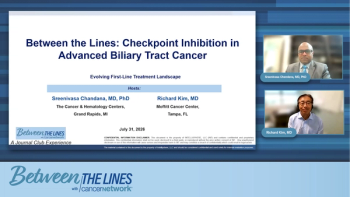
The faculty review patient-reported outcomes, subgroup consistency, and biomarker testing before introducing the second pivotal trial.

Lizza Hendriks, MD, PhD, discussed why excluding patients with brain metastases from clinical trials is no longer ethical.

Sunil Singhal, MD, explained how a fluorescent dye technology helps surgeons see and remove tumors more completely.

Dr. Zunairah Shah explains how she uses shared decision-making and discusses real-world access to Prosigna genomic testing in high-risk breast cancer.
Dr. Zunairah Shah discusses OPTIMA data showing comparable outcomes with and without chemotherapy in low-risk, Prosigna-guided patients with breast cancer.
Dr. Zunairah Shah outlines the phase 3 OPTIMA trial design, showing how Prosigna-guided testing informs chemotherapy decisions in high-risk breast cancer.

Dr. Matthew Karr and Dr. Shreyas Kalantri discuss what's next for chemo-free DLBCL regimens and open questions following the epcoritamab R-mini-CVP data.
Dr. Matthew Karr reviews safety and tolerability data for epcoritamab plus R-mini-CVP, including full treatment completion in frail, elderly patients with DLBCL.
Dr. Matthew Karr shares efficacy results from a trial of epcoritamab plus R-mini-CVP in elderly DLBCL, including an 86% complete response rate.
Dr. Matthew Karr outlines the phase 2 trial design and patient population for epcoritamab plus R-mini-CVP in frail, elderly, newly diagnosed DLBCL.

Dr. Shreyas Kalantri discusses PROTEUS's practice-changing takeaways for high-risk prostate cancer and the open questions future studies still need to answer.
Dr. Shreyas Kalantri reviews the safety profile of apalutamide plus ADT in PROTEUS, including rash management and comparable grade 3/4 adverse event rates.
Dr. Shreyas Kalantri explains how PSMA PET imaging revealed the metastasis-free survival benefit in PROTEUS that conventional imaging alone missed.
Dr. Shreyas Kalantri outlines the phase 3 PROTEUS trial design, showing perioperative apalutamide plus ADT improved pathologic response and metastasis-free survival.
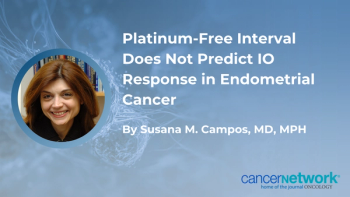
The platinum-free interval is prognostic but not predictive for lenvatinib plus pembrolizumab, Susana Campos, MD, MPH, told CancerNetwork.
Experts compared outcomes for NALIRIFOX in patients with metastatic pancreatic cancer based on real-world and clinical trial data.

Five-year follow-up showed 37% overall survival rate with lenvatinib plus pembrolizumab in dMMR endometrial cancer.

Up to 55% of endometrial tumors show HER2/neu heterogeneity, explained Susana Campos, MD, MPH, making biopsy at recurrence key for ADC eligibility.

Andrew Evens, DO & Joanna Rhodes, MD, on CLL's transformation, CAR-T vs bispecifics, Hodgkin survivorship, and delivering world-class lymphoma care across NJ.