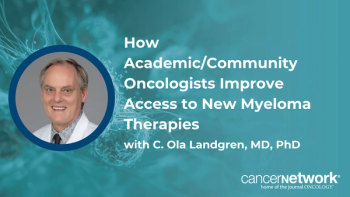
Additional translational research may help inform the design of next-generation therapies for patients with multiple myeloma, said Manoj Bhasin, PhD, MS.

Your AI-Trained Oncology Knowledge Connection!


Additional translational research may help inform the design of next-generation therapies for patients with multiple myeloma, said Manoj Bhasin, PhD, MS.

Experts discuss the importance of germline testing in younger gastric cancer patients and the evolving multidisciplinary approach to treatment.

Artificial intelligence may be used in CT scans to help detect early-stage disease in at-risk patients undergoing screening for cancer.

Kathie-Ann Joseph, MD, MPH, FACS, explored evolving surgical strategies for inflammatory breast cancer and phyllodes tumors.

Soumen Das, MBBS, MS, FACS, details how the BC-RADS-2 study standardizes clinical breast examinations to combat diagnostic delays and improve early-stage detection in low-resource oncology settings.

Soumen Das, MS, FACS, discusses the BCRADS-2 study, a validated clinical scoring system designed to standardize breast cancer triage and downstage palpable lesions in low- and middle-income countries.

Soumen Das, MBBS, MS, FACS, discussed the BC-RADS-2 study, a community-integrated approach to standardizing breast cancer detection in low-resource settings through a structured clinical reporting and data system.

Panelists discuss how sequencing choices before third-line CAR T balance disease control and eligibility preservation, while avoiding prolonged therapies that could compromise later collection or outcomes.

Experts discuss treatment options for a 70-year-old woman with low-risk MDS, emphasizing the need for more clinical trial data and real-world evidence.

Panelists discuss how prior BCMA-directed or bispecific therapy may affect T-cell fitness and CAR T planning, including the value of early referral and strategic washout/bridging approaches when feasible.

Ian Flinn, MD, PhD; and Danielle Brander, MD, reflect on the key long-term findings from the SEQUOIA trial, with particular emphasis on durability of response and outcomes in high-risk patient populations.

In this segment, experts review 6-year follow-up data from the SEQUOIA and ALPINE studies in CLL and SLL, with a focus on efficacy, safety, and treatment selection in the modern era.

This study explores the efficacy and safety of amivantamab plus lazertinib for patients with EGFR mutations and brain metastasis.

Multidisciplinary teams reassess advanced cancer patients post-chemotherapy to optimize surgical outcomes and manage treatment-related challenges effectively.

In this concluding segment, the panel reflects on the evolving landscape of treatment for myeloid malignancies, including high-risk MDS and CML, with a focus on oral HMAs. Dr. Fazal emphasizes the importance of clinical trial participation, noting that although some combination therapies may not show overall superiority, subsets of patients demonstrate meaningful benefit, highlighting the need for ongoing research and novel therapeutic strategies.

Panelists discuss how the expanding volume of clinical data—both positive and negative—is increasing treatment complexity while reinforcing the need for individualized, patient-centered decision-making.

Discover the latest FDA-approved therapy for high-risk smoldering myeloma, enhancing early intervention strategies and patient care discussions.

The final segment synthesizes the discussion and looks ahead to the future of BCMA bispecifics. Jagannath recaps the extraordinary strides made thus far, from strong response rates to improved safety management, and highlights the growing role of combinations with agents like daratumumab and the expansion into newly diagnosed and smoldering myeloma clinical trials.

Panelists discuss how toxicity monitoring and quality-of-life considerations must be adapted as potent therapies move into earlier-line and curative-intent settings.

This segment focuses on practical strategies for managing high-risk CML, particularly in patients with proliferative and cytopenic symptoms. The discussion begins with balancing symptomatic management, such as fatigue, early satiety, splenomegaly, anemia, and thrombocytopenia, alongside disease-directed therapy.

Explore the complexities of managing stage 3 gastric adenocarcinoma, including neoadjuvant therapy and nutritional strategies for optimal patient outcomes.

Explore the evolving landscape of smoldering myeloma treatment, focusing on fixed-duration therapy and patient-provider communication strategies.

Panelists discuss how clinicians distinguish candidates for second-line versus third-line CAR T by weighing disease aggressiveness, relapse timing, cytogenetic risk, patient preferences, and toxicity tradeoffs.

Panelists discuss how differences in BCMA-directed CAR T constructs (including binding configuration and expansion kinetics) can influence toxicity timing, monitoring needs, and real-world product selection.

Soumen Das, MBBS, MS, FACS, discussed the BC-RADS-2 study and its potential to transform early breast cancer detection in low- and middle-income countries.

Clinical Scenario A: 77-year-old male with newly diagnosed LR-MDS

Experts debate the optimal dose escalation strategy for Luspatercept in treating low-risk MDS, emphasizing patient-centric approaches and long-term outcomes.


Experts discuss the benefits of combination therapies for non-small cell lung cancer, emphasizing improved survival rates and patient quality of life.