
Experts discussed proactive strategies for managing diarrhea and making dose reduction decisions with NALIRIFOX in pancreatic cancer.
Experts discussed proactive strategies for managing diarrhea and making dose reduction decisions with NALIRIFOX in pancreatic cancer.
In the third debate round of this Cancer Network Face Off on advanced hepatocellular carcinoma (HCC), moderator Rachna T. Shroff, MD, presents a Child-Pugh A, BCLC stage B patient eligible for locoregional therapy, asking whether clinicians should prioritize locoregional treatment or introduce systemic therapy earlier.
In the second debate round of this Cancer Network Face Off on advanced hepatocellular carcinoma (HCC), moderator Rachna T. Shroff, MD, presents a treatment-naive patient with Child-Pugh B7, BCLC stage C disease and compromised liver function, asking how limited liver reserve should influence frontline selection.
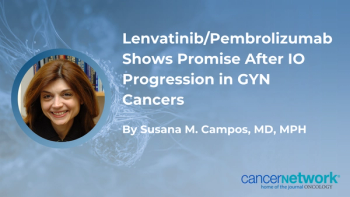
A retrospective series found a 75% response rate adding lenvatinib after pembrolizumab progression in dMMR endometrial cancer, said Susana Campos, MD, MPH.
Experts discussed how NALIRIFOX compares with FOLFIRINOX and gemcitabine/nab-paclitaxel as frontline therapy for metastatic pancreatic cancer.

Barbara Burtness, MD, outlined the rationale behind OrigAMI-4 eligibility criteria and how tumor boards can select patients with HNSCC for amivantamab.
Following the MAJESTEC-3 presentation, the faculty discuss how the trial findings may influence the evolving treatment landscape for relapsed/refractory multiple myeloma (R/R MM).

Treatment until progression may not be the way forward with bispecific antibodies, according to Hans Lee, MD.
Dr. Harsh Parmar presents results from the phase 3 MAJESTEC-3 trial evaluating the combination of teclistamab and daratumumab versus standard daratumumab-based regimens in patients with relapsed/refractory multiple myeloma (R/R MM) who had received one to three prior lines of therapy.
Barbara Burtness, MD, discussed strategies for managing skin reactions and MET-driven edema in head and neck cancer treated with subcutaneous amivantamab.
Laura Alder, MD, discussed how her team at Duke monitors and educates patients for immune-related toxicities while receiving tarlatamab for brain metastases.

Hans Lee, MD, said it is only a matter of time before bispecific antibodies move into the newly diagnosed multiple myeloma setting.

In this segment, Isabel Curtin, LCSW, discusses the emotional and practical challenges that patients and families may face while navigating relapsed/refractory multiple myeloma and multiple lines of therapy.
In this opening segment, Samantha Shenoy, NP, introduces the From All Angles discussion and is joined by Elizabeth Bohannon, who shares her experience living with multiple myeloma, and Isabel Curtin, LCSW, who provides a psychosocial and supportive care perspective.
Experts emphasize that ongoing communication, whether from an academic or community oncology standpoint, is key for providing optimal multiple myeloma care.
Laura Alder, MD, discussed how tarlatamab’s intracranial activity compared with chemotherapy and radiation options for brain metastases in small cell lung cancer.
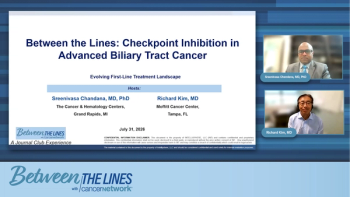
The discussion turns to the TOPAZ-1 study design and its long-term efficacy update.
Cell therapy will eventually become a part of the therapeutic strategy for newly diagnosed multiple myeloma, according to Joshua Richter, MD.
Laura Alder, MD, outlined the 3 objectives behind a retrospective analysis evaluating tarlatamab’s efficacy and safety in patients with SCLC and brain metastases.
Experts outline how certain practices may have an “incomplete understanding” of where the multiple myeloma field is today.
The phase 1b PRISM study is assessing the ability of ruxolitinib/retifanlimab to reinvigorate the tumor microenvironment in immune-resistant RCC.
Experts discuss the roles that telemedicine and outpatient programs can play in increasing access to novel cellular therapies among those with multiple myeloma.
In the first debate round of this Cancer Network Face Off on advanced hepatocellular carcinoma (HCC), moderator Rachna T. Shroff, MD, presents a patient with Child-Pugh A, BCLC stage C disease and bulky tumor burden, asking each team to defend a frontline regimen.
The panel discusses the timing of systemic therapy alongside locoregional treatment in intermediate-stage hepatocellular carcinoma (HCC), focusing on the EMERALD-1 results.
Edward S. Kim, MD, MBA, explained how City of Hope leverages AI tools to help community oncologists match patients with multidisciplinary clinical trials.
Toxicity management for patients who receive CAR T-cell therapy for multiple myeloma is improving, according to Marco Davila, MD, PhD.
Yu-Wei Chen, MD, MS, discussed research on ARNT expression patterns in RCC and potential implications for HIF-1β targeting therapies like NEO-811.
Academic clinicians have an incumbent role to improve access to novel cellular therapies, according to Marco Davila, MD, PhD.
Following the presentation of the real-world sequencing analysis, the faculty discuss how these findings align with their own clinical experience treating relapsed/refractory multiple myeloma (R/R MM).
Dr. Mansi Shah presents a multinational real-world analysis evaluating how BCMA-directed CAR-T cell therapies and BCMA bispecific antibodies are being used in routine clinical practice for patients with relapsed/refractory multiple myeloma (R/R MM).