
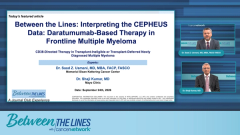
Opinion|Videos|September 30, 2026
Evolving Treatment Goals in Multiple Myeloma
Dr. Saad Usmani and Dr. Shaji Kumar discuss how treatment goals and measures of clinical benefit have evolved in newly diagnosed multiple myeloma.
Advertisement
Episodes in this series
Dr. Saad Usmani and Dr. Shaji Kumar discuss how treatment goals and measures of clinical benefit have evolved in newly diagnosed multiple myeloma. Dr. Usmani highlights the shift from relying primarily on overall response rate and progression-free survival toward incorporating measurable residual disease (MRD) negativity as an important endpoint, given its association with survival outcomes and its emerging role in regulatory evaluation. Dr. Kumar emphasizes that the deeper responses achieved with quadruplet regimens in both transplant-eligible and transplant-ineligible multiple myeloma have been associated with improved clinical outcomes, supporting the importance of treatment depth. The discussion then turns to older patients with multiple myeloma, particularly those aged 80 years and older or those younger patients who may not tolerate quadruplet therapy. Dr. Kumar notes that these patients were not represented in trials such as PERSEUS and emphasizes the relevance of data from MAIA, where daratumumab plus lenalidomide and dexamethasone demonstrated durable disease control and tolerability in transplant-ineligible patients. The experts highlight how CD38-directed therapy has contributed to increasingly durable PFS outcomes in older patients.
Advertisement
Related to this article

Chih-Yi “Andy” Liao, MD, discusses how oncologists are sequencing pemigatinib, futibatinib, and lirafugratinib and how their tolerability differs.
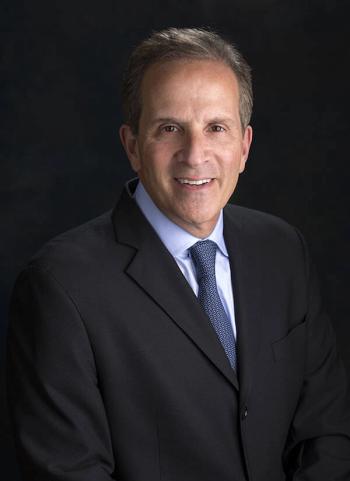
“It should be protocol that 100% of your patients with metastatic prostate cancer get germline testing. Full stop. No exceptions,” said Neal D. Shore, MD, FACS.

Chih-Yi “Andy” Liao, MD, discusses the FDA approval of lirafugratinib and what the field has learned about resistance to FGFR2 inhibitors.

In the phase 3 NRG-CC009 trial, SRS led to longer overall survival vs HA-WBRT plus memantine with similar neurocognitive failure in SCLC brain metastases.

In a phase 1 first-in-human trial, BMS-986453 showed a favorable safety profile and high response rates in relapsed/refractory multiple myeloma.
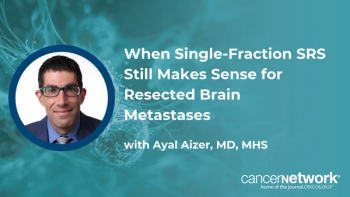
Ayal Aizer, MD, MHS, discusses patients for whom single-fraction SRS may remain reasonable after brain metastasis resection.
Extended belantamab mafodotin dosing intervals were associated with maintained vision-related function in the phase 1 DREAMM-9 study.
The phase 3 NRG-GI003 trial showed no overall survival benefit with proton therapy over photon therapy in patients with advanced hepatocellular carcinoma.
Advertisement
Advertisement
Trending on CancerNetwork
1
Multimodal Biopsy Combo Shows Low Morbidity in Suspected Prostate Cancer
2
BCMA/GPRC5D CAR T-Cell Therapy Shows Early Efficacy in R/R Multiple Myeloma
3
Integrating Talazoparib Plus Enzalutamide Into HRR-Mutated mHSPC Care
4
Proton Therapy Does Not Improve Survival in Hepatocellular Carcinoma
5